Artificial intelligence needs enormous amounts of electricity, and there is not enough to go around. That is making the companies that actually generate power unusually valuable.
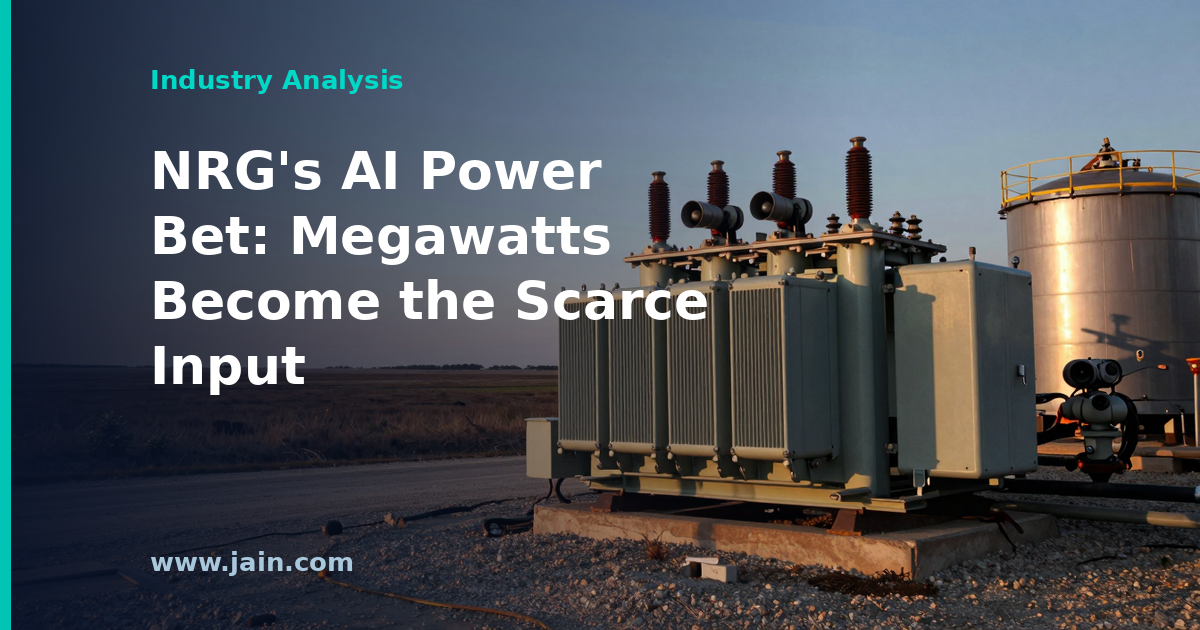
Shares of NRG Energy, a large American electricity producer and retailer, climbed sharply after investors focused on its plan to build about 4 gigawatts of new supply for data centers — roughly what four big nuclear reactors put out. One Texas project, sized at 1.2 gigawatts, is earmarked for a major cloud computing company that has not been named.
The stock is still down about 29 percent this year, so this is a bet, not a victory lap.
NRG Energy shares rose sharply in trading after bouncing off a fresh 52-week low, with TipRanks reporting that the move was driven by renewed investor attention to a perceived valuation disconnect and to NRG’s 4-gigawatt pipeline of power projects aimed at data centers — including a 1.2 GW build in Texas serving a major cloud operator. A gigawatt is a billion watts; 1.2 GW is the scale of a large conventional power station.
The rally coincided with broad strength across power and data-center infrastructure names as markets reassessed the long-term revenue potential of supplying electricity to AI-heavy cloud workloads. No specific analyst price-target changes accompanied the move. NRG’s market capitalisation stood at $23.35 billion, with year-to-date price performance of -29.08% and average trading volume of roughly 2.77 million shares.
Executive Summary
What moved was not an operating result but a valuation frame. NRG is an independent power producer and competitive retailer — a company that sells electricity at market prices rather than at rates set by a regulator. For most of the past decade, that business was valued like a mature commodity: cash-generative, cyclical, and structurally exposed to flat demand. The AI data-center buildout has broken that assumption, and the market is now testing whether generation capacity should be priced as a scarce asset instead.
The specific hook is NRG’s 4 GW development pipeline directed at data centers, anchored by a 1.2 GW Texas project tied to a large cloud customer. That combination — a named market, a named scale, and a described contracted anchor — is what separates a generator with an AI story from a generator with an AI slide. It gives investors something closer to a line of sight on high-margin, long-duration revenue than a general appeal to rising load growth.
The counterweight is the balance sheet. NRG carries a heavy debt load alongside recent revenue pressure and uneven cash flows, and it has committed to returning capital through buybacks and dividends. Those three claims on cash — deleveraging, development capital expenditure, and shareholder returns — compete directly. A stock still down more than 29% year-to-date reflects that unresolved tension as much as it reflects any AI optimism.
The Scarce Input Is No Longer the Chip
The bottleneck in AI infrastructure has migrated. Two years ago it was accelerators; today it is increasingly firm, deliverable electricity at a specific location on a specific date. Servers can be shipped. Interconnection — the physical and contractual process of attaching a large load to the grid — cannot be expedited by writing a bigger cheque. Where a hyperscaler (one of the giant cloud operators that build data centres at national scale) can secure power, it can build; where it cannot, capital sits idle.
That inversion is what re-rates a merchant generator. A company whose fleet was previously valued on forward power curves and capacity payments now holds an option on the fastest-growing industrial load in a generation. NRG’s move off a 52-week low on pipeline news rather than earnings news is the market pricing that optionality, not the underlying quarter. The distinction matters: optionality is real value, but it is value contingent on execution, and it can be repriced downward just as quickly.
Texas Is the Point, Not an Incidental Detail
The 1.2 GW project sits in Texas, and geography is doing analytical work here. Texas operates its own grid under ERCOT, largely outside federal interconnection jurisdiction, with an energy-only market design and a historically faster path from project conception to energisation than the multi-year queues that characterise other US regions. For a cloud operator with a delivery deadline, speed to power is worth a premium over marginal price.
NRG’s incumbency in that market is the differentiator. It already has generation assets, retail customer relationships, and operating experience in the region — which means the data-centre opportunity is an extension of an existing footprint rather than a greenfield bet. That lowers execution risk relative to a pure-play developer, though it does not eliminate the shared industry constraints: turbine manufacturing lead times, gas supply and pipeline capacity, transmission upgrades, and local permitting all sit outside any single company’s control.
A Pipeline Is a Menu, Not a Contract
The most important discipline for readers is distinguishing between the two numbers in this story. The 4 GW figure is a development pipeline — projects at varying stages of maturity, some of which will be built, some deferred, some abandoned. The 1.2 GW Texas build is described as anchored by a major cloud customer, which places it in a different category. Conflating the two produces a valuation that assumes 4 GW of contracted, revenue-generating capacity, which is not what a pipeline means.
This is where the balance sheet re-enters. Multi-gigawatt generation development is capital-intensive, front-loaded, and slow to convert to cash. A company with elevated leverage and uneven cash flows faces a genuine allocation problem: money spent on turbines is money not spent on debt reduction or buybacks. Investors rewarding NRG for growth and rewarding it for capital returns are, at some point, asking for two different companies. How management sequences those priorities — and whether it funds development on-balance-sheet, through project finance, or through partnership structures — will matter more to the outcome than the headline gigawatt count.
Who Wins, Who Pays
The clear beneficiaries of this repricing are owners of dispatchable generation — plants that can produce on demand rather than when the wind blows or the sun shines — in markets with load growth and workable interconnection timelines. Their bargaining position with data-centre developers has improved materially, and the contract structures now being negotiated increasingly resemble long-dated industrial offtake agreements rather than spot commodity sales.
The less-discussed side is who bears the cost. Large new loads on a constrained system put upward pressure on prices for everyone else, and the allocation of transmission and generation build costs between data-centre customers and general ratepayers is an unresolved regulatory question in several states. For enterprise buyers of colocation and cloud capacity, the practical implication is more immediate: power availability is becoming a primary site-selection constraint and a growing share of total cost, and contracts that were once priced casually on a per-kilowatt basis now deserve close reading on escalation, curtailment, and term.
Background
NRG Energy is a Houston-headquartered independent power producer and competitive retail electricity provider, operating generation assets and selling power to residential and commercial customers in deregulated US markets, with a substantial presence in Texas. Unlike a regulated utility, which earns a set return on approved investment, a merchant generator’s economics turn on wholesale power prices, plant availability, and the terms it can negotiate with large customers — a model that rewards scarcity and punishes oversupply.
For much of the past decade, US electricity demand was broadly flat, and the sector was valued accordingly: as a source of cash returns rather than growth. The data-center buildout has reversed that assumption within roughly two years. Grid operators across several regions are now processing interconnection requests measured in gigawatts from single customers, and the constraint on AI capacity expansion has shifted from computing hardware toward power delivery. That shift is what puts companies like NRG — which already own dispatchable generation in load-growth markets — at the centre of an investment story they were not previously part of.
Sources
Source: NRG Energy Surges As AI Power Deal Ignites Rally — TipRanks report on NRG Energy’s share move off a 52-week low, its 4 GW data-center power pipeline, and the 1.2 GW Texas project serving a major cloud operator.
A Silicon Valley company that helps film studios protect and make money from their movies and music is setting up banks of powerful computers in Brunei, a small, oil-rich country on the island of Borneo.
Brunei’s national phone and internet company is building the facility and setting aside enough electrical supply for Vobile to run those machines — roughly what a small town uses.
Why it matters: tiny countries rarely host this kind of computing. Brunei is betting it can turn cheap energy and undersea internet cables into a new industry.
Vobile, a Santa Clara, California company that provides digital content protection and transaction services to studios, platforms, music labels and sports leagues, has signed strategic cooperation and commercial agreements with Unified National Networks Sdn Bhd (UNN), the integrated national telecommunication network operator of Brunei Darussalam. The agreements were signed on September 3, 2026 at UNN’s Tungku Submarine Cable Landing Station by UNN Acting Chief Executive Officer Christopher Phan and Vobile CEO Yangbin Wang, and witnessed by Yang Mulia Haji Hairul Mohd Daud bin Haji Abd Karim, Deputy Permanent Secretary (Infocommunications) at the Ministry of Transport and Infocommunications and a UNN board director. Vobile announced the deal on September 4.
Under the arrangement, UNN’s new AI-capable data center — designed with liquid cooling and high power density to support NVIDIA’s latest GPU systems — will allocate 25 megawatts (MW) of capacity to Vobile, with a further 25MW reserved for Vobile’s future expansion. Vobile says the capacity will run “AI factories” that scale DreamMaker, its platform for helping studios, independent producers and creators generate video with AI while protecting and monetizing their intellectual property.
Executive Summary
Stripped to its essentials, this is a capacity deal with a national carrier, dressed in the language of industrial policy. UNN gets a named anchor tenant for a new high-density facility; Vobile gets a claim on 25MW of GPU-ready space — enough to house a meaningful accelerator fleet — plus an option on the same again. A megawatt, in data center shorthand, is a unit of electrical draw; 25MW is not hyperscale, but it is a serious commercial footprint anywhere, and an unusually large one for a country of well under a million people.
The strategic logic is legible on both sides. Brunei has energy, political stability and, at Tungku, a submarine cable landing station — the point where intercontinental fiber optic cables come ashore. Those are the three ingredients a small state can plausibly offer an AI hosting market that is currently constrained by power and grid connection queues in Singapore, northern Virginia, Dublin and Amsterdam. Vobile, for its part, is a software and services company whose newer generative-video product implies compute costs it would otherwise rent from hyperscalers at retail cloud prices.
What is announced and what is contracted are not the same thing, and the release does not close that distance. Neither company has disclosed financial terms, an energization date, who buys the GPUs, or whether the 25MW allocation is a binding take-or-pay commitment or a reservation. Those are the details that determine whether this is a data center deal or a memorandum with a ceremony attached — and they are the right questions to put to both parties.
A Content-Protection Company Starts Buying Power Like a Cloud Provider
Vobile’s established business is fingerprinting and enforcement: identifying copyrighted video and audio wherever it surfaces online, and converting detections into licensing revenue for rights holders. That is a software business with a modest compute bill, largely inference at scale on commodity hardware. DreamMaker, the product this deal is meant to feed, is a different animal — generative video creation for studios, producers and creators, with rights protection built in. Generative video is among the most compute-hungry workloads in commercial AI, and the economics move from software margin toward infrastructure margin.
Taking 25MW of allocated capacity is therefore a genuine change in posture, not a press-release flourish. A company that rents inference by the hour is a customer; a company that anchors a facility is exposed to utilization risk. If DreamMaker demand arrives as forecast, owning the capacity floor is cheaper than paying hyperscaler retail rates and gives Vobile a cost advantage over rivals reselling someone else’s cloud. If demand lags, fixed capacity becomes a fixed cost — the same trap that has caught crypto miners and several AI hosting entrants pivoting between workloads.
The unanswered variable is who carries that risk. The release describes an allocation of capacity within UNN’s facility, not a Vobile-owned building, which suggests a colocation or hosting relationship rather than a self-build. Whether Vobile purchases the NVIDIA systems, leases them, or buys compute as a service from UNN determines how much capital this commits and how much of the downside sits on Vobile’s balance sheet. Neither company has said.
Why Brunei Can Compete — and Where the Depth Runs Out
The choice of venue is more considered than it first appears. The signing took place at a submarine cable landing station, which is the tell: for AI training workloads, latency matters less than it does for consumer applications, but international bandwidth, route diversity and the ability to move very large datasets still matter enormously. Brunei sits on the northern coast of Borneo, adjacent to the trunk routes linking Southeast Asia to East Asia and, onward, to the United States. An energy-exporting state with domestic generation and a government visibly present at the signing can move faster on power and permits than jurisdictions where a grid connection is a multi-year queue.
That is the genuine arbitrage in “sovereign AI” for small markets: not that Brunei can outbid Singapore or Johor on scale, but that it can offer a mid-sized tenant a decision timeline and a power allocation that larger markets currently cannot. Singapore’s constraints on new data center power have pushed capacity into the region for several years; Malaysia’s Johor corridor absorbed much of it and has itself begun to face grid and water questions. A 25MW block in an underbuilt market is a real product.
The limits are equally real, and they are structural rather than a criticism of either party. Hyperscalers demand deep, diverse power — multiple substations, firm redundancy, a credible path to hundreds of megawatts — plus multiple independent fiber routes, a large pool of electrical and mechanical technicians, and neighbors to share risk with. A single national operator with a single new facility offers concentration on every axis: one grid, one carrier, one landing station, one construction program. That concentration is survivable for a single anchor tenant with a specific workload. It is precisely what a hyperscaler screens out. This deal tests whether the mid-market between those two poles is a real, bankable segment.
Liquid Cooling, Tropical Heat and the 25MW Engineering Bill
The technical detail worth pausing on is that the facility is described as designed for liquid cooling and high power density. That is not decoration. Current NVIDIA GPU systems draw enough power per rack that air cooling has largely stopped being viable; liquid cooling circulates coolant directly to the chips or through rear-door heat exchangers. It raises capital cost and demands mechanical skills that are scarce almost everywhere, but it is the only way to land these densities.
In an equatorial climate, heat rejection is the hard part. High ambient temperatures and humidity year-round reduce the efficiency of the outdoor side of any cooling system, which pushes operators toward either higher energy overhead or water-consuming approaches. Neither company has described the cooling architecture beyond the phrase “liquid cooling,” the expected efficiency, or the water strategy — all of which are increasingly material to enterprise buyers with sustainability reporting obligations, and to any lender underwriting the build.
Then there is the supply chain. Advanced accelerators remain allocation-constrained and are subject to export control regimes that vary by destination and end user. A commitment to support “NVIDIA’s latest GPU systems” is a design statement, not a delivery guarantee. How many accelerators are actually secured, on what schedule, and under what licensing posture is the difference between 25MW of announced capacity and 25MW of working capacity.
Anchor Tenancy Cuts Both Ways
For UNN, a named anchor tenant is the single most valuable asset in early-stage data center development. It de-risks financing, justifies grid investment and gives a national carrier a credible story to tell prospective second and third tenants. UNN’s Chief Digital Officer framed the relationship as more than a customer-provider engagement, and that framing is consistent with the structure: strategic cooperation alongside commercial agreements suggests joint go-to-market ambitions in the region, not just a lease.
For Vobile, the reserved second 25MW is the more interesting term. Reserved capacity is effectively a call option on growth — valuable if DreamMaker scales, cheap to hold if the reservation carries no fee, expensive if it does. What triggers conversion, how long the reservation stands, and whether Vobile has any exclusivity in the facility are the terms that determine whether this option is worth much. None has been disclosed.
The broader read for the industry: this is the shape sovereign AI increasingly takes outside the largest economies — a national carrier, a government witness, a single foreign anchor tenant with a specific workload, and capacity measured in tens rather than hundreds of megawatts. It is a plausible model. Whether it produces durable digital-economy capability, as both parties argue, or a well-located facility serving one overseas customer, depends on whether the second and third tenants arrive. That evidence does not exist yet, and neither company claims it does.
Background
Vobile, founded in Silicon Valley and headquartered in Santa Clara, built its business on content identification: fingerprinting video, audio and music so rights holders can find unauthorized copies online and convert them into licensed, revenue-generating views. Its customers include entertainment companies, platforms, music labels, sports leagues and publishers, and it has operations across North America, Asia, Australia and Europe. Its parent, Vobile Group Limited, is publicly listed in Hong Kong. The company has been extending from protection into AI-assisted creation and monetization, of which DreamMaker is the flagship, alongside recent products such as an AI song detector and a program for tokenizing creative IP rights.
Brunei Darussalam is a small, energy-rich sultanate on the island of Borneo that has spent years pursuing economic diversification away from oil and gas. UNN was established to consolidate the country’s national network infrastructure under a single operator, giving it control of the fixed and mobile backbone as well as international connectivity through submarine cable landings. The presence of a senior Ministry of Transport and Infocommunications official at the signing reflects how closely digital infrastructure projects in Brunei are tied to national policy — a pattern common across the region, where governments treat AI-ready data centers as strategic assets rather than purely commercial real estate.
Nations are usually offered weapons, aid or trade deals to settle a conflict. The Wall Street Journal reports the United States offered something new: access to Nvidia’s artificial-intelligence chips, as part of the peace agreement it brokered between Armenia and Azerbaijan.
Those chips are the engines behind modern artificial intelligence. Nearly every government wants them, only one company makes the most sought-after ones, and Washington decides who is allowed to buy.
So computing power now sits on the negotiating table next to tanks and tariffs, and the rules about who gets it can change for reasons that have nothing to do with technology.
The Wall Street Journal reported that the United States used the promise of access to Nvidia chips as an inducement in brokering a peace deal between Armenia and Azerbaijan. The report places advanced AI accelerators — the graphics processing units, or GPUs, that train and run large AI models — alongside security guarantees and market access as instruments of American diplomacy.
Nvidia’s own disclosures do not address the matter. The company’s 8-K and second-quarter results filed August 26, 2026, its Form 10-Q of the same date, and the 8-K filed September 3 announcing a definitive agreement to acquire Hugging Face make no reference to either country. What those filings do establish is the scale of what is being offered and withheld: data center revenue of $89.0 billion in the quarter ended July 26, 2026, up 117% from a year earlier, and third-quarter guidance of $108.0 billion that assumes, in Nvidia’s words, no data center compute revenue from China.
Executive Summary
Export controls on AI accelerators began as a defensive measure — a way to slow a rival’s military and intelligence capabilities. The Armenia-Azerbaijan report describes something different in kind: chip access used affirmatively, as a reward offered to close a negotiation. If accurate, it marks the point at which compute stopped being merely a thing governments restrict and became a thing they spend.
That shift matters because the underlying asset is unusually well suited to the role. Advanced accelerators are scarce, concentrated in a handful of suppliers, already governed by a licensing regime, and legible to any head of state as a symbol of technological arrival. Nvidia’s second-quarter release documents how strong that appetite is: gigawatt-scale sovereign AI programs in Korea with SK Telecom, NAVER and Brookfield, a national AI infrastructure partnership with the Japanese government and industrial leaders, and a record 35 new AI supercomputers in development across Europe.
For infrastructure operators, the practical consequence is that policy risk now runs in both directions. The same filings that show demand also show a company guiding to $108.0 billion in quarterly revenue while assuming a major market contributes nothing, and committing to physical assets — data center leases of up to twenty years, guarantees capped at $105 billion — on timelines far longer than any political cycle.
Why Compute Works as Leverage
Diplomatic inducements need three properties: the recipient must want them badly, the giver must control them tightly, and they must be withdrawable. Advanced AI chips satisfy all three. Manufacturing is concentrated, the most capable parts are already subject to United States export licensing, and a license is a permission rather than a property right — it can be conditioned, narrowed or allowed to lapse as circumstances change.
The demand side is not speculative. Nvidia’s second-quarter release describes sovereign AI as a distinct customer class and lists national-scale programs: expanding Korea’s AI factory ecosystem at gigawatt scale, partnering with the Japanese government to launch what the company calls the world’s first national AI infrastructure, and 35 new AI high-performance-computing supercomputers under development across Europe. A country that cannot buy accelerators cannot host frontier training, cannot pitch itself as a regional cloud hub, and watches neighbors do both.
The analytical caution is that a promise of access is not the same as delivered hardware. Between an inducement and an installed cluster sit license applications, end-user screening, transformer capacity, grid interconnection, buildings and staff. Announcements of intent have historically outrun physical deployment by years, and nothing in the public record establishes where on that path this arrangement sits.
The China Line Already Priced Into Guidance
Nvidia’s own numbers show what happens when compute policy moves against a market. Shipments of data center Hopper products to China were less than 1% of data center revenue in the quarter, and the company’s third-quarter outlook of $108.0 billion plus or minus 2% explicitly assumes no data center compute revenue from China at all. That is a disclosed planning assumption, not a forecast of policy — but it is a remarkable one: a company can now guide to record revenue while zeroing out one of the world’s largest computing markets.
Read against the Armenia-Azerbaijan report, the symmetry is the point. If access can be granted to seal an agreement, it can be revoked when an agreement frays. Markets that open by diplomacy close the same way, and neither direction is underwritten by a contract that a supplier or an operator can enforce.
The evenhanded reading is that Nvidia’s exposure here is manageable at the corporate level and sharper further down the stack. With revenue of $96.2 billion in the quarter, up 106% year over year, and gross margins of 75.0%, the company has absorbed the loss of a large market without visible damage. A colocation provider that built to serve one geography does not have that cushion.
Long Leases, Short Policy Cycles
The infrastructure commitments in Nvidia’s disclosures are measured in decades. Supply commitments rose from $119 billion in the prior quarter to $279 billion, primarily for memory procurement. Data center leases run terms of up to twenty years, commencing between the third quarter of fiscal 2027 and fiscal 2033. In August 2026, Nvidia entered guarantees supporting the land, power and shell buildout for approximately 4.25 gigawatts at SB Energy’s PORTS-Pike Technology Campus in Ohio — a scale comparable to the output of several large power plants — which will exclusively host Nvidia infrastructure under twenty-year leases to OpenAI, with guarantee obligations capped at $105 billion and effective in phases as conditions such as readiness for service are met.
Set a twenty-year lease against an export-control regime that can be rewritten by a single administrative action, and the duration mismatch becomes the central financing question of this cycle. Concrete, substations and memory contracts do not reprice when a licensing posture changes. Nvidia has also disclosed that it signed roughly fifteen-year leases commencing in fiscal 2028 and 2029 that it expects to reassign to third parties, and that its maximum gross exposure under other land, power and shell guarantees is $3.5 billion — useful markers of how much balance-sheet risk is being intermediated between chipmaker, cloud and landlord.
None of this is evidence of trouble. It is evidence that the industry’s capital structure now assumes political stability in export policy over horizons that no government has ever guaranteed. Anyone underwriting a fifteen- or twenty-year asset should be able to say what the residual value is if the intended end market becomes unlicensable.
Compliance Migrates Downstream
When chip access travels as part of a diplomatic package, conditions travel with it: approved end users, permitted applications, restrictions on re-export and on remote access from third countries. Those conditions are enforced not in Washington but at the rack — by the colocation operator that knows who is in the cage, and by the cloud provider that knows whose workload is running. Operators serving newly permitted jurisdictions should expect know-your-customer obligations, end-use attestations and audit rights to become standard contract terms rather than legal boilerplate.
The model layer carries a parallel exposure, and Nvidia said so itself. In the September 3 8-K announcing the $11.9 billion agreement to acquire Hugging Face, the company added a risk factor warning that governments may impose new requirements governing the development, training, release, distribution, access, transfer, deployment or use of AI models, including open-source models. It goes further, noting that many of the world’s most popular open models originated in China and are then downloaded and fine-tuned by developers worldwide, and that restrictions on supporting models derived from any region could have a material impact.
That is an unusually direct statement of the theme this story illustrates. The same company that benefits when compute is used to open a door is telling investors, in a filed document, that policy can close doors around hardware and software alike. For buyers, the practical takeaway is to treat regulatory contingency as a procurement question — portability of workloads, jurisdictional diversity of capacity, and contractual remedies if a supply route is closed by rule rather than by failure.
Background
Nvidia designs the graphics processing units that became the default hardware for training and running large AI models, together with the CUDA software layer that keeps developers on its platform. Since 2022, successive United States rules have restricted sales of the most capable accelerators to China, turning a commercial product line into an instrument of national technology policy. The company has since built a second demand base among governments buying so-called sovereign AI capacity, so that the same hardware is simultaneously withheld from some states and courted by others.
The scale of the current buildout is what makes policy decisions consequential. Nvidia’s latest quarter shows $96.2 billion of revenue and $89.0 billion from data centers, supply commitments of $279 billion, data center leases running up to twenty years, and guarantee structures that place the chipmaker between AI clouds, model developers and the landlords financing gigawatt-scale campuses. Compute is no longer a component purchase; it is long-lived infrastructure whose value depends on rules that can change without notice.
Marvell makes chips that move data using light instead of electricity. The company says it has shipped more than five million of them, built with a manufacturing partner, Tower Semiconductor.
That matters because the computers behind artificial intelligence are now so large they no longer fit in one room. Moving data between them fast enough has become a bottleneck, and light is the fix.
Marvell’s most recent quarter set a company revenue record: $2.739 billion, up 37 percent from a year earlier.
Stocktwits reported on June 18, 2026 that Marvell Technology (NASDAQ: MRVL) said it had shipped more than 5 million coherent photonic integrated circuits to customers worldwide, produced in partnership with specialty foundry Tower Semiconductor, and that Marvell shares rose more than 5% in premarket trading; the same report said the announcement came days before Marvell’s June 22, 2026 entry into the S&P 500, replacing Pool Corporation, and cited Nvidia chief executive Jensen Huang’s earlier description of Marvell as the “next trillion-dollar company.”
The company framed the shipment as a response to component scarcity in the data center market. “This milestone demonstrates the strength of our collaboration,” said Dr. Radha Nagarajan, Marvell’s Senior Vice President and Chief Technology Officer, Optical Engineering, adding that the two companies would “continue working… to advance next-generation coherent technologies for scale across data center architectures.” Two months later, in results reported to the SEC on August 27, Marvell posted record quarterly revenue of $2.739 billion, up 37% year over year, with Data Center revenue growth accelerating to 46%.
Executive Summary
A coherent photonic integrated circuit is a chip that sends and receives information as light rather than as electrical current, encoding data in the phase and amplitude of a laser beam. The technique was developed for long-haul telecom, where signals travel hundreds of kilometres. It has migrated into the data center because AI training and inference clusters have outgrown single buildings, and copper cabling loses too much signal over the distances involved.
The significance of a five-million-unit figure is not technical but industrial. Performance claims are made with a single working part; volume claims require yield, tested wafer capacity, packaging, and a foundry relationship that holds under load. Marvell attaching a unit count to a photonics announcement, rather than a data rate or a power-per-bit number, is a statement that this product line has left the qualification stage.
Marvell’s own financial disclosures give that claim a supportive backdrop without confirming its specifics. In the press release filed as an exhibit to its August 27 Form 8-K, Marvell reported record second-quarter fiscal 2027 revenue of $2.739 billion and guided the current quarter to $3.150 billion, plus or minus 5%. Chairman and CEO Matt Murphy pointed to “strong demand in Connectivity and a significant acceleration in our Custom business.” What the release does not do is size the photonics business itself.
A Unit Count Is a Supply Claim, Not a Speed Claim
Optical interconnect vendors usually announce firsts: the first 800-gigabit module, the first demonstration at a new modulation scheme. Those announcements tell buyers what is possible. A shipment total tells them something different and, for anyone building capacity, more useful — that parts exist in quantity, that they have been through a customer’s qualification process, and that a supplier is willing to be measured against a number it will have to keep growing.
That distinction is the heart of the story. For most of the current AI buildout, optics has been discussed as a constraint: lasers, modulators and the specialty processes that produce them have been among the harder items to source, alongside advanced packaging and memory. A supplier publicly counting units in the millions is signalling that at least one part of that constraint is loosening. It also changes the competitive question from who has the best device to who can produce devices reliably at a price that survives volume, which is the question commodities are settled on.
Buyers should hold the enthusiasm in proportion. The milestone is cumulative and undated — five million units shipped over what period, across how many product generations, and to how many customers are all open. A number that large spread thinly across several years and several generations describes a mature product family; the same number concentrated in recent quarters would describe a genuine volume inflection. Marvell has not said which it is.
The Foundry Half Deserves Equal Billing
Silicon photonics is a specialty manufacturing problem before it is a design problem. Building waveguides, modulators and detectors alongside conventional transistors requires process steps that leading-edge logic foundries generally do not offer, which is why the work concentrates in a small number of specialty fabs. Naming Tower Semiconductor in the announcement is therefore not courtesy — it identifies where the physical capacity actually sits.
This is a real strategic asset and a real dependency at the same time. A designer with a proven, high-yielding photonics platform at a partner fab has a lead that competitors cannot close by hiring engineers alone; process qualification takes years. But the same relationship concentrates risk. If demand for coherent optics keeps compounding at the rate Marvell’s Data Center commentary implies, the binding constraint moves upstream to wafer starts, laser supply and packaging throughput — none of which Marvell controls outright.
Neither company has described the commercial architecture underneath the partnership: whether capacity is contractually reserved, whether the arrangement is exclusive in either direction, or what expansion is planned. Those terms determine how much of a five-million-unit milestone is a durable moat and how much is a snapshot of a good year.
What the August Filings Confirm — and What They Leave Out
Marvell’s fiscal calendar ends in late January, so the quarter reported on August 27 (fiscal Q2 2027) covers the three months to August 1, 2026 — the period immediately following the photonics announcement. The results were strong on their face: revenue of $2.739 billion came in $39.0 million above the midpoint of prior guidance, GAAP net income was $308.0 million ($0.33 per diluted share), non-GAAP net income was $865.9 million ($0.94), and operating cash flow was $605.5 million. The company raised its revenue outlook for both fiscal 2027 and fiscal 2028.
The gap between $0.33 GAAP and $0.94 non-GAAP earnings is worth explaining rather than glossing over. GAAP figures follow standard accounting rules; Marvell’s non-GAAP measures exclude stock-based compensation, amortisation of intangible assets acquired in past deals, restructuring and similar items. The company itself notes in the release that acquired intangibles “contributed to Marvell’s revenues” and that their amortisation will recur. Both numbers are informative; neither is the whole picture, and the spread between them is unusually wide.
Crucially, the results tell you nothing directly about photonics. Marvell’s quarterly filings group revenue into Data Center and Communications and Other, and the 10-Q filed August 28 for the quarter ended August 1 also flags geographic revenue concentration, including China — a disclosure that matters for any company whose growth depends on globally distributed AI buildouts. Optical connectivity, custom AI silicon, storage and networking all sit inside the Data Center line. When management says growth accelerated to 46% there and that Custom will accelerate significantly in the second half, it is describing a portfolio, not a product. Anyone using the five-million-unit figure to infer photonics revenue is doing arithmetic the company has not enabled.
Index Inclusion and Endorsements Are Not Operating Results
Marvell’s addition to the S&P 500 generates mechanical demand for its shares from index funds, and it reflects that the company already met the index’s size, liquidity and profitability tests. It is a consequence of prior performance, not a cause of future performance, and it says nothing about coherent optics volumes, gross margin or customer concentration. The same holds for a competitor chief executive’s public praise: a warm comment from Nvidia’s Jensen Huang is a read on sentiment within the industry, not a purchase order, a forecast, or a commitment by anyone.
The more meaningful signal in the same window is the one attached to a filing. Raising the revenue outlook for two consecutive fiscal years in an SEC-furnished release carries legal weight that a milestone press release does not, because guidance is measured against actuals ninety days later. Marvell’s Q3 guide of $3.150 billion, with non-GAAP gross margin of 57.5% to 58.5% — slightly below the 58.9% just delivered — is the kind of detail that rewards attention: it implies a mix shift toward products that carry lower margin as they scale, which is exactly what commoditisation looks like in the numbers.
For infrastructure buyers, that trade is generally welcome. Falling unit economics on optical interconnect is how link budgets across a campus stop being a scarce resource. For investors, it is the tension to watch across Marvell’s October 6, 2026 Investor Day: revenue growing faster while the margin profile of the growth is not identical to the margin profile of the past.
Background
Marvell Technology is a Santa Clara-based supplier of data infrastructure semiconductors — the silicon behind networking, storage, custom accelerators and optical connectivity rather than the general-purpose processors most consumers recognise. Its optical position was substantially built through the 2021 acquisition of Inphi, which brought the digital signal processing expertise that turns raw optical signals into usable data links. The company’s fiscal year ends in late January, so its fiscal 2027 second quarter closed on August 1, 2026.
Tower Semiconductor is a specialty foundry that manufactures analog, radio-frequency and silicon photonics devices on processes distinct from leading-edge digital logic. Silicon photonics has spent two decades moving from telecom long-haul networks toward shorter reaches, and the AI buildout accelerated that migration sharply: as training clusters spread across multiple halls and campuses, the interconnect between them became a design constraint on how large a single computing fabric can be. That is the market both companies are addressing.
The investment firm Blue Owl, alongside Pacific Investment Management Company, is lending $2.4 billion to a company called IREN. The loan is secured against the chips themselves — the specialised processors that train artificial intelligence systems.
IREN once mined Bitcoin. It now rents computing power to artificial intelligence firms, Microsoft among them. It disclosed the loan on 27 August alongside annual results showing a $703 million loss, mostly from scrapping old mining machines.
Why it matters: the money funding the artificial intelligence boom increasingly comes from private lenders, secured on hardware that loses value fast.
IREN Limited (NASDAQ: IREN) disclosed on August 27, 2026, in a press release filed as an exhibit to a Form 8-K, that it has secured $2.8 billion of new GPU financings for non-investment-grade customer deployments. The largest tranche is a $2.4 billion facility led by Blue Owl and Pacific Investment Management Company LLC, as adviser to certain investors, at a 9.0% fixed rate. IREN says the facility funds 90% of the GPU capital expenditure associated with its air-cooled expansion at Mackenzie, and that combined with customer prepayments it provides funding in excess of GPU capex, freeing cash for other data center spending.
The disclosure came inside IREN’s full-year results for the fiscal year ended June 30, 2026, filed the same day alongside its annual report on Form 10-K. Yahoo Finance and 24/7 Wall St. reported that IREN shares climbed about 4% on the news, with fellow bitcoin-miner-turned-AI-host Cipher Mining up about 2%.
Executive Summary
The headline number is $2.4 billion, but the more revealing number is 9.0%. In the same results release, IREN disclosed a separate $3.6 billion “investment grade” GPU financing tied to its Microsoft contract priced at 6.0%. The two facilities buy substantially the same physical asset — racks of NVIDIA accelerators in IREN-owned data centers — yet they clear 300 basis points apart. The difference is not the hardware. It is who signed the offtake contract.
That spread is the story for anyone trying to understand how the AI buildout is actually being paid for. Lenders are underwriting GPU deployments as discrete, contract-matched financings rather than lending against a corporate balance sheet, and they are pricing each one off the credit quality of the customer at the other end. Private credit managers, not banks and not equity markets, are supplying the capital at the riskier end of that curve.
For IREN, the mechanics are aggressive by any standard. The company says recent three-year contracts are being struck at more than $20 million of revenue per megawatt of IT capacity, implying roughly a two-year payback, with customer prepayments covering 45–55% of GPU capex. Layer 90% debt financing on top of prepayments of that size and the equity cheque approaches zero — which is precisely the point, and precisely the risk.
Three Hundred Basis Points Is the Price of a Name
Read IREN’s two GPU financings side by side and you get an unusually clean market reading. The $3.6 billion facility supporting the Microsoft deployment is described as investment grade and priced at 6.0%; together with prepayments it funds 96% of the associated GPU capex. The $2.4 billion Blue Owl and PIMCO-led facility supports non-investment-grade customer deployments at 9.0% and funds 90% of GPU capex on its own. Same operator, same asset class, same vintage of silicon, roughly the same moment in the market.
What separates them is counterparty credit. When a hyperscaler with a top-tier rating signs the contract, the lender is effectively buying that hyperscaler’s payment stream with a data center wrapped around it. When the offtaker is a fast-growing but unrated AI developer, the lender is exposed to a company that may not exist in its current form when the loan matures — and charges accordingly. IREN’s recently disclosed customer list, which includes Cohere, Prometheus, Perplexity, Figure AI, Fal AI and Higgsfield AI alongside an unnamed frontier lab, is a plausible map of what sits behind that 9.0%.
This is a healthier signal than it might first appear. Credit markets differentiating between AI counterparties is what functioning risk pricing looks like; a world in which every GPU deployment funded at the same rate regardless of who was buying the compute would be far more worrying. The open question is whether 300 basis points is enough compensation for the gap between a hyperscaler and a Series C startup.
Collateral That Depreciates on a Two-Year Clock
GPU-backed lending inverts the usual logic of infrastructure credit. A data center shell, a substation and a power interconnection are long-lived assets that hold value across decades and multiple tenants. Accelerators are not. They are consumables on a rapid product cadence — IREN’s own Horizon 1 build for Microsoft runs GB300 NVL72 systems that did not exist a couple of generations ago — and their residual value depends on a secondary market that has never been tested at scale through a downturn.
The economics only work if cash comes back faster than the collateral ages. IREN’s disclosed contract terms are built for exactly that: more than $20 million of revenue per IT megawatt on three-year deals, active discussions at around $25 million, and a stated payback of roughly two years. If those contracts perform, the loan is largely repaid from revenue before hardware obsolescence becomes the binding question, and the collateral is a backstop rather than a repayment source. If a non-investment-grade customer stops paying in year one, the lender is left holding used accelerators and looking for a replacement tenant — the scenario the 9.0% is meant to cover.
Scale sharpens the point. A fully drawn $2.4 billion at a 9.0% fixed rate implies on the order of $216 million in annual interest before any amortization — close to IREN’s entire FY26 adjusted EBITDA of $245.7 million. That comparison is not a solvency warning; the facility is matched to new capacity that does not yet generate revenue. But it makes explicit that this debt is underwritten against contracted future cash flows, not against the business as it exists today.
The Cost of Leaving Bitcoin Behind
IREN’s FY26 accounts show a company mid-pivot and paying for it. Total revenue rose to $707.0 million from $501.0 million, with AI Cloud Services revenue up roughly eightfold to $128.8 million while bitcoin mining still contributed $578.2 million. The company reported a net loss of $702.6 million for the year, including $638.8 million of non-cash impairments that IREN attributes primarily to decommissioning bitcoin mining hardware as sites convert to AI workloads. Adjusted EBITDA slipped to $245.7 million from $269.7 million, and fell sharply in the June quarter to $19.2 million on higher headcount and platform investment ahead of the AI revenue ramp.
Those impairments are best read as the accounting cost of a strategic decision rather than a deterioration in trading. Converting a mining site to liquid-cooled AI capacity means writing off machines that still work but no longer fit the plan. The relevant test is whether the replacement revenue arrives: IREN says its 2026 capacity is largely sold out, that contracted annualized run-rate revenue for 2026 capacity stands at $4 billion against $1 billion operating today, and that it holds $14 billion in cash plus committed GPU financing and prepayments.
The gap between $4 billion contracted and $1 billion operating is where the entire thesis sits. It is a delivery problem — Horizon 2 is commissioning, Horizon 3 and 4 are in late-stage construction targeting Q4 2026 delivery, and cumulative targets of 0.3GW of IT capacity in 2026 rising to 0.8GW in 2027 depend on power, supply chain and construction all landing on schedule across sites in Texas, Oklahoma, British Columbia, Australia and Spain.
Private Credit Becomes the Buildout’s Balance Sheet
Step back from IREN and the structural shift is the real news. Blue Owl and PIMCO are not project-finance banks; they are alternative asset managers deploying institutional capital into an asset class that barely existed three years ago. A $2.4 billion single-asset-class facility at a fixed rate, sized to a specific deployment at a specific site, is closer to how aircraft and shipping fleets are financed than to how enterprise IT has traditionally been bought.
The appeal to operators is obvious. Ninety percent debt funding plus prepayments covering roughly half of GPU capex means expansion without commensurate equity dilution — a meaningful advantage for a company whose share count has grown through equity offerings, at-the-market facilities and convertible notes maturing in 2029 and 2030. The appeal to lenders is spread: 9.0% fixed on collateralised paper is attractive in a market where comparable yield is scarce, provided the underwriting holds.
The systemic question is concentration. If a large share of the world’s AI compute capacity ends up financed by a relatively small group of private credit managers, against collateral whose value is correlated to a single technology cycle and whose repayment depends on the durability of AI customer demand, then a broad slowdown would hit lenders, operators and chip demand simultaneously rather than sequentially. Nothing in IREN’s disclosures suggests distress. But the structure is new enough that no one has yet observed how it behaves when contracted revenue fails to convert.
Background
IREN Limited is one of a cohort of bitcoin mining companies attempting to convert accumulated power capacity, land and data center shells into AI compute hosting. The logic is that the scarce input for AI infrastructure is not chips but energized real estate — grid interconnections, substations and cooling — and miners spent years acquiring exactly that. The conversion is not simple: AI training racks draw far more power per rack than mining rigs, frequently require liquid cooling, and demand redundancy and network performance that mining sites were never built to provide.
IREN reports two segments, Bitcoin Mining and AI Cloud Services, with the latter growing from $16.4 million in FY25 to $128.8 million in FY26. In FY26 the company completed acquisitions of Mirantis and Nostrum, adding software and managed services capability and a European footprint, nearly tripled headcount, and made five C-suite appointments. It has a stated pipeline of more than 5GW across sites including Childress and Sweetwater in Texas, Kiowa in Oklahoma, Mackenzie, Canal Flats and Prince George in British Columbia, Bundey in Australia and Badajoz in Spain. Its capital structure includes dual-class shares, convertible senior notes due 2029 and 2030, an at-the-market equity facility and now several billion dollars of asset-backed GPU debt.
Blue Owl, a large investment firm, plans to bundle about $6.5 billion worth of its data centers into a company whose shares trade on the stock market. Data centers are the warehouse-sized buildings full of computers that run apps and artificial intelligence.
Today, most new data centers are paid for by big private funds that ordinary savers cannot easily buy into. If this listing happens, anyone with a brokerage account could own a slice. The share price would then show how much everyday investors think the artificial intelligence building boom is really worth.
Blue Owl Capital is planning a publicly traded real estate investment trust (REIT) that would hold about $6.5 billion of data center assets, Bloomberg reported on September 4, 2026. The vehicle would roll up data center holdings that Blue Owl currently manages into a single listed company. Public investors could then own the buildings directly through shares, rather than only through the firm’s private funds.
The plan would add a second sponsor-built listed data center vehicle to the market. Blackstone is preparing a data center REIT of its own. Timing, listing venue, and the precise portfolio were not disclosed.
Executive Summary
A REIT is a company that owns income-producing property and passes most of its taxable income to shareholders as dividends. In the US, the requirement is at least 90%. By putting roughly $6.5 billion of data center assets into a listed REIT, Blue Owl would move part of its AI-era infrastructure out of closed private funds and into a vehicle priced every trading day.
That matters beyond Blue Owl. Most of the capital behind recent data center construction has come from private funds, infrastructure investors, and the balance sheets of the largest cloud companies. A listed vehicle gives stock-market investors a way to own that buildout directly. It also produces something the private market does not: a continuous public price for these assets. That price will show whether public investors value AI-driven data center portfolios as richly as private buyers have.
With Blackstone also preparing a listed vehicle, the two plans together suggest large private sponsors now see public equity as a funding channel for data centers, and no longer only as a place to sell out.
A Daily Price for Assets That Have Rarely Had One
The core consequence of the plan is price discovery. Private data center funds value their holdings periodically, often through appraisals and transaction comparables. A listed REIT gets repriced every trading day by investors who can sell at any time. If Blue Owl’s roughly $6.5 billion portfolio trades at a premium to the value of its underlying assets, it would signal that public investors will pay up for AI-linked infrastructure. That would lower the cost of equity for the next round of construction. If it trades at a discount, private sponsors learn that public markets want a higher return than private buyers have been accepting.
Several groups are directly affected by that signal. Developers borrow and raise equity against expected asset values. Large cloud and AI tenants depend on landlords being able to finance new capacity. Private fund investors want to know what their marks are worth in an open market. A single listing will not settle those questions for the whole sector, but it creates a public reference point where few existed for sponsor-owned AI-era portfolios.
Why Sponsors Want a Public Door
A REIT listing is also a capital-recycling tool. When assets move from a private fund into a listed vehicle, the sponsor can return cash to earlier investors, free up capacity for new projects, and keep earning fees for managing the listed company. For a firm growing a data center platform, that turns finished buildings into a source of funding for unfinished ones.
The REIT structure has a built-in tension, though. Because REITs pay out most of their taxable income, they retain little cash. Growth usually means issuing new shares or taking on debt. Data center development is extremely capital-hungry: power equipment, cooling systems, and the buildings themselves all have to be paid for before any tenant pays rent. A listed data center REIT that wants to keep expanding will likely need to come back to public markets repeatedly. Its share price therefore feeds directly into how fast it can build.
A Crowding Public Shelf
Public investors already have options. Equinix and Digital Realty are established listed data center REITs, and Blackstone’s planned vehicle would add another. Blue Owl’s REIT would be judged against all of them on tenant quality, lease length, power availability, and development pipeline. The size and makeup of the portfolio will matter more than the headline asset figure.
The listing also exposes AI infrastructure to risks that private funds can hold more quietly. Those include interest-rate swings, which weigh on all yield-oriented stocks, and concentration risk if a small number of very large tenants account for most of the rent. Equipment obsolescence is another question. Facilities built for one generation of AI chips may need costly power and cooling upgrades for the next. Public shareholders will price those risks explicitly, and that scrutiny is part of what the market will learn from this deal.
Background
Blue Owl Capital was formed in 2021 through the combination of Owl Rock Capital and Dyal Capital Partners and trades on the New York Stock Exchange. Alongside its lending and private equity stake businesses, it has expanded into real assets and digital infrastructure. That includes data center investment and financing for large-scale campuses built to serve cloud and AI customers.
Listed data center ownership has long been dominated by a few specialist REITs, notably Equinix and Digital Realty. Much of the capital behind the recent wave of AI-driven construction has come instead from private equity, infrastructure funds and hyperscale cloud companies building for themselves. Plans by Blue Owl and Blackstone to create listed vehicles would open more of that privately funded buildout to public-market investors.
Flex, a company that builds and assembles products for other big brands, is paying $4.4 billion in cash for EPC Power, a California maker of equipment that converts electricity into the exact form computers can use.
Why care? The machines that run artificial intelligence swallow enormous amounts of electricity, and the unglamorous boxes that deliver it cleanly have become the hard part to get. Flex is betting the shortage is in the electrical plumbing, not the chips.
The deal is expected to be completed by the end of 2026.
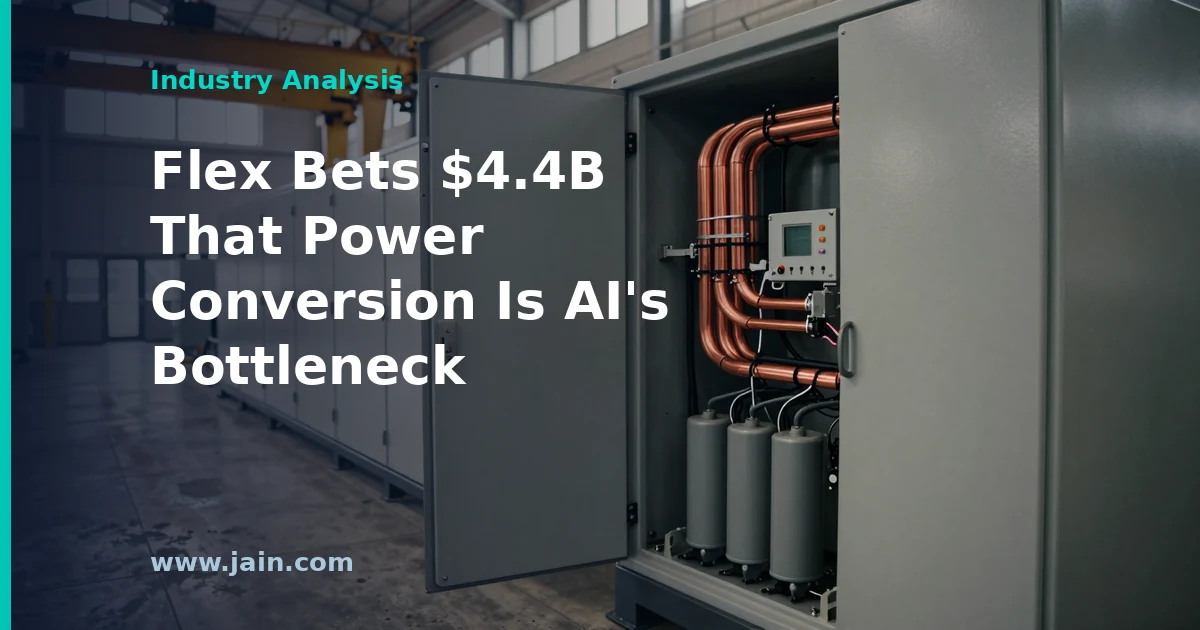
Flex Ltd. (NASDAQ: FLEX) has agreed to acquire EPC Power Corp., a Poway, California designer and manufacturer of power conversion systems, for $4.4 billion in cash. The parties signed a Stock Purchase Agreement on September 3, 2026, under which Flex subsidiary ACS Acquisitions, Inc. buys all equity in EPC Power from Charge Parent, LLC, the holding vehicle for controlling shareholders Goldman Sachs Alternatives and Cleanhill Partners. Flex disclosed the agreement in an 8-K filed with the SEC on September 4, and is a party to the contract solely to guarantee its subsidiary’s obligations.
Flex’s announcement puts EPC Power’s calendar 2026 revenue at approximately $800 million, with roughly 40% organic growth expected in 2027 and EBITDA margin expanding by double-digit percentage points to approximately 30% that year. EPC Power says it has more than 15 GW deployed across 62 countries, and that annual U.S. manufacturing capacity will surpass 30 GW in 2027. The transaction is expected to close in the fourth quarter of 2026, subject to Hart-Scott-Rodino antitrust clearance and other customary conditions, after which EPC Power joins Flex’s Cloud and Power Infrastructure segment.
Executive Summary
This is a contract manufacturer paying a technology-company price. Flex has built its business designing and building hardware for other brands; EPC Power builds the equipment that sits between the grid and the server rack — rectifiers, DC-DC converters and grid-forming inverters, with solid-state transformers described in Flex’s announcement as planned development. Flex’s stated thesis, in CEO Revathi Advaithi’s words, is that “a generational shift in power architecture is underway,” and that owning the conversion layer lets Flex sell data center infrastructure as an integrated system rather than as parts.
The financial architecture matters as much as the strategic one. The 8-K describes a “locked box” structure in which EPC Power’s enterprise value was fixed as of June 30, 2026, with contractual protections against value leakage until closing — a mechanism common in private equity exits that gives the seller price certainty. Flex simultaneously signed a commitment letter with Citigroup Global Markets, Bank of America and BofA Securities for a senior unsecured 364-day bridge facility of up to $4.4 billion, a backstop it expects to replace with a permanent mix of debt and equity.
The timing is the sharpest detail. Flex states in both the 8-K and its announcement that EPC Power will land inside the Cloud and Power Infrastructure business, which Flex plans to separate into an independent public company in the first calendar quarter of 2027 — weeks after the acquisition is expected to close. Flex is, in effect, buying a $4.4 billion asset and then handing it to shareholders in a new vehicle.
The Bottleneck Moved Downstream of the Chip
For three years the constraint on AI buildouts was accelerators. The constraint discussed in this transaction is different: getting utility power into a building fast, and then converting it into something a rack of GPUs can drink without destabilizing the neighborhood grid. AI training and inference clusters draw power in large, fast swings — thousands of processors ramping together — which is closer to an industrial arc furnace than to the steady hum of a traditional colocation hall. EPC Power’s marketing centers on exactly this problem, and Flex is paying for the claim that solving it is a durable business rather than a moment.
The technical hook is the shift toward 800-volt DC distribution inside the data center. Conventional facilities step voltage down repeatedly and convert between alternating and direct current several times before power reaches a chip, losing a slice at each stage; higher-voltage DC architectures cut the number of conversions and the copper needed to carry the current. Flex’s announcement says EPC Power’s platform is engineered for these architectures with capabilities across rectifiers and DC-DC conversion. The grid-forming piece is complementary: most inverters follow the grid, matching a frequency someone else sets, while grid-forming units can establish voltage and frequency themselves, which is what lets a site run on batteries through a disturbance or energize before the utility interconnection is fully mature.
What $4.4 Billion Buys, Priced Against Flex’s Own Forecast
Work the disclosed numbers and the price becomes legible. Against approximately $800 million of calendar 2026 revenue, $4.4 billion is roughly 5.5 times sales. Apply the stated 40% organic growth and 2027 revenue lands near $1.1 billion; at the stated approximately 30% EBITDA margin, that implies something in the neighborhood of $330 million of 2027 EBITDA, or about 13 times forward earnings before interest, taxes, depreciation and amortization. Those multiples are derived arithmetic from Flex’s own projections, not company-stated figures, and they hold only if both projections land.
The margin guidance contains its own admission. If EBITDA margin expands by “double-digit percentage points” to reach approximately 30%, the 2026 margin is by definition 20% or below. Flex is paying today for a profitability structure that does not yet exist, on the expectation that mix shift toward data center product and scale in U.S. manufacturing delivers it. That is a defensible bet in a supply-constrained market — pricing power tends to follow scarcity — but it is a bet, and it is the single assumption most worth revisiting when the combined business reports actual results.
Buying an Asset You Plan to Give Away
Flex has told investors it will separate its Cloud and Power Infrastructure portfolio into an independent public company in the first quarter of 2027. EPC Power is being bought into that segment in the fourth quarter of 2026. The sequencing is deliberate: it makes the entity that goes public materially larger, faster-growing and more differentiated than it would otherwise be, and it moves the story of that company from “builds infrastructure hardware to order” toward “owns the power conversion layer.”
It also raises a capital-structure question that the filings flag rather than answer. Flex says it is evaluating financing alternatives and expects a combination of debt and equity, with committed financing from Citi and Bank of America standing behind it. Which balance sheet ultimately carries that debt — Flex’s or the new company’s — shapes both entities. Flex’s own forward-looking statement language lists the ability to achieve anticipated capital structures, credit ratings and financing in connection with the spin-off among its risks, which is an unusually direct acknowledgment that the two transactions are financially entangled. There is also a calendar risk: the purchase agreement’s outside date is December 31, 2026, subject to two automatic three-month extensions, meaning a slow antitrust review could push closing past the intended separation date.
Domestic Manufacturing as the Second Product
EPC Power’s pitch is not only technical. Flex describes U.S.-based engineering and manufacturing, and EPC Power’s own announcement says it expanded its domestic manufacturing footprint nearly tenfold under Goldman Sachs Alternatives and Cleanhill Partners, which first invested in 2021. In a market where electrical equipment lead times are a scheduling input and where tariff exposure and procurement rules increasingly favor domestic content, capacity located in the United States is a commercial asset in its own right, distinct from the merits of the hardware.
For buyers, the practical consequence is consolidation of the supply chain. A hyperscaler or colocation developer that previously bought conversion equipment, cooling and IT integration from separate vendors can, in principle, buy a larger integrated block from one supplier — faster to specify, but a heavier dependency. For other electronics manufacturing services firms, the transaction sets a marker: this asset was priced as differentiated intellectual property, not as assembly capacity, and the pool of independent power conversion specialists available to buy is not deep. For established power-equipment vendors, a well-capitalized new competitor now sits inside a manufacturing organization with a footprint spanning 30 countries.
Background
Flex Ltd. is one of the largest electronics manufacturing partners in the world, designing and building products for other brands across a footprint spanning 30 countries. In recent years it has pushed beyond assembly into data center power, cooling and IT infrastructure, organizing that work in a Cloud and Power Infrastructure segment that it has told investors it intends to separate into a standalone public company in the first quarter of 2027. Acquiring a power conversion specialist into that segment shortly before separation changes what the new company will look like on its first day of trading.
EPC Power was founded in 2010 in California and spent most of its life supplying inverters to the utility-scale battery storage market. Cleanhill Partners invested in 2021 on the thesis that power conversion would become critical as renewables, grid modernization and digital infrastructure converged; Goldman Sachs Alternatives later joined as a controlling shareholder. AI data centers then arrived as a second, larger market for the same core competence, because a building drawing power in large, rapid swings needs the same conversion and grid-stabilization hardware that a battery plant does — which is the convergence Flex is paying for.
SoftBank, the Japanese investment giant behind some of the largest bets on artificial intelligence, is paying $4 billion for DigitalBridge — a firm that owns and finances the buildings, cables and towers that computers run on.
The surprise: the boss of the company being sold is publicly saying this moment feels like the late 1990s, just before the internet stock crash.
Why care? The same buildings will host the artificial intelligence tools you use. If the money behind them is nervous, that is worth knowing.
Crypto Briefing reported that SoftBank Group has struck a deal to acquire DigitalBridge Group (NYSE: DBRG) for $4 billion, and 24/7 Wall St. reported that DigitalBridge’s chief executive — having just agreed to sell the digital-infrastructure firm — is publicly likening current market conditions to a late-1990s moment.
DigitalBridge is one of the few pure-play investment platforms built entirely around digital infrastructure: the data centers that house computing equipment, the fiber-optic networks that connect them, the cell towers that carry mobile traffic, and the small edge facilities that sit close to end users. A sale at $4 billion would move that platform under the control of a buyer that has already committed enormous sums to artificial-intelligence compute.
Executive Summary
The transaction, as reported, is a vertical move rather than a financial one. SoftBank already owns chip designer Arm, has taken positions across the AI model and semiconductor stack, and is a named partner in large-scale AI data center ventures. What it has lacked is a permanent, in-house capability for originating, financing and operating the physical layer — land, power, buildings, fiber routes and tower sites. DigitalBridge is precisely that capability, staffed and running.
The second element of the story is harder to price. The executive selling the business is, at the same time, drawing a comparison to the late 1990s — the period when telecom and internet capital expenditure ran far ahead of demand, before a severe correction. Sellers are not disinterested commentators, but neither are they usually inclined to talk down the sector they just monetized. That tension is the most interesting thing in the announcement.
For buyers of capacity, for limited partners in DigitalBridge’s funds, and for competing infrastructure managers, the practical questions are about structure: what transfers, what needs consent, and what SoftBank intends to do with the platform once it controls it. Those questions have not yet been answered publicly.
What $4 Billion Actually Buys
There is a meaningful difference between buying assets and buying a platform. An asset is a building with power and tenants; it produces rent. A platform is an origination machine — the relationships with utilities, the land bank, the permitting expertise, the construction teams, the leasing pipeline and, critically, the ability to raise other people’s money against all of it. DigitalBridge is the second kind of business. Its portfolio companies have included large-scale data center operators, fiber networks and tower platforms, but its core product is the capability to assemble and fund such businesses repeatedly.
For SoftBank, which has committed capital to AI compute at a scale few institutions can match, owning that capability changes the arithmetic. Instead of negotiating with landlords and developers on each project, it can direct an in-house team at the constraint. It also gains something scarcer than capital in this market: people who have already sat through interconnection queues, substation upgrades and multi-year entitlement fights, and know which sites are real and which are brochures.
The strategic logic, in other words, is stack completion. Chip design, model-layer exposure, and now the physical estate that both depend on. Whether $4 billion is a good price for that depends on terms not yet public — but the intent is legible.
A Seller’s Bubble Warning, Read Two Ways
The late-1990s analogy is a specific one, and it deserves to be handled precisely rather than as a headline. In that period, telecom carriers laid fiber far in excess of near-term demand, financed it with cheap debt and equity, and a great many of them did not survive the reckoning. The nuance usually omitted: the fiber itself was not wasted. It was bought cheaply out of bankruptcy and carried the next two decades of internet traffic. The infrastructure was right; the capital structures and the timing were wrong.
Applied to today, that reading is neither bullish nor bearish so much as a statement about who absorbs the risk. If AI compute demand arrives more slowly than current construction schedules assume, the buildings and power interconnections will still be valuable — but the equity and debt raised at 2025–2026 assumptions may not be. That is a solvency and duration question, not a technology question.
It is also fair to note what the warning is not. As reported, it is a characterization of market conditions, not a forecast attached to numbers, a demand model or a timeline. A comparison to a prior era is a useful frame for readers; it is not evidence about occupancy, lease terms or capital costs at any specific operator. Readers should weigh it as informed commentary from someone with an unusually good view of infrastructure financing — and also as commentary from a party who has just agreed to sell.
The Fee Stream Is the Asset — and the Complication
An investment manager’s value sits substantially in contracted management fees and in the expectation of raising the next fund. Those fees rest on relationships with limited partners — the pension funds, sovereign wealth funds and insurers whose money is actually deployed. Fund agreements typically contain change-of-control provisions and key-person clauses precisely so that investors are not silently handed a new owner or a new management team.
That makes the human and contractual side of this transaction more consequential than in a straightforward asset purchase. If a corporate parent with its own large AI ambitions controls the manager, limited partners will reasonably ask how deal allocation works: when an attractive site emerges, does it go into a third-party fund, or to the parent? Managing that conflict is routine in the industry, but it has to be documented, and investors have to accept the documentation.
For competitors — the large private-markets firms that have built digital-infrastructure practices of their own — the read-through is competitive rather than existential. A DigitalBridge aligned with a single strategic owner may become a harder counterparty for some clients and a more aggressive bidder for others. Independent managers may find that independence is itself a selling point to limited partners who want no ambiguity about whose interests come first.
Power, Not Money, Is the Binding Constraint
The reason infrastructure platforms command premiums right now has less to do with construction and more to do with electricity. A large data center campus needs a grid connection measured in hundreds of megawatts — a megawatt is roughly the continuous power draw of several hundred homes — and utilities in most major markets have multi-year queues for connections of that size. Capital is abundant; energized land is not.
This is why buying a platform beats buying buildings. Positions in interconnection queues, options on land near transmission capacity, and standing relationships with utilities and regulators are slow to build and cannot be conjured with a cheque. If SoftBank’s intent is to accelerate its own compute buildout, the acquired pipeline may matter more than the acquired earnings.
It is also where the bubble warning bites hardest. Power constraints delay revenue but not interest expense. A project financed on the assumption of a 2027 energization date and a signed tenant behaves very differently if either slips. Neither company has disclosed the contracted capacity or delivery schedules that would let outsiders judge that exposure.
Background
DigitalBridge traces its lineage to Colony Capital, a real estate investment firm that repositioned itself around digital infrastructure and rebranded as DigitalBridge in 2021. It wound down legacy real estate exposure and rebuilt as a specialist manager focused on the physical layer of the internet, with portfolio businesses spanning wholesale and edge data centers, long-haul and metro fiber, and communications towers. It trades on the New York Stock Exchange under the ticker DBRG.
SoftBank Group is a Japanese holding company founded by Masayoshi Son, known for the Vision Fund and for concentrated, large-scale technology bets. It owns chip designer Arm, whose architectures underpin most mobile devices and a growing share of data center silicon, and has taken significant positions across the artificial-intelligence ecosystem, including participation in large multi-party data center ventures. Its recent acquisitions have leaned toward compute infrastructure rather than consumer internet.
Nvidia, the company that makes the chips nearly all artificial intelligence runs on, is buying Hugging Face for roughly $13 billion. Hugging Face is best described as a public library for artificial intelligence: developers everywhere go there to download, share and reuse free models and data.
Nvidia says it will keep that library open, including to models built for rival chips. The deal needs government approval and is not expected to be final until sometime in the first half of 2027.
Why care? The company that sells the engines just bought the shelf the software sits on.
NVIDIA has entered into a definitive agreement to acquire Hugging Face, Inc., the company disclosed in a Form 8-K filed with the Securities and Exchange Commission on September 3, 2026, reporting an earliest event date of September 2. The filing puts the purchase price at approximately $11.9 billion payable to Hugging Face stockholders, subject to certain adjustments, plus an equity-based retention program of up to approximately $1.0 billion for Hugging Face employees joining NVIDIA — the roughly $13 billion total reported by Bloomberg.
NVIDIA describes Hugging Face as a platform and community for developing, sharing and deploying open-source models, datasets and applications. The transaction is expected to close in the first half of 2027, subject to customary closing conditions including required regulatory approvals. In the same filing, NVIDIA committed to keeping the platform open — continuing to let model makers, developers and users upload and download models and datasets of their choosing, and to support other silicon vendors.
Executive Summary
For most of the AI boom, NVIDIA’s dominance has been described in hardware terms: accelerators, networking, racks, and the software layer — CUDA — that locks developers to them. The Hugging Face acquisition is a different kind of move. It reaches past the compiler and the driver into the distribution layer, the place where an open model is published, discovered, benchmarked and pulled down by the developer who will eventually need somewhere to run it.
The economic logic is straightforward and NVIDIA states it plainly in the 8-K’s new risk factor: demand for open-source foundation models “promotes the use of our products worldwide.” Every open model that gets fine-tuned and deployed is downstream compute demand. Owning the shelf that model sits on is a cheap way to stay close to the moment a workload is born — cheap, at least, relative to NVIDIA’s own scale. The company reported $96.2 billion of revenue in the quarter ended July 26, 2026, per its August 26 results release, and guided to $108 billion for the following quarter. The entire Hugging Face price is roughly a fortnight of revenue at that run rate.
The complication is that a neutral commons owned by the largest interested party is no longer obviously neutral. NVIDIA anticipated this and pre-committed in the filing to keeping the platform open and supporting other silicon vendors. That commitment is the most consequential sentence in the document, and its durability — how long it binds, who enforces it, what “support” means in practice — is what regulators, rival chipmakers and the open-model community will spend the next several quarters testing.
Buying the Shelf, Not Just the Engine
The AI stack has a chokepoint at every layer. NVIDIA already owns two of them: the accelerator itself and CUDA, the programming toolkit that makes those accelerators worth buying and makes switching expensive. What it has not owned is the layer where the artifacts of AI — trained models and the datasets behind them — are actually distributed. That is the layer Hugging Face occupies, and the 8-K’s own description of it as a “platform and community” is telling. Communities are hard to build and harder to replicate; you can copy a file repository, but you cannot copy the habit of a million developers going to the same place first.
The strategic value is positional rather than financial. NVIDIA disclosed no revenue, margin or user figures for Hugging Face in the filing, and at roughly $11.9 billion for the equity plus up to $1.0 billion to keep the staff, this is not a deal justified by near-term earnings contribution. It is justified by proximity — being present at the moment a developer chooses a model, and therefore implicitly at the moment they choose the hardware, cloud and runtime to serve it. In a quarter where NVIDIA’s Data Center segment alone produced $89.0 billion, up 117% year over year, a $13 billion option on where the next generation of workloads originates is a rounding error with leverage.
The Openness Pledge Is the Load-Bearing Wall
NVIDIA did something unusual in the 8-K: it wrote its behavioural commitments into a securities filing before anyone asked. The company states it has committed to keep Hugging Face’s platform open “consistent with Hugging Face’s existing practices,” to continue permitting uploads and downloads of models and datasets of users’ choosing, and to “support other silicon vendors.” Read that last clause carefully — it means models optimised for AMD, Google’s TPUs, Amazon’s Trainium and the rest remain welcome on a platform their competitor owns.
What the filing does not do is specify how long the commitment runs, what mechanism enforces it, or what counts as support. Those are exactly the terms that regulators reviewing the deal will want defined, and the reason the pledge appears at all is almost certainly anticipatory: NVIDIA’s last attempted large acquisition, of Arm, collapsed in 2022 under precisely this class of objection — that a dominant supplier acquiring a neutral point in the ecosystem cannot credibly promise to stay neutral. The lesson NVIDIA appears to have taken is to lead with the remedy rather than negotiate it later.
There is a fair counterargument on the other side, and it deserves stating without cynicism. Hugging Face’s value to NVIDIA depends on it remaining the default destination for the whole field. Degrading support for rival hardware would push model publishers toward alternatives and destroy the asset being bought. Self-interest and the pledge point the same direction — for now. The question is what happens in a future where those interests diverge, and nothing disclosed so far answers it.
The Regulatory Bet Hidden in the Risk Factor
The most analytically interesting passage in the filing is not about the deal mechanics at all. NVIDIA added a risk factor headed “Government restrictions may negatively impact our business and the Hugging Face platform,” and it says two things worth pausing on. First, that other parties are “actively lobbying the U.S. Government and other stakeholders worldwide” for measures that would restrict or disadvantage open-source models. Second, that “many of the world’s most popular and successful open-source models originated in China” and are then downloaded and fine-tuned by developers worldwide — and that any restriction on serving models derived from any region, China included, could materially affect both the platform and NVIDIA’s business.
That is a company telling investors it has just bought an asset whose value is partly hostage to open-model policy, and simultaneously declaring which side of that policy fight it is on. It is also a candid acknowledgement of an uncomfortable dependency: an American chipmaker’s open-model distribution business runs in significant part on weights that originate outside the United States. NVIDIA does not quantify the exposure, and no figures are given for how much platform activity involves models of any particular origin.
For enterprise buyers, this converts an abstract policy debate into a procurement variable. If your inference stack is built on openly published weights pulled from a public hub, the regulatory treatment of those weights — export rules, provenance requirements, licensing conditions — is now part of your supply chain risk, and one of your suppliers has said so in writing.
A Software Deal Amid an Extraordinarily Capital-Heavy Buildout
The acquisition lands in the middle of a spending posture that reframes what $13 billion means. In CFO commentary filed alongside the August 26 results, NVIDIA disclosed that supply commitments rose from $119 billion in the prior quarter to $279 billion, primarily for memory procurement; that it holds land, power and shell guarantees for AI cloud partners’ lease obligations with maximum gross exposure of $3.5 billion; and that in August 2026 it entered guarantees capped at $105 billion to support roughly 4.25 gigawatts at SB Energy’s PORTS-Pike Technology Campus in Ohio, a site that will exclusively host NVIDIA infrastructure under 20-year leases to OpenAI, subject to limited exceptions. A gigawatt is roughly the output of a large nuclear reactor.
Against those numbers, Hugging Face is inexpensive, and the contrast is the point. NVIDIA is now underwriting the physical constraints of the buildout — land, power, shells, memory supply — while separately buying the software surface where demand originates. The company frames the infrastructure arrangements as helping customers who are “growing faster than their balance sheets and long-term credit profiles can support.” That is an honest description of a market where the chip vendor increasingly finances, guarantees and now curates the demand for its own product.
For the data center and connectivity industry, the second-order effects matter more than the headline. If open models remain freely distributed and cheap to obtain, inference demand disperses — toward enterprise colocation, regional and sovereign clouds, and edge deployments, rather than concentrating solely in a handful of frontier training campuses. That dispersion is good for operators outside the hyperscale tier. Whoever owns the distribution point has meaningful influence over how fast it happens.
Background
NVIDIA has spent the AI cycle converting a graphics-processor business into the default substrate for machine learning, pairing its accelerators with CUDA, the software toolkit that makes them usable and makes leaving costly. Its fiscal 2027 second-quarter results, reported August 26, 2026, showed $96.2 billion in revenue with $89.0 billion from the Data Center segment, alongside disclosures that the company is now underwriting parts of the physical buildout itself — memory supply commitments, multi-decade data center leases, and guarantees on land, power and shell capacity for AI cloud partners.
Hugging Face grew up in a different part of the stack. As open-weight models proliferated — released publicly rather than served only through an API — the field needed somewhere to publish, version, document and discover them. Hugging Face became that place, the shared repository where researchers, startups and enterprises both contribute and consume. Its position depended on being unaligned: every hardware vendor, cloud and lab used it because none of them owned it. That is the assumption this transaction changes, and the reason NVIDIA wrote an openness commitment into its regulatory filing on day one.
Investigators in Germany are looking into whether someone deliberately damaged equipment at two power substations. A substation is the fenced yard of transformers and switches that takes electricity off long-distance lines and turns it into the kind you can use in a building.
Nobody has been blamed yet. It matters because the warehouses that hold our email, banking and streaming data sit directly behind that equipment. If a substation goes down, backup generators buy hours or days — not weeks.
The Associated Press reported that German authorities have opened an investigation into suspected sabotage following disruption at two electricity substations. Substations are the switching and voltage-conversion nodes that connect the high-voltage transmission network to the lower-voltage lines serving homes, industrial sites and data centers.
“Suspected sabotage” is an investigative classification rather than a finding: it describes how prosecutors are treating the damage while they work, not a conclusion about who caused it or why. Attribution, motive and the full operational impact are among the questions the investigation exists to resolve.
Executive Summary
An open sabotage investigation at two substations is, on its own, a small news item. Its significance for digital infrastructure is that it moves grid security out of the tabletop-exercise category and into the physical one. Most of the industry’s security spending and regulatory attention over the past decade has gone to cyber defence — network segmentation, intrusion detection, supply-chain controls. The asset that actually determines whether a data hall keeps running is a fenced compound full of transformers and switchgear, frequently sited on the edge of an industrial park, and usually protected by perimeter fencing, cameras and a locked gate.
The number two is the part worth noticing. European transmission and distribution networks are planned around an N-1 standard, meaning the system is designed to survive the loss of any single element without dropping customer supply. Simultaneous or near-simultaneous disruption at two sites is precisely the scenario that N-1 planning does not cover, which is why investigators treat multi-site events differently from a single equipment failure.
For data center operators, landlords and their enterprise customers, the practical question raised is not whether this particular incident affected any specific facility. It is whether the substations that feed dense clusters of digital infrastructure are secured in proportion to what depends on them — and whether operators actually know which substations those are.
A Substation Is a Concentration of Risk in a Small Fenced Yard
A substation does three jobs: it changes voltage, it switches circuits, and it protects the network by isolating faults. The physical contents are unglamorous — power transformers, circuit breakers, disconnectors, protection relays, control cabinets — and are often visible from a public road. There is no redundancy inside the fence. A transformer is a single object weighing tens of tonnes, filled with oil, and it either works or it does not.
What makes substations a disproportionate target is the repair asymmetry. Damage can be inflicted quickly and cheaply; large power transformers are custom-engineered for a specific network position, built to order, and moved by specialised heavy transport. Replacement is measured in months, not days, unless the operator holds a compatible spare and can physically get it to site. Utilities manage this with spares pools and mutual-assistance arrangements, but those programmes were sized for storms and equipment failure, not for a pattern of deliberate damage at multiple locations.
This is also why an investigation into two sites reads differently from an investigation into one. Coordination, if it is established, changes the planning assumption. It is worth being precise here: coordination has not been established, and treating an open probe as a confirmed campaign would be running ahead of the evidence.
Where Data Centers Actually Sit in the Blast Radius
A well-built colocation facility has layered protection against utility failure. Uninterruptible power supplies — battery or flywheel systems — carry the load for seconds to minutes. Diesel or gas generators then take over and, given fuel and fuel-delivery contracts, can run for days. Higher-resilience designs take two utility feeds, ideally from separate substations on separate network paths, so that one upstream failure is survivable without ever starting an engine.
Two things weaken that picture. First, “two feeds” is often two circuits that converge upstream at a single substation or a single transmission corridor — diversity on the invoice, not in the ground. Second, generators are engineered for outages measured in hours or days. A substation loss with a months-long transformer replacement is a different failure mode: the facility survives it technically, on fuel deliveries, at a cost structure nobody underwrote and with an emissions and permitting profile that many sites are not licensed for over extended periods.
The exposure is also geographically concentrated. Europe’s data center capacity clusters heavily around a handful of metros — Frankfurt above all, alongside London, Amsterdam, Paris and Dublin — precisely because that is where fibre, land and grid connections already exist. Concentration is efficient for interconnection and unhelpful for resilience: the same few substations and corridors serve a large share of a region’s compute.
Critical Infrastructure on Paper, Ordinary Utility Asset in the Field
Europe’s regulatory architecture already treats both energy and digital infrastructure as essential. The NIS2 Directive covers cybersecurity and incident reporting across sectors including energy and data centers, and the Critical Entities Resilience Directive addresses physical resilience — risk assessment, resilience plans, incident notification — for entities providing essential services. On paper, the substation and the data center it feeds are both in scope.
The gap is between designation and hardening. Obligations of this kind produce risk assessments, plans and reporting duties; they do not automatically produce ballistic barriers, intrusion detection at the fence line, hardened transformer walls or on-site response at every distribution node. The United States offers a useful comparator: after the 2013 Metcalf substation shooting in California, regulators adopted a dedicated physical security standard, NERC CIP-014, which requires targeted risk assessment and protection — but only for a defined set of transmission stations whose loss would cause instability or cascading outages. Most substations, in most countries, fall outside such tiers by design, because hardening every one of them is not economically serious.
That triage logic was built around outage consequence for the electricity system. It was not built around the question of which substations feed several hundred megawatts of concentrated digital load underpinning payments, logistics and public services. Whether those two rankings produce the same priority list is an open and answerable question, and one that data center operators are better placed to raise with their network operators than to wait to be told.
What Operators Can Reasonably Do Before the Regulation Catches Up
Nothing in an ongoing investigation obliges a data center operator to act. But the incident points at a diligence exercise that is cheap relative to its value: knowing, specifically, which substations and which transmission paths a site depends on, and whether the redundancy purchased is real upstream diversity or a paper duplicate. Many operators can answer this for their own switchgear and cannot answer it two nodes out.
The second exercise is duration. Contingency plans and service-level agreements are usually written against outages of hours. Modelling a multi-week loss of a primary feed changes the questions: fuel logistics and contracted supply priority, permit ceilings on generator run-hours, staffing rotations, and whether workload can be shifted to another region and at what latency and cost. Customers negotiating colocation or wholesale capacity are within their rights to ask for these answers in writing.
None of this argues for alarm. Grid operators handle equipment failure and weather damage continuously and restore service well; the system is more robust than a single investigation makes it look. The measured conclusion is narrower: physical security of the electricity assets serving digital infrastructure deserves the same explicit, documented attention that cyber risk has received, and right now, in most contracts, it does not get it.
Background
Electricity reaches a data center through a chain: generation, high-voltage transmission, one or more substations that step the voltage down, and finally the distribution circuits into the site’s own switchgear. Substations are the hinge points, and because they concentrate transformers and switching equipment in one compound they are also the points where a single physical failure has the widest effect. Grid planners compensate with the N-1 principle — designing the network so any one element can fail without cutting supply — and with spares pools and mutual-assistance agreements between utilities.
Digital infrastructure has been formally recognised as essential in European law: data centers sit within the digital infrastructure sector under NIS2, alongside energy in the same regime, and the Critical Entities Resilience Directive extends resilience duties beyond cyber to physical threats. The practical hardening picture is uneven, however, because protection regimes worldwide triage substations by their consequence for the electricity system rather than by the digital load they carry. That distinction is what an investigation into physical damage at grid assets brings into focus for the data center industry.