Two companies that rent out powerful computers for artificial intelligence recently borrowed money, and one is paying far more for it.
CoreWeave took a $2.6 billion loan that costs 5.5 percentage points above a standard benchmark interest rate. Its rival Nebius borrowed $775 million at just 2.5 points above that same benchmark.
The difference comes down to what backs each loan. Nebius tied its loan to one financially strong customer’s contract, while CoreWeave’s covers many customers. If demand for artificial intelligence cools, cheaper borrowing could become a real advantage.
Dealroom reported that CoreWeave closed a $2.6 billion delayed-draw term loan in August, priced at Term SOFR plus 5.50% and maturing in September 2031, with $1.2 billion drawn so far. That margin is three percentage points above the SOFR plus 2.50% Nebius Group secured on a $775 million facility in July. Nebius has described that facility as backed by deployed GPU infrastructure and cash flows from an investment-grade customer.
Separately, Nebius closed $5.75 billion of convertible notes in August. In a Form 6-K filed September 8, it announced that Palantir had named it a preferred sovereign AI infrastructure partner.
Executive Summary
Two of the best-known neoclouds, the specialist providers that rent GPU computing for artificial intelligence, have borrowed against their buildouts within weeks of each other on very different terms. CoreWeave’s $2.6 billion facility carries a 5.50% margin over the Secured Overnight Financing Rate (SOFR), the US benchmark for floating-rate loans. Nebius’s smaller $775 million facility carries 2.50%.
The gap does not show lenders favoring one company’s AI prospects over the other’s. It shows lenders pricing the specific collateral and customer contracts behind each loan. Nebius’s loan sits on a single contracted deployment with an investment-grade customer, meaning one with a strong credit rating. CoreWeave’s loan finances committed deployments across a broader customer pool and gives the company more flexibility, and it pays more for that flexibility.
This matters beyond the two companies. AI infrastructure is being built largely with borrowed money. When credit markets start pricing each buildout on its own contracts and collateral, the cost of capital becomes a competitive variable, and it could separate winners from strugglers if GPU rental prices or utilisation weaken.
Same Industry, Very Different Price of Money
Floating-rate corporate loans charge a benchmark rate plus a fixed margin, or spread. The benchmark here is SOFR, which tracks the cost of overnight borrowing secured by US Treasuries. Because both CoreWeave and Nebius pay SOFR, the spread is the part that reflects how lenders view the risk. CoreWeave’s 5.50% is 2.2 times Nebius’s 2.50%, a gap of three percentage points. Describing it as ‘triple’ is loose shorthand. Once the shared benchmark is added back, the difference in all-in borrowing cost is proportionally smaller, though still substantial.
The structure also matters. A delayed-draw term loan lets the borrower tap committed funds in stages as spending arrives, which suits GPU deployments that come online in phases. CoreWeave has drawn $1.2 billion of its $2.6 billion. As simple arithmetic before fees, three extra percentage points on the drawn balance comes to roughly $36 million a year. On the full facility it would be roughly $78 million a year.
Collateral and Contracts, Not Confidence, Set the Spread
Nebius’s facility resembles project finance. It is secured by hardware already deployed and by cash flows from an investment-grade customer, and Nebius said it covers more than 100% of that deployment’s capital expenditure. Lenders are underwriting a known asset with a known payer, which is why the margin is low. The model works best if Nebius can repeat it, and the company points to more than $40 billion of additional customer commitments as the pipeline for doing so.
CoreWeave’s loan spreads risk across a broader set of committed deployments and runs to September 2031. That breadth gives CoreWeave room to serve shorter contracts and higher-margin enterprise work that a single-customer structure would not accommodate. The trade-off is a higher hurdle rate, the minimum return each financed GPU must earn before it adds value for shareholders. Neither structure is inherently better. One buys cheap money through narrow contracts, and the other pays for flexibility.
Capital Hunger on Both Sides of the Comparison
Neither company is borrowing from a position of surplus. Nebius’s $5.75 billion convertible note sale in August dwarfs its $775 million facility. Convertible notes are debt that investors can later swap for shares, so they carry potential dilution. Nebius is also adding demand-side relationships. Its September 8 filing describes Palantir naming Nebius its preferred sovereign AI infrastructure partner and the two working to deploy new capacity, including modular data centers at sites where power is already available. That filing disclosed no financial terms, contracted capacity or timeline.
Investor positioning is mixed. CoreWeave’s hedge fund holder count rose to 71 in the second quarter of 2026 from 63, even as Magnetar Capital trimmed its stake 24% to 52,062,927 shares. Nebius’s count rose to 86 from 60, while Orbis Investment Management cut 22% to 6,494,719 shares. On August 31, 17.89% of Nebius’s float was sold short. With billions of convertible debt outstanding, part of that short interest likely comes from convertible holders hedging their positions rather than outright bets against the company.
Why the Pricing Gap Could Matter More If Demand Cools
While AI compute is scarce and rental prices hold, a three-point spread difference is easily absorbed. The risk appears when utilisation or pricing slips, a concern that resurfaced after September 14. Expensive debt then consumes a larger share of revenue, and strong top-line growth can coexist with weak returns to shareholders.
The likely beneficiaries are providers that can attach financing to long contracts with highly rated customers, and the lenders who have learned to tell those deals apart. Providers relying on broader, flexible facilities are not disadvantaged today, but they carry more exposure to a downturn. If lenders keep pricing buildouts deal by deal, a lower cost of capital becomes a durable advantage that is hard for rivals to copy quickly.
Background
CoreWeave and Nebius are leading examples of neoclouds, companies that build and rent out GPU computing capacity for training and running artificial intelligence models. CoreWeave, which listed on Nasdaq in 2025, is US-based. Nebius Group, listed on Nasdaq as NBIS and headquartered in Amsterdam, is led by founder and CEO Arkady Volozh and was formed from the international businesses of the former Yandex N.V.
Both companies need large amounts of capital, because GPUs, power and data center space must be paid for well before customers’ rental payments arrive. That has made debt markets central to the sector, and lenders have increasingly looked at the specific contracts and collateral behind each deal rather than lending against the AI growth story as a whole.
Texas’s power grid has reportedly promised away all the room it set aside for new giant electricity users. That is roughly the output of eight large nuclear power plants.
An existing hookup to the grid is now one of the most valuable things a company can own.
Wall Street research firm Bernstein expects companies that once ran computers to earn bitcoin, such as IREN, to rent those powered sites to artificial intelligence companies.
The bigger point: electricity, not computer chips, is becoming the main limit on how fast artificial intelligence can grow.
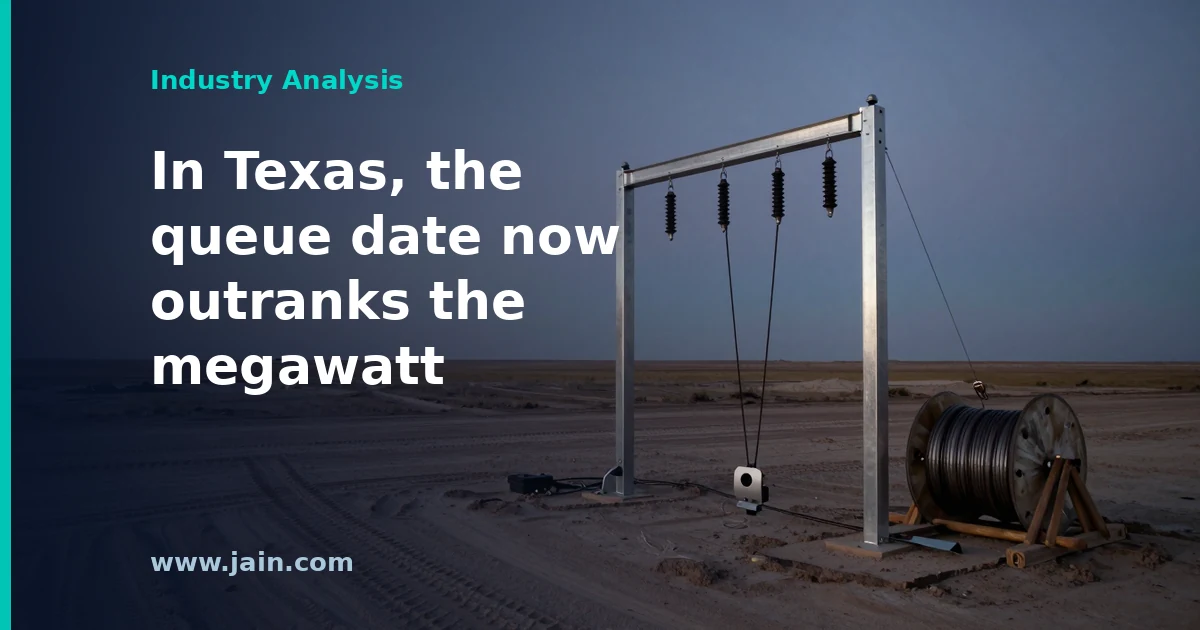
Moomoo reported that the Electric Reliability Council of Texas (ERCOT), which runs most of the Texas power grid, has fully allocated 8 gigawatts (GW) of connection capacity for large electricity users. That means no uncommitted headroom remains in that pool for new projects such as data centers.
Against that backdrop, research firm Bernstein argues that bitcoin miners like IREN (Nasdaq: IREN) will pivot to becoming AI infrastructure landlords. On this view, miners would collect rent from AI tenants for access to power-connected sites instead of relying mainly on mining revenue.
Executive Summary
The reported full allocation of ERCOT’s 8 GW large-load capacity is a signal about where the bottleneck in AI infrastructure now sits. Securing chips and capital matters, but the hardest thing to obtain in a fast-growing market like Texas is increasingly a grid connection, the approved right to draw large amounts of power at a specific site.
Bernstein’s thesis follows from that scarcity. Bitcoin miners spent years building energized, high-capacity sites in Texas and elsewhere. If new connections are effectively closed off, those existing sites become scarce real estate. Owners could lease them to AI and cloud customers under longer-term contracts, which may produce steadier income than bitcoin mining.
The thesis is plausible and consistent with how the sector has been moving, but it remains an analyst’s forecast rather than a company commitment. Whether any individual miner earns landlord-style returns depends on conversion costs, tenant contracts and the terms of its grid access, and those details have not been set out alongside the claim.
Grid Access Is the New Scarce Asset
For a large data center, the power hookup is the part of the project that is hardest to speed up. Before a facility can draw tens or hundreds of megawatts, the grid operator and local utilities must study whether the transmission system can handle it. This review is often called the interconnection process, and projects wait in a queue while it runs. When a pool of approved capacity is fully spoken for, a new entrant faces a longer wait, a costlier upgrade, or a move to another market.
Texas has been a magnet for power-hungry computing because of its large, fast-moving market and relatively quick build times. If the 8 GW pool is fully allocated, the advantage moves to whoever already holds approved or energized capacity. For comparison, 8 GW is in the range of the output of about eight large nuclear reactors. That scale shows how much demand has already lined up, and it suggests Texas’s reputation as the easy place to plug in is being tested.
Allocation is not the same as consumption, though. Capacity promised to projects on paper may never be built if financing, tenants or equipment fall through. How much of the 8 GW turns into operating load will shape whether the scarcity is lasting or partly an artifact of speculative requests.
From Hashrate to Rent: The Landlord Thesis
Bitcoin mining revenue swings with the bitcoin price, network competition and the periodic halving of mining rewards. A miner that instead leases powered space to an AI company trades that volatility for contracted payments. That model looks more like a data center operator or real estate investment trust than a commodity producer. Bernstein’s framing of miners collecting rent captures this shift: the valuable asset is the site and its power, not the mining machines.
The economics are attractive in principle. Investors typically value long-term, contracted infrastructure income more highly than volatile mining cash flow. A miner with existing grid access can also offer something a newcomer cannot: a faster path to energized capacity at a time when waiting years for a connection is a real cost.
Conversion is not free. Mining facilities are often built for cheap, interruptible power with minimal backup, simple air cooling and limited fiber connectivity. AI tenants, especially those running dense GPU clusters, generally need liquid or advanced cooling, redundant power, strong network links and uptime commitments. Closing that gap takes significant capital and time, and the returns depend on lease terms that are rarely disclosed in full.
Winners, Losers and the Risks Beneath the Rent
The likely winners are operators already holding energized, well-located capacity, including miners that move early to sign creditworthy tenants. Hyperscalers, the largest cloud providers, and AI labs gain a quicker route to power, though scarcity may push up what they pay. Late-arriving developers without approved connections are the most exposed, as are smaller miners whose sites lack the scale or location AI customers want.
The landlord model also brings new risks. Tenant concentration is one: a miner leasing much of its capacity to a single AI customer swaps bitcoin price risk for counterparty risk. Policy is another. Texas has already moved to put more obligations on large loads, including sharing grid costs and accepting curtailment during emergencies. Further rule changes could alter what an allocated connection is worth. Finally, if AI demand cools or new transmission eases the bottleneck, today’s scarcity premium could narrow.
The claim that grid access is now a strategic asset is well supported by the broader shift toward power as AI’s limiting factor. The narrower forecast, that miners specifically will capture durable landlord economics, remains a projection that each company will have to prove through signed contracts and completed conversions.
Background
Texas operates a largely separate power grid managed by ERCOT, with limited connections to neighboring grids. Its competitive electricity market, large renewable buildout and relatively fast permitting drew bitcoin miners over the past several years. Many miners took part in programs that pay large users to reduce consumption when the grid is under strain. More recently, AI data center developers have been competing for the same power, and Texas lawmakers have moved to put more cost-sharing and reliability obligations on large loads.
IREN, which renamed itself from Iris Energy, is one of several publicly listed miners repositioning toward AI and high-performance computing. The industry-wide logic is that the power infrastructure miners built, including substations, grid connections and large land parcels, is increasingly worth more to AI customers than to bitcoin mining itself.
Amazon is building a string of data centers across Pennsylvania — large buildings packed with computers that run websites, cloud services and artificial intelligence.
Pennsylvania does not charge its 6 percent sales tax on the computer equipment inside them. State budget writers expect that break to cost close to $2 billion in uncollected taxes by 2031.
Lawmakers in both parties voted this summer to end it. Neither version reached the governor’s desk. The argument is really about who helps pay for the buildings behind your chatbot.
Capital & Main reported on September 16 that Amazon has so far claimed Pennsylvania’s data center sales-and-use tax exemption at two locations, according to the state Department of Revenue, while expanding a portfolio that now includes a permit application for 36 data centers at the 4.5-gigawatt Homer City campus in southwestern Pennsylvania, a 1,300-acre site in Hazle Township, a pending site in Kline Township, and a prospective end-user role at a rezoning-denied site in Montour County. Amazon pledged $20 billion of data center investment in the state in 2025, beginning with projects in Salem Township and Falls Township.
The exemption relieves buyers of the state’s 6% sales and use tax on equipment bought, stored or used at qualifying data centers. Pennsylvania projects it will forgo $188.4 million in fiscal 2026-27 and close to $2 billion by 2031. In late June, the Democratic-controlled House and Republican-controlled Senate each passed a repeal; neither reached Governor Josh Shapiro before he signed the budget on July 12. Shapiro’s August 18 executive order left the exemption intact but conditioned it on a consent order binding operators to new siting, disclosure and energy standards.
Executive Summary
The substance here is not that a state subsidizes data centers — most do. It is the shape of this particular subsidy. Pennsylvania’s exemption attaches to equipment, and equipment is the part of a modern AI facility whose cost is rising fastest. The nonprofit research group Epoch AI estimates servers account for almost 60% of the cost of owning a one-gigawatt data center, with the remainder split across the building, network gear, energy, land, labor and water. A tax break written against that base grows with every generation of accelerators, whether or not the campus gets bigger or hires anyone else.
That is why a program appropriated at $5 million in 2016 is now projected to reach $517.2 million in fiscal 2030-31 under Shapiro’s own 2026 budget proposal — more than a hundredfold increase. It also explains why the repeal fight crossed party lines in June and why it is unresolved: the exemption has become the single largest state-level lever on data center economics in Pennsylvania, and the governor chose to attach conditions to it rather than remove it.
For anyone underwriting capacity in the PJM footprint, the operational takeaway is that Pennsylvania’s cost question has migrated. The debate that dominated 2024 and 2025 was about electricity price and interconnection. The debate now decided in Harrisburg is about the state revenue base — and it introduces a policy variable into equipment capex that most site-selection models still treat as fixed.
A Subsidy Indexed to Silicon, Not to Square Footage
Most location incentives are written against things that change slowly: assessed property value, payroll, acreage. Pennsylvania’s data center break is written against the 6% sales and use tax on equipment — servers, storage, and the gear that supports them. That distinction is the whole story. Epoch AI’s estimate that servers make up almost 60% of the cost of owning a one-gigawatt facility means the exempt share of a project’s spend is the share dominated by AI accelerators, whose unit prices have climbed faster than any other line in the stack.
The arithmetic follows mechanically. Two campuses of identical size, power draw and headcount will generate very different amounts of forgone state revenue if one is filled with general-purpose cloud servers and the other with AI training racks. The state’s own projections trace that curve: $188.4 million forgone in fiscal 2026-27, growing to a projected $517.2 million in fiscal 2030-31, against a $5 million appropriation when the program passed in 2016 — before generative AI or hyperscale campuses were part of the conversation. Nothing in the statute had to change for the cost to multiply. The compute did.
Who is affected: the state treasury, which is absorbing the growth while legislators field demands to fund public transit and close a structural deficit; developers whose pro formas capitalize a 6% equipment discount that two chambers have already voted to remove; and county tax bases that receive the land and the substation but not the largest slice of the spend. It also means the conventional local-benefit argument — that a campus pays for itself through construction and property tax — is being made about the smallest part of the capital stack.
A Program the State Cannot Meter
There is a real weakness on both sides of this argument, and it is the same weakness. When the incentive was converted from a refund to an exemption in 2021, Pennsylvania lost the ability to track exactly how much revenue it gives up when an operator claims it. The Department of Revenue confirmed Amazon has received the incentive at two locations; it did not put a dollar figure on them.
That should temper the numbers everyone is citing. The $188.4 million and the roughly $2 billion cumulative figure are budget projections, not measured losses — useful, but not audited outcomes. By the same token, claims that the exemption is a modest and self-financing inducement cannot be verified either, because the state has no per-claim ledger to check them against. Amazon’s $20 billion commitment is not a tax base: only the portion spent on qualifying equipment is exempt, and the company has not broken that out. Good policy on either side would start with disclosure, and the current design forecloses it.
Conditioning the Subsidy Instead of Ending It
Shapiro’s August 18 executive order did something more interesting than the repeal bills would have. It kept the exemption but turned it into an enforcement hook: operators claiming it must sign a consent order committing to the standards in the order, which bars state officials from signing nondisclosure agreements with operators, requires demonstrated local community support, and pushes developers toward supplying their own energy so the grid is not strained. “I want to be clear: These are not voluntary standards — these are legally binding requirements in order to operate here in the Commonwealth,” Shapiro said at the signing.
Critics argue the conditions are beside the point. “Shapiro is Pennsylvania’s governor, not Amazon’s, not Meta’s, not Microsoft’s,” said Megan McDonough of Food & Water Watch when the underlying principles were introduced in May, arguing the state should withhold support rather than regulate access to it. The counterargument is that a consent order reaches conduct a repeal never would — siting, disclosure and self-supplied power are not things the tax code addresses. The tension is genuine: repeal is cleaner and cheaper; conditioning is narrower but touches the grid and permitting questions that actually determine whether these projects get built.
The process history is the part that will keep drawing scrutiny. Heatmap reported in April, based on correspondence obtained by a Pennsylvania resident, that Amazon was shown a “feedback draft” of the plan on March 18, months before public release; that the administration had offered “exclusive early access” to fast-tracked permitting subject to a nondisclosure agreement; and that the Department of Community and Economic Development secretary had described the plan to an Amazon representative as “intended to be voluntary.” The executive order now prohibits the NDA practice. Whether pre-consultation with a major investor is ordinary policy development or preferential access is a fair question, and it is fair in both directions — states routinely test regulatory drafts with the regulated, and doing so under an NDA is what changed.
Permitting Risk May Bite Before Tax Risk Does
Look at the pipeline and a different constraint appears. State officials have identified more than 100 projects at varying degrees of certainty. Yet the Hazle Township site was denied locally last year and is under appeal; the Montour County rezoning was denied in February; Kline Township is still pending. A developer told the governor’s chief transformation and opportunity officer by email that Amazon had been “appealed in EVERY project at EVERY turn,” per Heatmap’s reporting. For a hyperscaler, a 6% equipment discount is worth real money, but it does not compound the way a two-year zoning delay does on a site whose power interconnection and construction slots are already booked.
Capital availability is clearly not the binding constraint. In an 8-K filed September 14, Amazon disclosed it had closed a sterling bond sale of £4.242 billion in aggregate public offering price across four tranches maturing 2029 through 2045, netting roughly £4.235 billion. The filing does not state a use of proceeds, and nothing in it ties the raise to Pennsylvania. What it does show is a company funding a global buildout in size at fixed coupons ranging from 5.200% to 6.650% — a cost of capital against which state-level equipment tax treatment is a meaningful but second-order input.
The practical consequence for anyone building, powering or financing this infrastructure: Pennsylvania’s attractiveness is now a function of two variables moving in opposite directions. The exemption is under bipartisan legislative pressure, with both chambers back in session and 11 scheduled session days left this year. Meanwhile the executive order raises the local-consent and self-supplied-power bar, which favors sites with generation already next door — the pattern visible at Salem Township, where Amazon Web Services construction sits adjacent to Talen Energy’s Susquehanna nuclear station. Projects that solved power first are the ones least exposed to whichever way Harrisburg moves.
Background
Pennsylvania created its data center sales and use tax incentive in 2016 with a $5 million appropriation, aiming to attract facilities housing servers and storage equipment. It was restructured from a refund into an exemption in 2021. Over the following two years the state became a focal point of the AI buildout, with officials identifying more than 100 projects at varying degrees of certainty — drawn by PJM interconnection, legacy generation sites including retired coal plants and operating nuclear units, and abundant natural gas.
Amazon announced its $20 billion Pennsylvania commitment in 2025, anchored by AI-serving campuses in Salem Township and Falls Township. Opposition has grown in parallel and across party lines, driven by electricity demand, land use and local control; hundreds of residents rallied at the state Capitol on June 23. The result is a policy fight in which repeal bills, an executive order, campaign finance scrutiny and local zoning appeals are all running at once, in an election year in which Governor Shapiro is seeking reelection.
CoreWeave rents out computers that run artificial intelligence. On September 16 it published results from an independent industry test and said its machines handled AI requests faster than those of rival rental companies.
The more interesting result is quieter: on machines it installed months ago, it got about 20 percent more work out of each chip purely by improving its own software. No new hardware.
That matters because those chips cost a fortune. Squeezing more out of the ones you own, instead of buying more, is where the profit in this business actually sits.
CoreWeave on September 16, 2026 published its submissions to MLPerf Inference v6.1, the industry benchmark round released the same day by MLCommons. Writing on the company blog, Shadi Saba said CoreWeave entered the Datacenter Closed division’s Available category across four NVIDIA platforms — HGX B200, HGX B300, GB200 NVL72 and GB300 NVL72 — and four model families: Qwen3-VL-235B-A22B, DeepSeek-R1-671B, GPT-OSS-120B and Llama 2 70B. Headline figures include 16,635 tokens per second per GPU on GPT-OSS-120B in the offline scenario, more than 1.19 million tokens per second from a single GB300 NVL72 rack, and 944,902 tokens per second on Llama 2 70B in the server scenario. NVIDIA, in a blog post of its own, announced that its next-generation Vera Rubin NVL72 made its MLPerf debut in the same round.
One day later, on September 17, CoreWeave filed an 8-K disclosing a proposed $3.0 billion offering of convertible senior notes due 2033, with an option for a further $500 million, alongside an Equity Distribution Agreement covering at-the-market share sales and collared forward sales through eleven banks. The two disclosures, a day apart, describe the same business from opposite ends: what the fleet produces, and what it costs to keep building.
Executive Summary
CoreWeave’s MLPerf claims break into two categories, and they are not equally interesting. The absolute throughput records — 1,196 queries per second on the multimodal Qwen3-VL model, over 1.16 million tokens per second on GPT-OSS-120B from one rack — are a function of running NVIDIA’s newest shipping silicon, GB300 NVL72, at scale. Any operator with the same racks and the same power envelope is in that fight.
The second category is harder to replicate. CoreWeave says that comparing its 72-GPU v6.1 submission against its 64-GPU v6.0 submission on GB200 NVL72, derived per-GPU server throughput on DeepSeek-R1-671B rose 19.8% in the five months between rounds. That gain came from serving-stack tuning, scheduling and operations, not from a new chip. If it holds in production, it changes the revenue a depreciating asset can generate across its life — which is the number that underwrites everything else.
That includes the financing. The 8-K filed September 17 shows CoreWeave raising $3.0 billion in converts on top of an existing stack of senior notes carrying coupons from 8.500% to 9.750%. Capital that expensive is serviced by output per installed accelerator, and software gains on hardware already paid for are the cheapest output there is.
The 19.8% That Didn’t Require a New Chip
Strip the benchmark round down and one number does real work. CoreWeave reports that its DeepSeek-R1-671B per-GPU server throughput on NVIDIA GB200 NVL72 rose 19.8% between MLPerf Inference v6.0 and v6.1 — five months apart — through changes to its serving stack, scheduling and operations rather than new hardware. The mechanisms it names are specific: topology-aware scheduling through SUNK, which pins an inference workload inside a single high-bandwidth NVLink domain so that tokens moving between accelerators never leave the fastest interconnect in the rack, and fleet-level health monitoring through Mission Control. For a mixture-of-experts model like DeepSeek-R1 — an architecture that routes each token through a subset of specialised sub-networks, so traffic between chips is constant — placement is not a detail. It is the workload.
Who this affects is everyone financing GPUs on a multi-year schedule. An accelerator bought in early 2026 has a fixed capital cost and a depreciation clock that does not care how efficiently it runs. If per-GPU output rises roughly a fifth without capex, the cost per token served falls by a comparable amount across the remaining life of that asset, and the residual economics of the installed base improve rather than decay. That is a materially different asset story from the one where value arrives only with the next generation of silicon.
The claim deserves its caveats stated plainly, and CoreWeave states some of them itself. Per-GPU throughput is a derived metric — total system throughput divided by accelerator count — and the company notes it is not verified by MLCommons. The comparison also spans two differently sized submissions, 64 accelerators in v6.0 against 72 in v6.1, so scaling behaviour and configuration changes are folded into the same percentage as the software work. The direction is credible and the mechanism is named; the precision of the figure is CoreWeave’s own arithmetic, not the benchmark’s finding.
The Unit of Account Moved From the Chip to the Rack
The GB300 NVL72 is not a server. It is a rack in which 72 accelerators share one NVLink domain, meaning they address each other at memory-like speeds rather than over conventional networking. CoreWeave’s results read accordingly: over 1.16 million tokens per second in the server scenario and over 1.19 million offline on GPT-OSS-120B from a single rack, 944,902 and 1,136,100 tokens per second on Llama 2 70B, and 1,196 queries per second on Qwen3-VL-235B-A22B. The company’s GB200 NVL72 submission reached 901,058 tokens per second on GPT-OSS-120B in the server scenario — the same architecture, one generation back, and a visible step down.
The consequence lands on the people who build and power facilities rather than the people who buy models. When the smallest sensible deployment unit is a rack drawing far more than a legacy hall was designed for, throughput per rack becomes a proxy for how much revenue a given square metre and a given megawatt can carry. Operators comparing a rack-scale NVL72 deployment against clusters of HGX B200 or B300 servers — which CoreWeave also submitted, and which it says led all HGX entries from cloud providers — are really comparing two different power-density and liquid-cooling commitments, not two spec sheets.
Available Is the Word Doing the Most Work
CoreWeave’s submissions sit in the Datacenter Closed division’s Available category. Closed means every entrant runs the same reference implementation, so results are comparable rather than a contest in custom optimisation; Available means the system can actually be obtained. That second qualifier matters this round, because NVIDIA used the same release to announce that its next-generation Vera Rubin NVL72 made its MLPerf debut. A benchmark headline generated by a platform that is debuting is not a price a buyer can procure against today; CoreWeave’s four platforms are all Blackwell and Blackwell Ultra, the generations in production now.
For anyone running a procurement process, the practical read is to check three fields before treating any v6.1 result as a quote: which silicon generation produced it, whether the entry sits in the Available category, and whether the metric quoted is a submitted number or a derived per-GPU figure. CoreWeave also stresses that it ran on the same production clusters and images customers get rather than a benchmark-tuned rig — a genuinely meaningful distinction, though one the benchmark itself does not audit.
Throughput Is the Collateral Story
The day after the benchmark post, CoreWeave’s 8-K disclosed a proposed $3.0 billion offering of convertible senior notes due April 1, 2033, sold under Rule 144A to qualified institutional buyers, with an option for up to $500 million more and capped call transactions to limit dilution on conversion. A concurrent Equity Distribution Agreement adds at-the-market share sales and collared forward sales through a syndicate that includes Deutsche Bank, Goldman Sachs, J.P. Morgan, Morgan Stanley and Citigroup. Interest and conversion terms, the release states, are set at pricing.
The comparison worth making is internal. CoreWeave’s own press release lists the existing obligations the new notes will rank alongside: senior notes at 9.250%, 9.000%, 9.750%, 9.625% and 8.500%, and earlier convertibles at 1.75%. Converts price far below straight debt because the buyer is paid partly in equity optionality rather than cash coupon — cheaper carry now, potential dilution later, which the capped calls are bought to blunt. For a business whose costs are dominated by accelerators, the servicing capacity for any of it comes back to tokens per installed GPU.
That is the honest link between two documents filed a day apart, and it is a structural one rather than a causal one: a benchmark result is a performance claim, not a revenue disclosure, and nothing in the filings ties the offering to the MLPerf round. But the neocloud model runs on both halves at once — demonstrable output per accelerator to justify the capital, and access to capital to buy more accelerators. Software gains of the kind CoreWeave reported on already-deployed GB200 racks are the half that does not require either.
Background
CoreWeave, based in Livingston, New Jersey and listed on Nasdaq as CRWV, is a specialist cloud provider built around NVIDIA accelerators for AI training and inference — a category often called a “neocloud,” distinguished from general-purpose hyperscalers by its narrow focus and its heavy reliance on debt and equity markets to fund hardware. The company was recently named a Visionary in the Gartner Magic Quadrant for Cloud AI Infrastructure.
MLPerf, administered by the MLCommons consortium, has become the closest thing the industry has to an audited comparison of AI serving performance, which is why vendors submit and why the categories matter. Inference — running a trained model to answer requests — is now the larger and more cost-sensitive half of the AI workload, because a model is trained once but served continuously. That shift is what makes tokens per accelerator, rather than raw chip specifications, the metric operators and their lenders increasingly watch.
Lam Research does not make computer chips. It makes the machines that make them — room-sized tools that carve circuits into silicon wafers.
The company plans to spend about 1.1 billion dollars, or Rs 10,000 crore, on a manufacturing plant in India.
Why it matters: only a few places in the world build these machines, and a new chip factory can wait a long time for one. Every artificial intelligence data centre sits downstream of that wait. A new place to build the tools is a new way to shorten it.
INDIA New England News reported that Lam Research Corporation, one of the world’s largest makers of semiconductor manufacturing equipment, will invest Rs 10,000 crore — roughly $1.1 billion at current exchange rates — in a semiconductor manufacturing facility in India.
Lam is a wafer fabrication equipment (WFE) supplier rather than a chipmaker: its systems etch and deposit the microscopic layers that make up a finished chip, and they are bought by the logic foundries and memory manufacturers that supply the processors and high-bandwidth memory used in artificial intelligence hardware. The investment figure is the substantive disclosure in the announcement; site, phasing, product mix and start-up date were not specified.
Executive Summary
The headline number is large by the standards of India’s semiconductor programme and unusual in its position in the supply chain. Most of the country’s chip announcements to date have concerned fabrication and assembly-test-packaging plants — the places where chips are made and put into packages. An equipment plant sits one layer higher: it makes the capital tools that every fab, anywhere, has to buy before it can produce anything at all.
That distinction is why the commitment is worth attention beyond India. Advanced chip toolmaking is concentrated in a small number of countries — principally the United States, Japan, the Netherlands, and the Taiwan-Korea manufacturing corridor that absorbs much of the output. Lead times on advanced etch and deposition systems are measured in quarters, not weeks, and they are the practical constraint on how quickly a foundry or memory maker can convert a capital-expenditure announcement into shipping silicon.
For data centre operators, cloud providers and anyone financing artificial intelligence capacity, this is the least visible link in the chain and one of the least elastic. A second significant node of tool manufacturing does not solve that constraint on its own. It does change the geography of it — and geography is the variable that has driven the last four years of semiconductor industrial policy.
The Layer Above the Chip Shortage
Public conversation about semiconductor supply focuses on fabs: who is building one, where, and how many wafers it will start per month. The equipment layer above it gets far less attention despite being the gating item. A fab is, in economic terms, mostly a building full of tools. The cleanroom shell, the power feed and the ultrapure water plant are expensive and slow, but they are construction problems with known solutions. The etch chambers, deposition systems, lithography scanners and metrology tools inside are the scarce, long-lead, technically differentiated part.
Lam Research occupies two of the most important slots in that equipment stack. Etch is the subtractive step — selectively removing material to define features. Deposition is the additive step — laying down films sometimes only a few atoms thick. Both processes are repeated hundreds of times over the life of a single wafer, and both have become more tool-intensive as chipmakers moved from flat transistor designs to three-dimensional ones and from planar memory to stacked memory. More process steps means more tools per unit of output, which means equipment demand grows faster than wafer demand.
That structural point is what makes an equipment-manufacturing investment different from a fab investment. A fab serves its owner’s customers. An equipment plant serves everyone building fabs.
Why AI Capacity Waits on Tools, Not Just Fabs
Here is the mechanism the Rs 10,000 crore commitment plugs into. When a memory manufacturer decides to add high-bandwidth memory capacity — the stacked memory that sits alongside an artificial intelligence accelerator and largely determines how fast it can be fed data — it does not simply turn on a line. It places tool orders, waits out the manufacturer’s backlog, takes delivery, installs, qualifies, and only then ramps. The same sequence applies to a foundry adding advanced logic capacity. The interval between the capital decision and the first qualified wafer is dominated by equipment delivery and installation, not by construction.
That interval is what data centre operators experience, one or two steps removed, as accelerator allocation. An operator signing for capacity today is bidding against everyone else for chips whose production capacity was ordered as tools several quarters earlier. When equipment backlogs lengthen, the effect propagates downstream on a lag: tighter chip allocation, longer hardware delivery windows, and capacity plans that slip into the following year. It is a slow-moving constraint, which is exactly why it is easy to under-weight until it binds.
A roughly $1.1 billion manufacturing facility does not shorten that queue by itself, and nobody should claim it does. What it does is add manufacturing capacity and a new geography to a supply base that is unusually concentrated, in a country that is simultaneously trying to build the fabs that consume the output. The effect that matters for buyers is optionality — more places where tools, subsystems and spares can be built and shipped from, and one less single-region dependency in the layer that gates everything below it. Who benefits, concretely: chipmakers ramping capacity, whose tool delivery schedules set their ramp; and the operators and financiers downstream, whose capacity timelines inherit those schedules whether they track them or not.
What Rs 10,000 Crore Actually Buys
Even-handedly, the announcement establishes scale and intent, not capability. Semiconductor equipment plants span a wide range of activity, and the differences are material. At one end is manufacture of subsystems, modules, chambers and precision components, plus spares and refurbishment — genuinely valuable, high-employment work that improves supply resilience without relocating core technology. At the other is final assembly and test of complete process tools, which carries far more supply-chain weight. The announcement as reported does not say which of these the facility will do, or in what mix over time.
The realistic reading is that a plant of this size is a multi-year, phased build rather than a single switch-on, and that its early output is likelier to be components and subsystems than flagship systems. That is not a criticism; it is how equipment supply chains are normally localised. It does mean the supply-chain effect is gradual and should be judged over years, against disclosed milestones, rather than assumed from the headline figure.
There is also an ecosystem question underneath the capital number. Equipment manufacturing depends on a dense local base of precision machining, vacuum components, ultra-clean fabrication, specialty materials and calibrated metrology. India has been building toward that base, but a plant of this scale tends to pull suppliers with it rather than find them already in place. The supplier development timeline, not the construction timeline, is often what determines when a facility reaches meaningful local content.
India Moves Up the Stack, and Why That Is the Interesting Part
India’s semiconductor strategy has been read, sometimes dismissively, as a late entry into commodity fabrication and packaging. An equipment investment complicates that reading. Toolmaking is higher-margin, more engineering-intensive and considerably harder to replicate than assembly — and it is a market where demand comes from every fab on earth rather than from a domestic customer base that India is still building. A plant serving global equipment demand does not need local fabs to be viable, which removes the sequencing problem that has slowed other parts of the programme.
For the wider industry, the significance is directional rather than immediate. Since 2020, the semiconductor supply chain has been reorganised around resilience — second sources, allied manufacturing, and reduced exposure to any single strait, grid or jurisdiction. Most of that effort has gone into chips themselves. Far less has gone into the tools, which remain the narrowest part of the chain. Adding a manufacturing node in a fourth major jurisdiction is a modest structural change in the right direction, and it is the kind of change that shows up in lead-time statistics years after the ribbon-cutting, if it shows up at all.
The honest caveat is that concentration is not only about where plants sit. Intellectual property, critical subcomponents and the scarcest engineering talent can remain concentrated even as assembly disperses. Diversifying manufacturing footprint and diversifying the supply chain are related but not identical, and the announcement as it stands speaks to the first.
Background
Lam Research Corporation, headquartered in Fremont, California, is one of the small group of companies that supply the wafer fabrication equipment used by every advanced chip factory in the world. It is best known for etch and deposition systems and sells to both logic foundries and memory manufacturers. Its business is inherently cyclical: revenue tracks its customers’ capital spending, which rises and falls with chip demand — and which has been pushed upward in recent years by investment in capacity for artificial intelligence processors and the memory that accompanies them.
India launched a national semiconductor programme earlier this decade, pairing capital incentives with state-level support to attract fabrication, assembly and testing investment. Most announced projects to date have sat in those downstream segments. Equipment manufacturing is a newer and higher-margin part of the chain, and one where global demand does not depend on a domestic customer base — which is what makes an investment at this layer notable in the programme’s trajectory.
A startup called Blue Energy asked federal nuclear regulators for permission to build a power plant on the Texas coast that runs on both natural gas and small nuclear reactors.
The electricity would feed a computing site built by Crusoe for artificial intelligence — buildings full of computers that need power around the clock.
Here is the catch: the gas part gets built first, by around 2030. The reactors come later, in the 2030s.
So the plant sold as nuclear will spend its early years running mostly on gas.
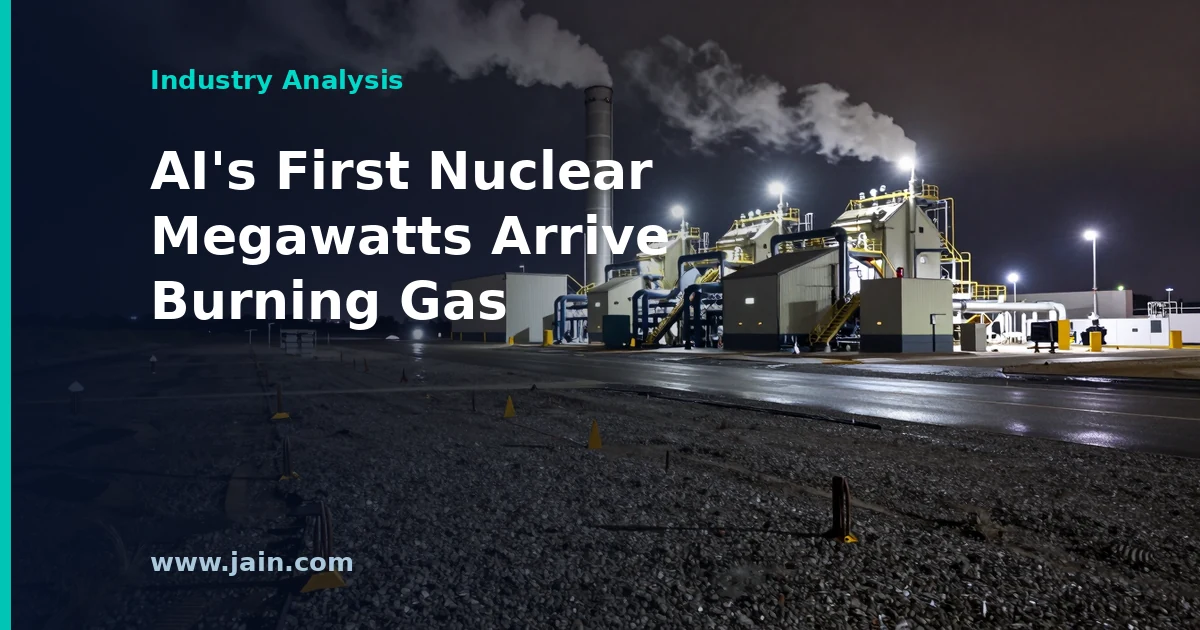
EnergyTech reported that North Carolina-based startup Blue Energy has submitted its first construction permit application to the U.S. Nuclear Regulatory Commission for a hybrid gas-and-nuclear generating station at the Port of Victoria, Texas. The project would pair a GE Vernova 7HA.02 gas turbine with the GE Vernova-Hitachi BWRX-300 small modular reactor, building toward a 2.5-gigawatt plant by the early 2030s that would serve an AI data center — an “AI factory” — developed by Crusoe, along with other loads.
The build is staged. Phase one centers on the gas turbines, which the company says are the quickest to install and commission, targeted for the end of this decade. Phase two would add perhaps five BWRX-300 units, each generating close to 300 megawatts at capacity, with the gas units eventually phased out or reduced. Blue Energy estimates project cost at more than $6 billion, with Société Générale acting as lead financial advisor.
Executive Summary
The filing is a procedural milestone rather than a construction start, and that distinction matters. No small modular reactor has been fully approved or begun construction in the United States. Federal applications of this kind typically take years to move through technical and environmental review before a permit issues. Blue Energy is entering a queue that also contains the Tennessee Valley Authority’s BWRX-300 application at Clinch River — which GE Vernova Hitachi says is approaching a decision — and applications from other developers including X-energy.
What makes the Victoria project analytically interesting is not the reactor. It is the sequencing. A 2.5-gigawatt site whose first phase is combustion turbines and whose second phase is five reactors is, for the first several years of its operating life, a gas plant with a nuclear option attached. If roughly five units at close to 300 megawatts each eventually arrive, that implies on the order of 1.5 gigawatts of nuclear capacity and the balance from gas — meaning the gas fleet is not a token bridge but a substantial share of the nameplate.
For GE Vernova, the strategic value is fleet economics: the same reactor design, the same licensing work and the same supply chain applied across multiple sites, so that each project is cheaper and faster than the last. For data center developers, the practical value is that a credible nuclear pathway may make a gas-first interconnection easier to defend to customers and communities that have made carbon commitments.
The Permit Is Nuclear. The First Electrons Are Gas.
Read the phasing literally. Blue Energy says phase one focuses on the gas turbines because they are the quickest to install and commission, with a target of the end of this decade. Phase two would add perhaps five BWRX-300 reactors, each producing close to 300 megawatts — a megawatt being roughly the power draw of a few hundred homes, and 300 megawatts being enough for a serious data center campus on its own. The total plant is described as 2.5 gigawatts by the early 2030s. Subtract the nuclear arithmetic from the total and roughly a gigawatt of gas-fired capacity is carrying the site before the reactors show up, and continuing alongside them after.
That is the operational conclusion buried in an otherwise routine regulatory filing. Crusoe’s AI factory, if it energizes on the announced schedule, will be a nuclear-adjacent load long before it is a nuclear-powered one. Nobody has misstated this — the release is explicit that gas comes first and that the gas units would later be “phased out or reduced.” But the framing of hybrid gas-nuclear projects generally, and the headlines they generate, tend to lead with the reactor rather than with the turbine that will actually be spinning in 2030.
Who this affects: any hyperscaler or AI developer signing power agreements against projects like this one needs to price two different assets. The near-term asset is dispatchable gas generation with commodity and emissions exposure. The long-term asset is a first-of-a-kind reactor deployment with schedule and licensing risk. Blending them into one “clean firm power” line item on a sustainability disclosure understates the first and overstates the certainty of the second. The honest version is that gas is buying time for nuclear to clear regulatory review — which is a defensible strategy, just not the same claim.
Fleet Licensing Is the Product GE Vernova Is Actually Selling
Jason Cooper, CEO of GE Vernova Hitachi Nuclear Energy, framed the Blue Energy filing around repeatability: “This is what fleet deployment looks like: projects advancing on common technology, licensing work and supply chain capabilities, allowing us to apply lessons from one project to the next.” That sentence is the commercial thesis of the entire small modular reactor category, compressed.
Conventional nuclear construction in the United States has been defeated less by physics than by one-off engineering. Every plant a bespoke design, every licensing review starting near zero, every supply chain assembled and then dispersed. The BWRX-300 bet is that if the same design goes through the Nuclear Regulatory Commission repeatedly — Clinch River with the Tennessee Valley Authority, now Victoria with Blue Energy — the review gets shorter, the vendors keep their tooling, and the crews carry experience forward. Blue Energy’s Jake Jurewicz echoed the point, saying the team moved from technology selection to construction permitting “in a matter of months.”
The claim is plausible and, so far, unproven at the only point that counts: a completed unit. Nothing in the release establishes that the second application will be reviewed faster than the first, or that fabrication cost falls on unit two. Investors and buyers should watch the Clinch River decision closely, because it is the first real data point on how much of the fleet argument the regulator is prepared to credit.
More Than $6 Billion, and the Project-Finance Test
Blue Energy puts the project above $6 billion and has engaged Société Générale as lead financial advisor. Kim Hill, the bank’s transaction lead, described the mandate as a step toward deploying private capital markets for advanced nuclear “just like it has for wind, solar, and battery technologies.” That comparison is the tell. Wind, solar and storage became bankable because their capital costs are predictable, their construction windows are short, and their revenue is typically locked to long-term contracts before anyone breaks ground.
Advanced nuclear does not yet satisfy the first two conditions in the United States — no unit has been built to prove them. Which is another reason the gas-first phasing is more than an engineering convenience: turbines are a financeable, well-understood asset class with an established construction schedule, and early cash flow from gas generation changes the risk profile a lender sees when it underwrites the reactors behind it. The strategic investor list, which includes Constellation Technology Ventures, VXI, Engine Ventures, At One Ventures and Tamarack Global, reflects venture-stage risk tolerance; a $6 billion project needs a different class of capital entirely.
Why the Load Growth Argument Has Real Force — and Its Limits
Nuclear supplies about 18% of the U.S. utility-scale electricity mix, and the fleet spent years under pressure from operating costs, cheap gas, renewables and, critically, flat demand. Data center growth has reversed the demand assumption, and the industry’s argument is that carbon-free baseload — power that runs continuously rather than when the wind blows — is the natural answer for loads that run at high utilization around the clock.
The counterargument, which the release also records, is that nuclear projects remain expensive, slow and contested on health and safety grounds. Both positions can be evaluated on evidence rather than assertion, and the evidence arrives on a schedule: permit decisions, construction starts, and the first concrete date. Until then, the sharpest thing to say about Victoria is that it is a credible attempt at a genuinely difficult sequencing problem — build generation fast enough for AI load that exists now, while licensing generation clean enough for the commitments that load has already made.
Background
Blue Energy is a North Carolina-based startup pursuing what it describes as a repeatable, rapidly built approach to new nuclear construction — EnergyTech has previously reported the company raised $380 million to advance prefabricated reactor construction. It selected the BWRX-300 design earlier this year for co-location with gas turbines and, by its own account, moved from technology selection to federal construction permitting within months.
The BWRX-300 is a boiling water small modular reactor from GE Vernova Hitachi Nuclear Energy, a joint venture between GE Vernova and Hitachi. It is the design furthest along in the U.S. licensing process, through the Tennessee Valley Authority’s Clinch River project, and has been selected by several developers internationally. The broader context is a U.S. power sector that spent a decade planning around flat demand and is now contending with data center and AI load growth that has made firm, round-the-clock generation scarce and valuable again.
Texas cannot connect every giant computer warehouse that wants to plug into its power grid. So the agency running the grid has started rationing, deciding who gets electricity first by paperwork and start dates rather than by who asks loudest.
One company, Cipher, cleared an early hurdle for enough power to run a large city. Its shares jumped about nine percent.
A filing from rival Core Scientific shows the catch. Sites switched on before March 2022 skip the line. Everything newer waits, even after the concrete is poured.
Yahoo Finance reported that shares of Cipher Digital rose roughly 9% after the company received conditional status from the Electric Reliability Council of Texas (ERCOT), the operator of the Texas power grid, for 3.2 gigawatts of capacity in the state, with Core Scientific up about 4% and IREN slightly higher on the same read-across.
The move landed days after Core Scientific furnished an 8-K to the Securities and Exchange Commission on September 10, 2026, disclosing the ERCOT power status of each of its existing and proposed Texas data centers site by site: 371 megawatts at Denton, 600 megawatts at Pecos and 431 megawatts planned at Hunt. That filing is the clearest public description yet of how ERCOT is now sorting large data center loads — and of how much of a miner’s announced capacity is conditional rather than secured.
Executive Summary
The news event is a share price move, but the substance underneath it is regulatory. ERCOT is running an allocation exercise it calls Batch Zero, which assigns large new electrical loads to defined pathways and only releases a final allocation and load ramp when the process concludes. Conditional status inside that process is now the gating item between a developer’s announced gigawatts and energized, billable capacity.
Core Scientific’s 8-K sets out how the sorting works in practice. Denton’s existing 297 megawatts was conditionally approved as “Base Load, Pathway (a)” — longstanding existing load — purely because it energized before March 25, 2022, and is exempt from Batch Zero altogether. A further 74 megawatts at Denton is also exempt, because ERCOT had already incorporated it into the 2025 Regional Transmission Plan study cases. Pecos, by contrast, sits inside Batch Zero: 300 megawatts as “Base Load, Pathway (b)” for load energized after March 25, 2022, and another 300 megawatts as “Studied Load.” Hunt’s planned 431 megawatts qualified under Pathway (e) for demonstrated maturity, which the company earned by completing interconnection studies, clearing a 431-megawatt stability study, posting collateral, ordering long-lead equipment and starting construction.
For anyone buying, financing or underwriting Texas compute capacity, that hierarchy is the story. Two identical 300-megawatt blocks at the same site carry different regulatory certainty because of when they switched on. Cipher’s 3.2 gigawatts of conditional status is a real milestone; it is not the same thing as a final allocation, and the market repriced three companies on the distinction in a single session.
The Scarce Asset in Texas Isn’t a Megawatt. It’s a Date.
Core Scientific’s filing is unusually legible about a mechanism the industry usually discusses in the abstract. At Denton, 297 megawatts of existing power was conditionally approved as “Base Load, Pathway (a)” on one qualification: it was energized prior to March 25, 2022. That single fact takes it outside the Batch Zero allocation process entirely. At Pecos, 300 megawatts of existing power — physically comparable capacity, already operating — was conditionally approved as “Base Load, Pathway (b)” because it energized after that cutoff and before July 10, 2026. It sits inside Batch Zero, and the company states plainly that it will not receive its final allocation and load ramp until the process concludes.
The same asymmetry shows up in a quieter form on Denton’s additional 74 megawatts, which is exempt not because of an energization date but because ERCOT had already validated it inside the 2025 Regional Transmission Plan study cases. Presence in the grid operator’s own planning model functions as an entitlement. This is what makes interconnection paperwork the scarce input: it cannot be bought with capital on a short timeline, it cannot be manufactured, and it is not fungible with megawatts sourced elsewhere.
Run the arithmetic across the three Texas sites and the exposure becomes concrete. Of 1,402 megawatts described in the filing, 371 megawatts — just over a quarter — is outside Batch Zero and effectively settled in status terms. The remaining 1,031 megawatts is conditional and awaiting final allocation. Anyone underwriting Texas capacity, whether a lender sizing a facility, a GPU cloud tenant signing a multi-year lease or an investor modelling ramp, now has to ask which bucket a given block sits in, because the headline gigawatt figure no longer distinguishes them.
Pathway (e) Turns the Queue Into a Capital Test
Hunt is the instructive case, because it shows the alternative route for capacity that has no date advantage. Its planned 431 megawatts was conditionally approved as “Base Load, Advancing Large Load, Pathway (e)” — demonstrated maturity and advancement through the interconnection process. Core Scientific earned that by doing five specific things: completing interconnection studies with its utility partner, obtaining ERCOT approval of a 431-megawatt stability study, posting financial collateral, ordering long-lead equipment, and commencing construction.
That is a queue that rewards irreversible spend. Long-lead equipment orders — transformers, switchgear, generation and cooling plant — are placed years ahead and are difficult to cancel cleanly. Posting collateral ties up cash. Starting construction commits site capital before final allocation is known. The effect is to sort applicants by balance sheet and by willingness to accept sequencing risk, which advantages incumbent operators with existing land, utility relationships and financing access, and disadvantages speculative filings that exist mainly to hold a position.
The policy logic is defensible: a queue clogged with phantom load helps nobody, and requiring proof of advancement filters it. The commercial consequence is that developers must now fund a substantial portion of a project before they know what load ramp they will be granted. That is a materially different risk profile from the pattern of the past several years, and it is a cost that eventually shows up in the price of Texas capacity.
Why Three Companies Repriced on One Company’s Filing
Cipher’s 9% move, Core Scientific’s 4% and IREN’s smaller gain describe a market re-rating regulatory position rather than operating performance. Nothing about hash rate, bitcoin price or a new customer contract changed that day. What changed was information about who is likely to be allowed to energize large load in ERCOT, and the read-across was applied to peers with Texas portfolios.
The spread between those moves is worth reading carefully rather than dramatically. A one-day share price reaction is not a valuation, and conditional approval is several steps short of revenue. The chain runs: conditional status, then final allocation and load ramp, then energization, then a signed tenant, then billable capacity. Core Scientific’s own history illustrates the far end of that chain — its February 2025 expansion with CoreWeave added 70 megawatts of contracted power at Denton, took the site to 260 megawatts of critical IT load, brought CoreWeave’s contracted total across six locations to 590 megawatts, and carried an expected $10.2 billion of revenue over 12-year contract terms against $104 million of company capital expenditure. Note that critical IT load and electrical power are different measures, the former excluding cooling and electrical overhead, so the 260-megawatt figure and the filing’s 297 megawatts are not directly comparable.
There is a neat coincidence in that pairing: Denton, the site carrying the deepest contractual commitment, is also the site with the cleanest queue position. That is the combination the market is now hunting for, and it is rarer than announced gigawatt totals suggest. Capacity that is both contracted and exempt from allocation risk is the genuinely scarce product; capacity that is conditional and uncontracted is an option on a process whose conclusion has not been dated publicly.
Background
Bitcoin miners built large, power-hungry sites in Texas over the past decade because the state combines abundant generation, an independent grid and a market that rewards flexible load. After the 2024 halving cut mining rewards, several of those operators pivoted their footprints toward hosting artificial intelligence and high-performance computing, where tenants pay long-term contracted rates rather than exposing the operator to commodity price swings. Core Scientific’s February 2025 Denton expansion with CoreWeave was an early template: $1.2 billion of investment, 70 additional megawatts of contracted power, and a stated intent to run 900 megawatts of its contracted capacity as HPC hosting against 400 megawatts of mining.
The constraint on that pivot has shifted from capital to connection. As requests for hundreds of megawatts per site multiplied, ERCOT moved to formalise how large loads are approved and sequenced, creating the pathway definitions and the Batch Zero allocation process that Core Scientific’s September 10 filing describes. The practical effect is that a developer’s position in that process — its energization dates, its completed studies, its posted collateral, its presence in the grid operator’s transmission planning model — now determines how much of its announced capacity it can actually energize, and when.
GE Vernova, an American company that builds some of the world’s biggest power-plant machinery, has agreed to supply gas turbines to B.Grimm Power, a Thai electricity company.
Gas turbines are giant spinning machines that burn natural gas to make electricity. Right now they are hard to get. Tech companies building huge computer warehouses for artificial intelligence have been lining up for them.
This deal shows that buyers in Southeast Asia are joining that same line. That matters for how quickly the region can add the power its factories, cities and computer centers need.
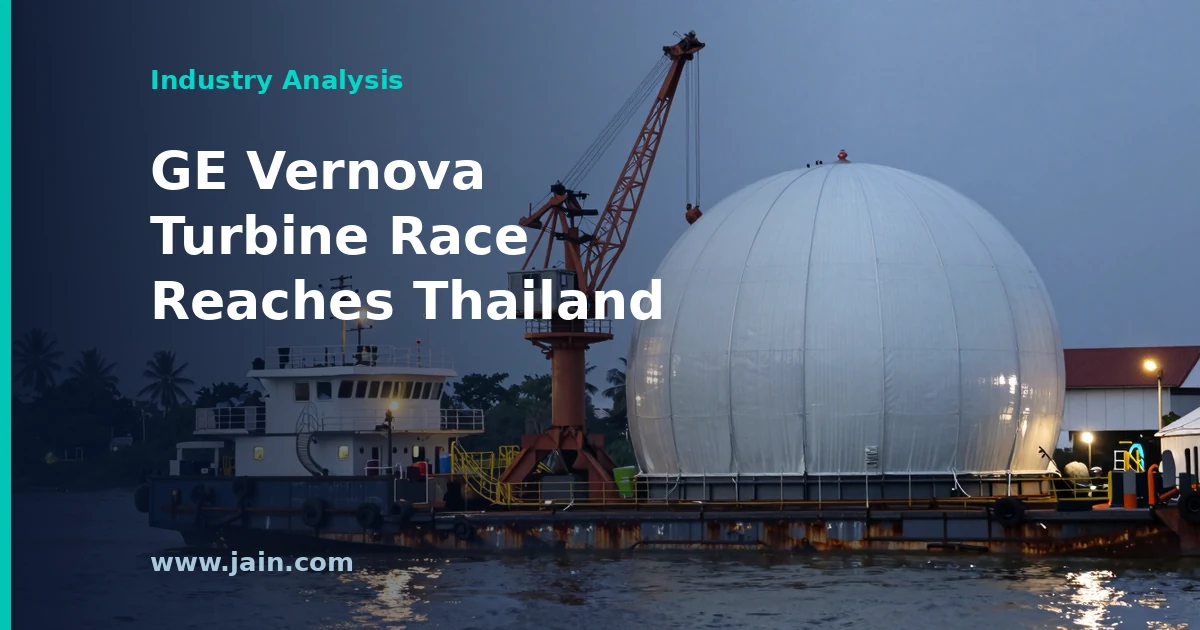
GE Vernova, the US energy equipment maker spun off from General Electric in 2024, and Thailand’s B.Grimm Power have signed agreements for the supply of gas turbines, Reuters reported. B.Grimm Power is one of Thailand’s established private electricity producers.
The companies have not publicly detailed the number of turbines, their generating capacity, the contract value, delivery dates or the specific power plants the equipment will serve.
Executive Summary
The agreement pairs one of the world’s three dominant makers of large gas turbines with a Thai power producer. It lands at a moment when turbines have become one of the tightest bottlenecks in energy infrastructure. In the United States, electricity demand from data centers, the large buildings full of servers that run cloud services and artificial intelligence, has helped fill manufacturers’ order books and lengthen wait times for new units.
The deal matters less for its size, which has not been disclosed, than for where it is. Securing turbine supply from a manufacturer in high demand shows that Southeast Asian generators are competing for the same limited factory output as American utilities and data center developers. For buyers of power across the region, including industrial parks and the digital infrastructure companies expanding there, the pace at which firms like B.Grimm can get equipment will shape how quickly new capacity can come online.
For GE Vernova, international orders spread its exposure beyond the US data center boom. They also typically bring decades of follow-on service work, because turbines need regular maintenance and upgrades across their operating lives.
The Turbine Queue Has No Borders
Large gas turbines, the jet-engine-like machines at the heart of most modern gas power plants, come mainly from three manufacturers: GE Vernova, Siemens Energy and Mitsubishi Power. Their factories cannot expand quickly. Turbine components need specialized castings, high-temperature alloys and skilled labor, so production capacity has lagged the jump in orders driven by electrification, manufacturing growth and data centers.
That scarcity turns every order into a claim on a finite production schedule. A utility in Texas, a data center developer in Virginia and a power producer in Thailand are in effect bidding for the same manufacturing slots. The B.Grimm agreements show that Asian buyers are not waiting for the US rush to cool before securing equipment. They are locking in supply alongside American customers.
The practical consequence is that the AI-driven demand story is no longer only a US grid issue. When one region absorbs a large share of global turbine output, lead times and pricing pressure spread to every other market that depends on the same suppliers.
Why Gas, and Why Thailand
Thailand generates the largest share of its electricity from natural gas, and B.Grimm Power built its business on gas-fired plants that sell electricity and steam to industrial estates, alongside a growing renewables portfolio. For a producer with that model, reliable turbine supply is core to growth and to replacing or upgrading aging units.
Southeast Asia has also become a destination for data center construction and for manufacturers diversifying their supply chains. Both need electricity that is available around the clock. Solar and wind are expanding across the region, but gas plants remain the main source of firm, dispatchable power, meaning output that operators can switch on when demand requires it. The companies have not said whether any of this turbine supply is tied to data center or other specific customers, so the link to digital infrastructure demand is a market context, not a disclosed purpose of the deal.
Gas also carries risks for Thailand. As domestic gas fields mature, the country leans more on imported liquefied natural gas, whose prices can swing sharply. New gas capacity is typically expected to run for decades, which raises questions about fuel cost exposure and about fit with long-term decarbonization goals.
What It Signals for GE Vernova and Its Rivals
For GE Vernova, orders from Asian independent power producers diversify a gas business whose recent momentum has been closely associated with US demand. The sale of a turbine is often only the start of the revenue. Long-term service agreements, which cover inspections, parts and performance upgrades, can generate income for the life of the plant and are frequently more profitable than the equipment itself. The companies have not said whether such service terms are part of these agreements.
In a seller’s market, manufacturers generally gain leverage over price, delivery terms and contract structure. Buyers that commit early may secure better positions in the queue, while those that hesitate risk longer waits. Competitors Siemens Energy and Mitsubishi Power face the same capacity constraints, which limits how much buyers can gain by shopping around.
Background
GE Vernova was formed from General Electric’s power, wind and electrification businesses and began trading as a standalone company in April 2024. Its gas power unit has been a major beneficiary of rising electricity demand, as utilities and developers order new plants to serve data centers, manufacturing and the broader shift toward electrification. Along with Siemens Energy and Mitsubishi Power, it is one of a small number of manufacturers capable of building large, utility-scale gas turbines.
B.Grimm Power is a Thai independent power producer and part of the B.Grimm group, a business with roots in Thailand dating to the 19th century. The company grew by building gas-fired cogeneration plants, which produce both electricity and steam, for customers in industrial estates, selling power to industrial users and to Thailand’s state grid operator. It has since expanded into renewable energy and projects in neighboring countries.
A South Korean company called FuriosaAI, which designs computer chips for running artificial intelligence, has installed its equipment in a large rented data center in Lisbon, Portugal.
Almost all artificial intelligence today runs on chips from one American company, Nvidia. FuriosaAI wants to offer European businesses and governments another option, one that keeps their data physically inside Europe.
If challengers like this gain ground, Europeans could get more choice over who powers their artificial intelligence and where their information lives.
BigGo Finance reported that FuriosaAI, a Seoul-based designer of AI accelerator chips, has deployed inference servers at an Equinix data center in Lisbon, Portugal. The company is targeting Europe’s sovereign AI market: organizations that want AI workloads to run on infrastructure located, and legally governed, inside Europe.
No deployment size, power capacity, customer names, launch date or commercial terms have been made public.
Executive Summary
FuriosaAI is placing its own inference hardware inside Equinix, one of the world’s largest colocation providers. Inference is the everyday work of running a trained AI model to answer questions or generate text, as opposed to training the model in the first place. Colocation means renting space, power and network connections in a shared data center rather than building one.
The move matters because it follows a pattern: chip challengers to Nvidia are using neutral, well-connected colocation sites as showrooms and on-ramps to regional markets. For European buyers weighing data residency rules and concerns about dependence on a single supplier, a locally hosted non-Nvidia option is worth watching. How significant this particular deployment is depends on details the companies have not yet disclosed.
Inference Is Where Challengers Can Compete
Training frontier AI models remains overwhelmingly an Nvidia business, anchored by its CUDA software ecosystem and years of developer familiarity. Inference is a different contest. Once a model is trained, operators care most about cost per query, latency and electricity use, and those metrics give specialized chips room to argue their case. FuriosaAI’s pitch, like that of several rivals, centers on running popular open models efficiently rather than matching Nvidia across every workload.
The economics favor that focus. Inference demand grows with every deployed chatbot, search feature and enterprise assistant, and it runs continuously rather than in one-off training runs. A chip that meaningfully lowers power per query can matter more to a data center operator’s bills than raw peak performance. Whether FuriosaAI’s hardware delivers that advantage at production scale is the claim buyers will want to verify with their own models.
Colocation as a Market-Entry Shortcut
For a hardware startup, building data centers across Europe is out of reach. Placing servers in an Equinix facility provides immediate access to power, cooling, security and, crucially, direct network connections to the enterprises, cloud providers and carriers already housed there. Prospective customers can test the hardware with low latency, without shipping equipment to their own sites or committing to a new cloud vendor.
Equinix benefits too. Colocation providers increasingly compete on the ecosystems they host, and a range of accelerator options gives tenants reasons to stay and expand. Chips marketed on power efficiency may also fit more easily into existing data halls than the densest GPU clusters, which increasingly require liquid cooling retrofits. That is a practical advantage if it holds, though no power or rack-density figures have been published for this deployment.
What Sovereign AI Actually Means Here
Sovereign AI has become a broad label covering data residency, legal jurisdiction, operational control and supply-chain independence. European demand is real, shaped by GDPR, the EU AI Act and public-sector reluctance to depend entirely on US platforms. A deployment on Portuguese soil addresses the first of those concerns: data can stay in the EU.
The other dimensions are less clear-cut. The chips come from a South Korean designer, the facility is operated by a US-headquartered company, and advanced chip manufacturing remains concentrated in Asia. None of that disqualifies the offering, since few AI stacks anywhere are fully domestic, but buyers should ask which layer of sovereignty is being delivered. Diversifying away from a single dominant chip supplier is itself a form of resilience that some European buyers value, regardless of where that supplier is based.
Why Lisbon, and What It Signals
Lisbon is not one of Europe’s traditional data center hubs of Frankfurt, London, Amsterdam, Paris and Dublin, where power and land constraints have tightened. Portugal offers a strong renewable electricity mix and sits at a landing point for subsea cables linking Europe with Africa, the Americas and beyond. For AI inference, which benefits from proximity to users but not necessarily to the largest hubs, secondary markets with available power are increasingly attractive.
The choice may also reflect pragmatism: a smaller market can offer faster access to capacity and a less crowded field. The trade-off is a thinner local customer base than in the core hubs, so the deployment’s commercial value will depend on whether it serves as a pan-European access point or mainly a regional one.
Background
FuriosaAI was founded in Seoul in 2017 to design dedicated AI accelerators. It is one of a cohort of chip startups trying to capture part of the fast-growing inference market, where efficiency and cost can matter more than the raw training performance that made Nvidia dominant. Its current product line centers on its RNGD inference chip, marketed for running large language models with lower power consumption.
Equinix is among the largest colocation and interconnection providers globally, operating data centers across dozens of metropolitan areas. Its facilities are valued less for floor space than for the density of networks, clouds and enterprises connected inside them. In Europe, demand for sovereign AI, meaning AI infrastructure kept within European jurisdiction, has grown alongside regulation and concerns about dependence on non-European technology providers.
Hut 8, a company that started out mining bitcoin, has filed plans with Texas for a $399 million computer building near Corpus Christi. It would cover about as much floor space as 11 football fields.
The building is part of a much larger site built to run artificial intelligence systems, tied to about $20 billion in long-term deals involving chipmaker Nvidia and the artificial intelligence companies Lambda and Anthropic.
Why it matters: sites like this use as much electricity as a city, and Texas is now asking whether its power grid and water supply can keep up.
Construction Review reported on September 15, 2026 that Hut 8 Corp. has submitted state filings for a $399 million, 657,130-square-foot data center at its Beacon Point campus in Nueces County near Corpus Christi, Texas. The facility is designed for artificial intelligence training and inference workloads and is linked to 704 megawatts of contracted capacity that the report values at nearly $20 billion in long-term contracts. Nvidia leases the facility, according to the report, in an arrangement under which Lambda supplies AI computing power to Anthropic.
The filing lands while Texas Governor Greg Abbott has ordered a full audit of the state grid and a temporary halt to new large-load connections until developers confirm land rights, permits, water use and financial backing. The project is under regulatory review.
Executive Summary
Hut 8 has moved Beacon Point from a capacity figure to a building. The $399 million state filing describes a single large facility, purpose-built for AI rather than general-purpose colocation (renting space, power and cooling to many tenants), inside a campus whose contracted value is put at roughly $20 billion. For a company with roots in bitcoin mining, the filing is a tangible step in turning secured power into long-term, contracted AI infrastructure revenue.
The announcement matters for two reasons. First, it shows how AI capacity is now being assembled: a site developer controls land and power, a chipmaker leases the building, a cloud provider sells computing time, and an AI lab consumes it. Second, it collides directly with Texas’s new scrutiny of data centers. Contracted megawatts are only valuable if the grid can deliver them, and the state’s verification demands on land, permits, water and financing now sit squarely in Beacon Point’s path.
What $399 Million Buys, and What It Does Not
The $399 million figure is a construction value for one facility, not the price of the campus. Divided across 657,130 square feet, it works out to roughly $607 per square foot. Divided across 704 megawatts, it is under $600,000 per megawatt, which is unlikely to represent the full cost of delivering that much AI-ready power once electrical systems, cooling, grid upgrades and computing hardware are counted. Readers should treat the filing as a marker of physical progress on one building rather than a measure of total capital at stake.
The $20 billion number is a different kind of metric again: the value of long-term contracts attached to the capacity, not a construction budget. Spread across 704 megawatts, that is roughly $28 million of contracted value per megawatt, a figure that implies multi-year commitments. The distinction matters, because contract value speaks to revenue potential while construction value speaks to what must be built and financed first.
A Layered Deal That Spreads Roles and Concentrates Exposure
As described, Beacon Point runs through a chain of parties. Hut 8 develops the campus, Nvidia holds the lease and provides chips, Lambda sells computing capacity, and Anthropic is the end consumer of that capacity. This kind of structure is increasingly common in AI infrastructure: each party takes the slice of risk it is best placed to carry, and the developer gains a creditworthy tenant rather than betting on speculative demand.
The same structure also concentrates exposure. Each link depends on the next. If AI demand from a single end user shifts, or contract terms are renegotiated anywhere along the chain, the effects flow back to the landlord. For Hut 8, the strength of the arrangement ultimately rests on the specific lease terms with its direct counterparty, which have not been published. The reported figures also describe both a 704-megawatt contracted capacity and a 700-megawatt campus, and the relationship between this one building and the campus-wide total is not spelled out.
Texas Is Changing the Rules for Big Power Users
Texas has been a magnet for data centers because of available land and a grid, run by ERCOT (the Electric Reliability Council of Texas), that historically connected large customers comparatively quickly. That advantage is now under pressure. ERCOT’s interconnection queue, the waiting list of projects seeking a grid connection, holds hundreds of gigawatts of data center requests, more than the state’s entire peak demand. Many of those requests will never be built, but regulators cannot easily tell which.
The governor’s audit and connection pause is effectively a filter: prove you have the land, permits, water and money, or wait. For well-capitalized projects with real tenants, that filter could help by clearing speculative requests from the queue. For every project, it adds time and uncertainty. A 704-megawatt load needs substantial grid upgrades and firm power supply commitments, and water consumption for cooling is explicitly on the evaluation list. Beacon Point’s contracts give it a stronger story than a speculative filing, but contracts do not substitute for delivered electricity.
Who Gains, and What Could Slow It
If Beacon Point clears review, Hut 8 gains a flagship example of the developer model it has been pursuing, and the Corpus Christi area gains a major construction project and a long-lived industrial facility. Nvidia and Lambda gain dedicated capacity at a time when power-ready sites are scarce. The broader signal for the industry is that land and power alone are no longer enough in Texas; verifiable financing, permits and resource plans are becoming the price of admission.
The main risks are timing and resources. A prolonged pause, costly grid upgrades, or water constraints could push back energization, the point at which a site receives power and starts earning. Local stakeholders will reasonably want clarity on water use and grid impact, while the companies will want certainty that contracted revenue materializes on schedule. Both sets of questions deserve answers backed by specifics rather than headline figures.
Background
Hut 8 Corp. built its business on bitcoin mining, an activity that requires large amounts of cheap, reliable electricity. That experience in securing power and sites has become valuable as artificial intelligence drives demand for data centers that can draw hundreds of megawatts. Like several former miners, Hut 8 has been repositioning toward developing and leasing power-ready infrastructure for AI and high-performance computing customers.
AI data center deals increasingly involve several layers of participants: site developers, chipmakers, specialist AI cloud providers and AI labs. Texas has been a leading destination for these projects, but the scale of demand has strained the ERCOT grid’s planning process, prompting state leaders to demand proof of land, permits, water and financing before connecting new large loads.