A giant battery site in Moss Landing, California, caught fire again on Friday. The owner is Vistra, a large power company. The site uses batteries to store electricity for the grid, and it already burned badly in January 2025.
This time about 1,500 battery packs caught fire. They had been unplugged from the grid after the last fire, but they still held a charge. About 106 nearby residents were told to stay indoors.
This matters because power companies and huge computing centers are counting on big batteries to keep the lights on. A battery that has been switched off can still catch fire.
A fire broke out shortly after 6:15 a.m. on Friday, September 18, 2026, at Vistra’s battery storage facility in Moss Landing, California, the Salinas Californian reported. It started in the Moss 300 building, the same structure heavily damaged in the January 2025 fire. North Monterey County Fire District Chief Jess Cortez said the fire involved the roughly 1,500 battery modules left on the building’s north side. By a noon briefing there was no active flame. The site was “hot and smoldering” and expected to burn out within 24 hours, with drones checking battery temperatures.
A shelter-in-place order covered about 106 residents within a third of a mile of the plant, and Dolan Road stayed closed near the site. Vistra temporarily shut down the natural gas plant on the same property as a precaution. No injuries were reported. Air monitors detected some fine particulate matter (PM 2.5), but none above screening levels, and no hydrogen fluoride.
Executive Summary
This is the second fire in about 20 months at one of the world’s best-known grid-scale battery sites. The detail that matters most is where it happened. Vistra plant manager Ron George said the modules that burned were idle and disconnected from the grid, but still energized, inside a unit Vistra has already retired and is remediating with the U.S. Environmental Protection Agency.
For utilities and data-center developers who plan to use large batteries as “firming” capacity, meaning storage that fills gaps when solar, wind or other supply falls short, the lesson is about the full life of the asset. A battery that has left service can still hold energy and still ignite. The cleanup phase therefore carries its own safety, siting and insurance risk. Vistra also shut down the neighboring gas plant as a precaution, which shows how a battery incident can reach other generation on the same site.
Both Vistra’s investigation into the cause of the January 2025 fire and a California Public Utilities Commission investigation are still open. A second fire has now occurred before either has reported a root cause.
Retired Is Not the Same as Safe
The headline fact is simple. The 1,500 modules that burned on September 18 were not delivering power to anyone. George said they were idle and disconnected from the grid but still energized. The Moss 300 unit was retired after the 2025 fire, and Vistra is working with the EPA on remediation. The modules that burned were sitting in a damaged building while that cleanup was under way.
This is how lithium-ion storage behaves in general. Unplugging a battery from the grid stops it from trading power, but it does not remove the chemical energy stored in its cells. Until modules are discharged, removed or otherwise made safe, a damaged battery building remains a hazard. Operators usually model safety risk during commercial operation. Moss Landing shows that the period after an asset stops earning revenue can carry comparable risk, and the local community still bears it.
That changes the math for anyone buying storage-backed power. A data-center operator or utility signing a long-term capacity contract is exposed to more than the chance that a battery fails during its service life. It is also exposed to how long a failed asset takes to wind down, and to what happens to neighboring assets while it does.
One Fire, Two Assets Offline
Vistra shut down the onsite natural gas plant “out of an abundance of caution.” Co-locating batteries with existing generation is attractive because it reuses grid connections, land and permits that took years to secure. Moss Landing shows the other side of that choice. An incident at the battery portion of a site can take down generation that has nothing to do with the batteries, at least temporarily.
This correlation is directly relevant to AI infrastructure planning. Large computing campuses increasingly look for power from sites that pair several resources: gas, storage and solar. The goal is reliability through diversity. If one resource’s safety incident forces a precautionary shutdown of another, the reliability benefit of pairing them is smaller than it appears on paper. Buyers need to know how often that can happen and how long it lasts.
Safeguards Worked, but Answers Are Still Pending
Parts of the response went well. After the 2025 fire, the Monterey Bay Air Resources District oversaw installation of six additional air sensors. Four sit at the facility fence line, one at Elkhorn Elementary School and one at a nearby boatyard. Officials reported fine particulate readings within health standards and no hydrogen fluoride, a toxic gas that burning lithium-ion cells can release. Schools outside the shelter zone lifted their own orders the same day. No one was hurt.
The monitoring also has limits. The air district’s Richard Stedman said the sensors are not testing for heavy metals, “although we would expect that to be in the smoke.” And the core question from 2025, why the original fire started, remains open in both Vistra’s investigation and the CPUC’s. Without a published root cause, other operators, insurers and permitting authorities cannot yet say which design, spacing or suppression changes would prevent a repeat. The industry is still waiting for that input to its siting and insurance decisions.
Background
Vistra Corp. is a large U.S. power producer. At Moss Landing on California’s Monterey Bay, it built one of the world’s largest battery energy storage installations next to an existing natural gas power plant, reusing the site’s grid connections. The batteries charge when power is abundant and discharge when California’s grid needs extra supply, often in the evening as solar output fades.
In January 2025 a major fire damaged the facility’s Moss 300 building, which Vistra has since retired. After that fire, the Monterey Bay Air Resources District oversaw installation of six additional air monitoring sensors around the site and the community. Vistra and the California Public Utilities Commission are each still investigating the 2025 fire’s cause.
Pennsylvania’s environmental regulator has approved how the Three Mile Island nuclear plant may use river water if it restarts. The plant’s power has been promised to Microsoft to help run its computer centers.
On its busiest days the plant could draw up to 73 million gallons from the Susquehanna River, enough to fill more than 100 Olympic swimming pools. About 21 million gallons a day would turn to steam and not return.
The takeaway: reviving old nuclear plants for artificial intelligence depends on rivers and fish, not just reactor safety.
The Pennsylvania Department of Environmental Protection (DEP) has issued a Section 401 Water Quality Certification for restarting Constellation Energy’s Three Mile Island nuclear plant in Londonderry Township, Dauphin County, PA Environment Digest reported on September 18, 2026. Notice of the decision appears in the September 19 edition of the Pennsylvania Bulletin, the state’s official register.
The certification covers water withdrawals from the Susquehanna River of up to 73.2 million gallons per day on a peak day, consumptive use of up to 21 million gallons per day, and heated-water discharges back to the river at a maximum of 110°F. Anyone aggrieved by the decision has 30 days from the notice to appeal to Pennsylvania’s Environmental Hearing Board.
Executive Summary
A Section 401 certification is the state’s formal finding that a federally licensed project will meet state water quality standards. For a nuclear plant, the federal license comes from the Nuclear Regulatory Commission (NRC), and under the federal Clean Water Act that license cannot take effect for an activity discharging into U.S. waters unless the state certifies it or waives its right to do so. DEP’s action therefore removes a state-level condition on the path to restarting Unit 1, the reactor Constellation has agreed to run for Microsoft under a 20-year power purchase agreement announced in 2024.
The certification also puts hard numbers on the restart’s physical footprint. The plant expects to withdraw up to 73.2 million gallons a day at peak and consume up to 21 million gallons, water lost to evaporation in cooling towers rather than returned to the river. DEP concluded that closed-cycle cooling will minimize harm to fish drawn into or trapped against the intake.
The decision is not yet final in a practical sense: the 30-day appeal window is open, and the certification is one of several approvals a restart needs. But it shows that the fastest route to firm, carbon-free power for AI, reviving a plant that already exists, still runs through water regulators.
Why a Water Permit Gates a Reactor Restart
Most coverage of nuclear power for AI focuses on the NRC, which judges whether a reactor is safe to operate. The Three Mile Island certification highlights a second, parallel track. A steam-cycle power plant is, in large part, a machine for moving heat into water: it pulls water from a river, uses it to condense steam, and either evaporates it through cooling towers or sends it back warmer. Every one of those steps touches state water quality law.
DEP’s notice identifies three impacts it had to weigh: withdrawal from the Susquehanna, consumptive use, and thermal discharge into a river designated for warm water fishes and migratory fishes. The figures are specific. Peak withdrawal of up to 73.2 million gallons a day, consumptive use of up to 21 million gallons a day, and a discharge temperature ceiling of 110°F. Those numbers define what the restarted plant is permitted to do, and they are set by the state, not by the NRC or the power buyer.
This is the mechanism behind the headline. A restart deal with a technology customer creates the demand; a reactor license makes operation legally possible; but without the water certification, the federal license cannot rest on a finding that state water standards will be met. For the developers, utilities and hyperscalers (the largest cloud operators) counting on restarts to bridge the AI power gap, water approvals belong on the critical path alongside nuclear safety reviews.
The Consumptive-Use Number Is the One to Watch
The 73.2-million-gallon withdrawal figure is the larger number, but the 21-million-gallon consumptive-use figure is arguably the more consequential. Consumptive use is water that does not return to the river, mostly because it evaporates from cooling towers. In a closed-cycle system, the plant recirculates water through towers instead of passing river water through once and discharging it, which sharply cuts withdrawals and the number of fish pulled into the intake (entrainment) or pinned against screens (impingement). The trade-off is that evaporation is built into the design.
That matters most in dry, hot periods, when river flows drop and every user of the basin competes for the same water. The release does not describe any low-flow conditions attached to the certification, which is why the full certification document, available from DEP’s Southcentral Regional Office, will be of interest to other water users downstream and to anyone modeling the plant’s summer availability.
Pennsylvania’s Grid Stress Raises the Stakes
The certification arrives in a week that illustrates why firm generation is valuable in Pennsylvania. PJM Interconnection, the grid operator for Pennsylvania and 12 other states plus Washington, D.C., issued maximum generation and load management alerts for September 17 amid hot weather and 35,000 megawatts of maintenance outages, and a Pennsylvania Public Utility Commission study warned that rapid data center growth could cause PJM to fail a reliability standard in 2027 absent further action. The same week, DEP opened comment on a water quality permit for an Amazon Data Services campus in Luzerne County and on stormwater permits for PPL Electric transmission projects intended to serve large loads.
Against that backdrop, a restart that returns an existing nuclear unit to service is one of the few supply additions that can arrive on a data-center timeline. But the pattern across these permits is consistent: whether the project is a reactor, a data center or a transmission line, state environmental permits for water and land disturbance are a gating step. Buyers of AI capacity who treat power as purely a contracting or interconnection question are likely to underestimate schedule risk.
Background
Three Mile Island, on the Susquehanna River south of Harrisburg, is best known for the 1979 partial meltdown at Unit 2, the most serious accident in U.S. commercial nuclear history. Unit 2 never reopened, but Unit 1 continued operating until 2019, when it closed for economic reasons. In 2024 Constellation Energy, the largest U.S. operator of nuclear plants, announced a 20-year power purchase agreement with Microsoft tied to restarting Unit 1, renamed the Crane Clean Energy Center.
The deal became a reference point for a broader trend: technology companies seeking around-the-clock, carbon-free electricity for AI data centers are turning to existing nuclear assets because new reactors take many years to build. Pennsylvania sits inside PJM, the largest U.S. grid region, where data center demand growth has become a central reliability and cost concern for regulators.
Shares in two companies building small, factory-made nuclear reactors jumped on Thursday. Oklo rose about 13% and NuScale about 10%.
The trigger was a vote in the US House of Representatives on how to power the huge computer warehouses behind artificial intelligence. The bill does not require anyone to use nuclear power.
That gap matters. Oklo had just arranged to sell up to $1 billion of new stock to fund its reactors. A higher share price means it can raise that money while handing out fewer new shares.
Shares of small modular reactor developers Oklo and NuScale Power rose sharply on Thursday after the U.S. House voted on legislation addressing electricity supply for data centers. Yahoo Finance and 24/7 Wall St. reported Oklo up 13% and NuScale up 10%. TechStock² put the gains at 11% and 9% and reported that the measure stops short of ordering the use of nuclear power. Other nuclear names, including NANO Nuclear Energy and fuel supplier Centrus Energy, also rose.
The rally came one week after Oklo disclosed, in an 8-K filed September 11, an equity distribution agreement with ten banks. The agreement lets it sell up to $1 billion of Class A common stock “at the market,” meaning gradually and at prevailing share prices.
Executive Summary
The House vote gave nuclear equities a policy signal, not a purchase order. The bill as reported does not compel data centers or utilities to buy nuclear power. It does not fund a reactor. It does not change how quickly the Nuclear Regulatory Commission licenses one. Even so, investors marked up the whole small-reactor group in a single session. That shows how much of these companies’ value rests on expectations about Washington’s direction rather than on operating assets. Neither Oklo nor NuScale yet runs a commercial reactor in the United States.
For Oklo, the timing turns a sentiment move into a financing variable. Its new at-the-market program sells shares at whatever the market is paying. A higher price lets the company raise the same dollars while issuing fewer shares, which means less dilution for existing holders. The company can also choose to raise more. For AI data-center developers hoping small reactors will eventually supply firm power, a well-funded developer matters. The capital to build is the first thing between a reactor design and a delivered megawatt.
A Rally on a Signal, Not a Mandate
The central fact of Thursday’s trade is the mismatch between the policy and the price move. The House measure concerns power for data centers, the warehouse-scale computing sites whose electricity demand has climbed with AI training and inference. The measure reportedly does not order that any of that power come from nuclear plants. Investors bid the sector up anyway. The best reading is that the market is pricing direction: Congress is treating data-center power as a legislative priority, and nuclear is the carbon-free, always-on source most often named alongside it.
That is a reasonable thing to be optimistic about, but it is not a revenue event. Small modular reactors (SMRs) are nuclear units far smaller than conventional plants, designed to be built in factories and installed in modules. They still have to clear licensing, secure fuel, finance construction and sign binding power contracts before they produce anything a data center can buy. A vote that addresses none of those steps directly moved the stocks by roughly a tenth. That tells readers more about how these valuations are built than about how soon reactors will run.
Why the Jump Matters Most to Oklo’s Share Sales
Oklo’s September 11 8-K sets out the mechanism. Under the equity distribution agreement, ten banks, including Goldman Sachs, BofA Securities, Citigroup, J.P. Morgan and Morgan Stanley, can sell Class A shares for Oklo in ordinary market trades, block trades or negotiated deals. Sales happen “at market prices prevailing at the time of sale,” up to $1 billion in gross proceeds. Oklo sets a daily maximum and a minimum acceptable price, and pays commissions of up to 1.5%. On the full $1 billion, that would be up to $15 million.
Because the price floats, the share price directly sets the cost of this capital to existing owners. Take any fixed dollar amount raised at a price 13% higher: it requires about 11.5% fewer new shares than it would have the day before (1 divided by 1.13). A policy-driven rally therefore does something concrete for Oklo that it does not do for a company without an open program. It cuts the dilution attached to funding reactor development, or lets Oklo raise more for the same dilution. The 8-K describes the shares as issued off a shelf registration declared effective in December 2025. That means Oklo can act on the higher price without a fresh registration process.
Two caveats keep this honest. Oklo has not said whether it has sold any shares under the program or at what prices. And a price gain built on a signal can reverse as quickly as it came. The benefit is real only for sales made while the higher price holds. Existing shareholders are the other affected party. Every share sold dilutes them, whatever the price.
A Basket Move, Not Company News
The breadth of the rally points to sector sentiment rather than company-specific developments. NuScale filed no material report with the SEC in the days around the vote. NANO Nuclear Energy’s most recent 8-K, filed September 17, reports only routine results from its September 15 annual meeting: six directors re-elected and Withum ratified as auditor. Nothing in that filing concerns the House bill, customers or reactors. When developers at different stages, and a fuel supplier, rise together on the same day, the market is repricing the theme, not the individual businesses.
For data-center developers and hyperscalers, the largest cloud operators, the practical lesson is to separate equity momentum from procurement reality. The gating items for nuclear-supplied AI capacity have not moved: licensed designs, fuel supply, construction financing and signed offtake agreements. Offtake agreements are long-term contracts to buy a plant’s output. A stronger share price can help with one of these, financing, and only for companies positioned to tap it.
Background
Oklo went public in 2024 through a merger with AltC Acquisition Corp., a blank-check company co-founded by Sam Altman. It is developing the Aurora, a compact fast reactor. Its first combined license application was denied by the Nuclear Regulatory Commission in 2022, and it has since been working back through licensing. NuScale Power’s design was the first small modular reactor design certified by the NRC. Its flagship Carbon Free Power Project with Utah municipal utilities was cancelled in 2023 after subscriptions fell short.
Both companies have positioned themselves as future suppliers of firm, carbon-free electricity to data centers, whose power needs have grown quickly with AI workloads. Both remain pre-revenue on commercial reactor sales. That leaves their share prices sensitive to policy news, to financing conditions and to any sign that large power buyers will commit.
Power companies across America are racing to keep up with the giant computer warehouses that run artificial intelligence, which use enormous amounts of electricity.
A new survey of 134 innovation chiefs at American power companies found that most now use artificial intelligence themselves to manage that demand. The catch: 84% say turning a small trial into something used across the whole company takes more than a year, and that delay is getting longer.
Why it matters to you: 83% of those leaders say the cost of serving these warehouses is showing up in household electricity bills.
National Grid Partners, the venture capital and innovation arm of UK and US energy company National Grid, released its third annual Utility Innovation Survey on September 18, 2026, at the NextGrid Alliance Summit in Boston. The survey of 134 innovation leaders at U.S. utilities, collected between May 20 and July 7, 2026, found that 78% are deploying or operationalizing at least one AI application to manage interconnection demand, while 74% say AI-driven data center load growth is affecting grid reliability.
The survey also found that 84% of organizations take more than a year to move projects from pilot to full rollout, up from 66% in 2024, and that grid reliability has overtaken net zero as a top-three priority. National Grid Partners also announced investments in two startups, Terragrit and LineVision, and noted that National Grid has joined the newly formed AI Energy Management Alliance as a founding member.
Executive Summary
The headline number is adoption: nearly four in five U.S. utility innovation leaders say they are putting AI to work on the flood of requests to connect new load, much of it from AI data centers. That is the industry using the technology driving its demand problem as part of the answer to it.
The more consequential numbers sit underneath. Innovation budgets rose at 72% of respondents, yet the share needing more than a year to scale a pilot has climbed for three consecutive surveys, from 66% to 78% to 84%. Most spending (59%) goes to incremental improvements, only 16% to transformational projects, and 87% say regulatory and rate-case frameworks written before the AI demand boom limit returns on innovation.
Taken together, the survey describes an industry that has accepted AI as a grid-planning tool but cannot yet deploy it at the pace data-center load is arriving. For data-center developers, utilities, regulators and ratepayers, the practical constraint is increasingly how fast utilities can change the way they plan, not only how much they build.
The Constraint Is Speed, Not Willingness
The survey rules out the easy explanation that utilities are reluctant to adopt AI. Seventy-eight percent say they are deploying or operationalizing at least one AI application to manage interconnection demand, meaning the queue of customers waiting for permission and capacity to plug into the grid. Seventy-two percent report bigger innovation budgets this year, and only 1% say they have no plans to work with early-stage technology companies.
What has not improved is the time it takes to turn an experiment into standard practice. Eighty-four percent of organizations now need more than a year to move a project from pilot to full rollout, up from 78% in 2025 and 66% in 2024. The trend has worsened for three straight surveys even as money has flowed in, which points to a structural bottleneck rather than a funding one. Respondents cite a shortage of workers skilled in AI and the industry’s traditionally cautious culture, and spending patterns reinforce the picture: 59% of innovation dollars go to incremental improvements against 16% for transformational initiatives.
That matters downstream because 74% of the same leaders say AI data center load is already affecting grid reliability. The pressure is present now; the tools meant to relieve it face a year-plus path to scale at most utilities. Data-center developers waiting in interconnection queues, utility planners fielding large-load requests, and the software vendors selling into utilities all operate on that clock. A tool that could, for example, help a utility study or approve a connection faster only helps once it is embedded in how the utility actually works.
Reliability Moves Ahead of Net Zero
The sharpest year-over-year shift in the survey concerns priorities. Asked to rank organizational priorities, 73% of utility leaders placed reliability in their top three, up from 43% in 2025. Net-zero goals fell from 54% to 16% over the same period.
This is a forced ranking of top-three priorities, so it measures relative emphasis rather than abandonment of climate commitments. Still, a swing of that size in one year is a clear signal about what is occupying planning attention. When a single data-center campus can represent a large new load on a regional system, keeping the lights on becomes the dominant planning question, and decarbonization targets compete for a smaller share of management focus.
Rate Cases Written for a Slower Era
Utilities in the U.S. generally recover investment through rate cases, the regulatory proceedings in which state commissions decide what a utility can charge customers and what return it may earn. Eighty-seven percent of respondents say those frameworks, developed before the current demand boom, are limiting returns on innovation investment. If a software tool that frees up grid capacity earns a utility less than building new poles, wires and substations, the incentive structure itself slows adoption, which is consistent with the lengthening pilot timelines.
The cost question cuts the other way for households. Eighty-three percent of respondents say the cost of building infrastructure to serve AI data centers is being passed on to residential customers through higher bills. That is the view of the utility leaders surveyed rather than a measured cost allocation, and the survey does not quantify it, but it is a notable admission coming from inside the industry, and it frames why regulators are likely to scrutinise who pays for data-center grid upgrades.
Flexible Data Centers as a Grid Resource
National Grid’s answer, alongside its investment activity, is flexibility. The company has become a founding member of the AI Energy Management Alliance, whose announced members include Google, NVIDIA, Anthropic, Emerald AI, RWE, Constellation and NRG. The group says it will push for policies encouraging flexible data centers that automatically reduce power use during peak demand, buffering nearby communities from price spikes.
The supporting evidence cited is a UK pilot last December involving Emerald AI, a National Grid Partners portfolio company, together with National Grid and NVIDIA, which found AI software could cut data center energy use by more than a third in under a minute during simulated grid strain while protecting critical workloads. That is a meaningful proof of concept, though it was a single pilot under simulated conditions. Whether flexibility becomes a dependable planning resource depends on data-center operators contractually committing to curtail, and on utilities trusting those commitments enough to connect load sooner, which brings the question back to how fast planning practices and rules can change.
Background
National Grid supplies electricity and natural gas to more than 80 million people in the UK, New York and Massachusetts, and is running major transmission programmes including the Great Grid Upgrade in the UK and the Upstate Upgrade in New York. Its venture arm, National Grid Partners, launched in 2018, is based in Silicon Valley with offices in Boston, London and New York, and describes itself as the utility industry’s only Silicon Valley-based corporate venture capital group.
National Grid also founded the NextGrid Alliance, which says it includes more than 1,000 senior decision-makers from over 170 utilities in 25 countries and has facilitated more than 500 introductions between utilities and startups. The survey arrives as U.S. utilities face surging requests to connect large AI data centers, a demand shift that is pressing on grid planning, reliability and how infrastructure costs are allocated among customers.
Nvidia, the company whose chips run most of today’s artificial intelligence systems, says it will sell twice as many chips next year as it does this year.
That sounds like it means twice as many data centers, twice the electricity and twice the cooling. It may not. Nvidia’s chips include the one inside the Nintendo Switch 2, plus chips for laptops and robots, and the company does not say how many of each it sells.
The businesses that must supply the power and cooling need that breakdown before they can plan.
Nvidia chief executive Jensen Huang said on Thursday, September 17, that the company will double the number of chips it sells next year, CNBC reported. “I expect Nvidia to sell twice as many chips as this next year as we do this year,” Huang said at a summit on AI safety with King Charles III in Scotland, attended also by representatives of Google DeepMind, OpenAI and Anthropic.
The remark follows Nvidia’s forecast of 70% growth for the fiscal year ending January 2028, a figure CNBC put at about $673 billion. Nvidia does not disclose how many chips it sells in total; last fall Huang said the company had shipped 6 million Blackwell GPUs in four quarters.
Executive Summary
Huang’s forecast is a headline-friendly number: twice as many chips in a single year. For the companies that build and supply AI data centers, it reads as a demand signal for everything a chip needs to run: electricity, cooling, high-bandwidth memory and the networking that links processors together.
The number is less precise than it sounds. Nvidia sells far more than data center graphics processing units (GPUs, the accelerators that train and run AI models). Its lineup includes central processors, network switch chips, optical networking chips, laptop chips, Jetson modules for robots and cars, and the processor in Nintendo’s Switch 2. A doubling of total units says nothing on its own about how many high-power data center accelerators are in the mix.
That matters because infrastructure is planned in megawatts and racks, not in chip counts. The direction of Huang’s forecast is clear; the load it places on grids and cooling plants is not yet specified.
A Unit Count Is Not a Load Forecast
A data center’s electricity and cooling needs are set by the accelerators and servers installed in it. A Blackwell or Rubin GPU sits in a liquid-cooled rack drawing power continuously; a Switch 2 processor sits in a handheld console on battery. Both count as one chip in a total unit figure. Doubling a blended count could therefore mean data center shipments doubled, or rose less while consumer and embedded lines rose more, or any combination in between.
The people who must translate Huang’s number into physical capacity — utilities fielding interconnection requests (applications to connect new load to the grid), developers securing sites, cooling-equipment makers, and memory suppliers allocating production — plan against deliveries of data center systems. Huang’s statement does not give them that figure. It confirms that demand is rising; it does not tell them by how much in the category that consumes the power.
That is the practical risk on both sides. Suppliers who read “twice the chips” as “twice the megawatts” could overbuild if the growth skews toward low-power parts. Suppliers who discount the statement could fall short if the growth is concentrated in data center accelerators. Either error is expensive in a business where transformers, cooling plants and memory lines take long lead times to add.
The Revenue Forecast Tells a Different Story Than the Unit Forecast
Nvidia’s own dollar guidance offers a cross-check. The company expects 70% growth in the fiscal year ending January 2028, which CNBC put at about $673 billion. That fiscal year broadly overlaps calendar 2027, the “next year” Huang appears to be describing.
If the two forecasts cover comparable periods, units growing 100% while revenue grows 70% implies average revenue per chip falls. One reading is a mix shift toward lower-priced parts; another is that the two figures simply measure different things over slightly different windows. Either way, the gap between them is a reason not to treat the unit figure as a proxy for data center buildout. The revenue figure, heavily weighted to data center products, is the better, though still indirect, gauge of the infrastructure load ahead.
What Power, Cooling and Networking Suppliers Can Still Take From It
The statement is not empty. Huang tied it to broad demand — “almost every single country that we’re in, people want to invest in AI” — and it extends a run of forecasts that, CNBC noted, pushed analyst expectations up and point to continued growth over the next six quarters. Nvidia’s list of product lines also includes switch chips and optical networking chips, so growth in AI clusters carries a networking and fiber component alongside compute.
For power equipment makers, cooling vendors, memory producers and data center landlords, the sensible reading is directional: demand for AI capacity continues to grow, and at a pace Nvidia expects to exceed this year’s. The sizing — how many megawatts, how many racks, how much memory — still depends on figures Nvidia has not broken out.
Background
Nvidia began as a graphics-chip company and became the dominant supplier of the accelerators used to train and run AI models. Its data center GPU families, Blackwell and now Rubin, are deployed in dense, often liquid-cooled racks whose power and cooling needs have reshaped how data centers are designed and where they are built.
The company also sells a wide range of other semiconductors, from networking and optical chips that link AI clusters together to processors for laptops, robots, cars and Nintendo’s Switch 2. That breadth is why a company-wide chip count and a data center buildout forecast are not the same thing.
Modine, a century-old Wisconsin maker of heating and cooling equipment, is splitting off its vehicle parts business and merging it into another company, Gentherm.
To keep the split free of a large tax bill, Modine will collect about $51 million less cash than planned: $159 million instead of $210 million.
Gentherm’s existing owners get a one-time payment of about $1.90 per share to balance things out.
What remains of Modine will focus on cooling the huge computer buildings that run the internet and online services.
Modine Manufacturing (NYSE: MOD) and Gentherm (NASDAQ: THRM) on September 17, 2026 revised the terms of their pending combination, under which Modine spins off its Performance Technologies business and merges it into a Gentherm subsidiary. Gentherm now expects to issue about 2,902,466 additional shares in the merger. To offset that, the cash Modine receives from the spun-off business falls from $210 million to $159 million, and Gentherm will pay its existing shareholders a special dividend of about $58.35 million, or an estimated $1.90 per share. Stock Titan first reported the revised terms.
Modine set September 28, 2026 as the record date for the spin-off. The distribution and merger are expected to close on October 1, 2026. After closing, legacy Gentherm shareholders are expected to own about 56.4% of the combined company, and former Modine shareholders about 43.6%.
Executive Summary
The update is a mechanical adjustment, but it shows what Modine will accept to keep its restructuring intact. The merger agreement contains a provision designed to preserve the tax-free treatment of parts of the deal for Modine and its shareholders. That provision has now been triggered, so Modine’s shareholders receive more Gentherm stock and Modine the company receives $51 million less cash at closing.
This matters for data-center infrastructure because of what Modine becomes afterward. In a September 10 release, Modine said it will rename itself Modexus Solutions, a thermal management company serving data center cooling, commercial HVAC (heating, ventilation and air conditioning) and refrigeration. The company that will sell chillers and cooling systems into data halls will start its new life with less deal cash than it had planned. In exchange, it avoids the tax exposure the adjustment mechanism exists to prevent.
Both companies describe the adjustment as economically neutral. The final exchange ratio, cash reduction and dividend will be set at closing and may differ from the current estimates.
Why Modine Accepts $51 Million Less at Closing
The deal is a Reverse Morris Trust. In this structure, a company spins a division off to its own shareholders and that division immediately merges with another company, which can let the parent shed the business without a corporate tax bill on the separation. Tax treatment for these deals broadly depends on the parent’s shareholders ending up with enough of the combined company. The joint release says the adjustment turns principally on how many investors are treated as holding both Gentherm and SpinCo stock just before the merger.
That overlap has shrunk. According to the joint release, trading in both stocks since the merger agreement was signed reduced the number of shared holders. The agreement’s mechanism therefore raises the exchange ratio, the number of Gentherm shares each SpinCo share converts into, by roughly 2.9 million shares in total. Those extra shares go to Modine’s shareholders. To keep the negotiated split of value in place, Modine the corporation takes a 24% smaller cash distribution: $159 million instead of $210 million.
The trade-off is clear from the order of the terms. Protecting the tax-free status of the separation takes priority over the size of the cash payment. For a company repositioning around data-center cooling, a clean exit from its vehicle-related business matters more than the last $51 million of proceeds.
What the Cooling Company Carries Out of the Deal
After closing, Modine will be a narrower business. Its September 10 release describes the future Modexus Solutions as serving ‘high-growth markets, including data center cooling, commercial HVAC and refrigeration.’ It will keep the MOD ticker, and CEO Neil Brinker and CFO Mick Lucareli will stay in place. Shareholders will vote on the name change within three months of closing.
Data-center cooling is capital- and capacity-hungry. Suppliers compete on manufacturing footprint, lead times and engineering for denser, hotter server racks. Cash from a divestiture is one of the cleaner ways to fund that. The revision leaves Modine with less of it: $159 million instead of $210 million. Modine’s shareholders keep the value as Gentherm stock, but that value sits in an automotive-focused company, not in the cooling business.
The companies have not said how the lower proceeds change Modine’s capital plans, if at all. Operators and investors watching Modine’s data-center capacity should look for that answer at its next disclosures, not assume the reduction is immaterial.
Who Absorbs the Adjustment
Each group is made whole in a different currency. Modine shareholders receive more Gentherm shares but are expressly excluded from the special dividend on those shares. Legacy Gentherm shareholders receive about $1.90 per share in cash, payable October 7 and only if the merger closes, to compensate for dilution from the added shares.
The combined Gentherm keeps $51 million inside SpinCo that would otherwise have gone to Modine, then pays out about $58.35 million to its legacy holders. On the current estimates, the combined company ends up with a few million dollars less cash than under the original terms, while Modine absorbs the full $51 million reduction. The two offsets together total roughly $109 million against about 2.9 million additional shares.
The companies say the adjustment has ‘a neutral effect on the economics of the transaction.’ That holds at the level of total value. It does not mean each corporate balance sheet is unaffected, and the balance sheet that shrinks most is the one aimed at data-center cooling.
Background
Modine, headquartered in Racine, Wisconsin, has made heating and cooling technology for more than 100 years and employs more than 13,000 people. It has been reshaping its portfolio toward what it calls high-growth thermal markets, most visibly cooling for data centers, where rising server power density makes heat removal a central design constraint.
Gentherm, based in Novi, Michigan, supplies thermal and comfort technologies, mainly to the automotive industry. Combining it with Modine’s Performance Technologies business gives Gentherm a larger vehicle-related platform. Modine keeps its climate, HVAC and data-center cooling operations under the planned Modexus Solutions name.
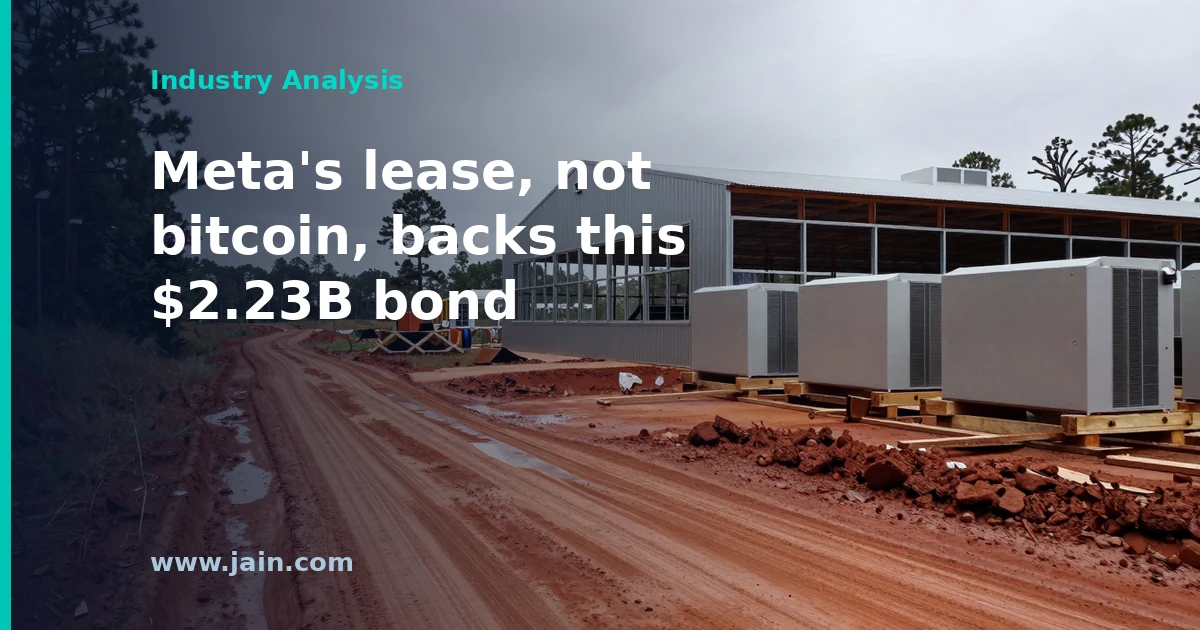
CleanSpark, a company best known for mining bitcoin, wants to borrow about $2.2 billion to finish a huge building full of computers for artificial intelligence in Sandersville, Georgia.
Meta, the owner of Facebook and Instagram, has agreed to rent the building for 20 years and has promised the rent will be paid. That promise, not bitcoin, is what lenders are really betting on.
The site is due to start earning rent in late 2027. Its computers are built to use as much electricity as well over 100,000 homes.
On September 17, 2026, CleanSpark (Nasdaq: CLSK) said in an 8-K filing and accompanying press release that its wholly owned subsidiary CSDC Finance I, LLC intends to offer $2.227 billion of senior secured notes due 2031. The notes will be sold privately to large institutional investors under Rule 144A and to non-US investors under Regulation S. Proceeds will pay the remaining build-out cost of CleanSpark’s Sandersville, Georgia data center, reimburse CleanSpark for earlier equity it put into the project, and fund debt service reserves. The offering is subject to market conditions, and the interest rate has not yet been set.
An investor presentation filed with the 8-K describes Sandersville as a 175-megawatt AI campus leased for 20 years to Anviran, LLC, a Meta subsidiary, with Meta guaranteeing rent and operating expenses. Several financial outlets characterized the deal as a junk, or high-yield, bond. Blockonomi reported that CleanSpark shares rose 4.73% on Thursday to close near $13.40.
Executive Summary
CleanSpark is raising $2.227 billion of debt against one building, not against the company. The notes sit in a special-purpose subsidiary, are secured by first-priority liens on that subsidiary’s assets and the Sandersville property company, and are backed by a 20-year lease whose rent Meta guarantees. According to the investor presentation, the lease carries about $6.6 billion of base-term contract value, a 3% annual rent escalator and roughly $330 million of average annual net operating income (rent left after operating costs).
That structure matters because it lets a company whose core business is mining bitcoin borrow on the strength of a trillion-dollar tenant’s promise to pay rent. It also shows where the risk actually sits: before rent begins, which is targeted for the fourth quarter of 2027, lenders are exposed to construction, and CleanSpark’s completion guarantee is the backstop. After that, the main question becomes refinancing the notes in 2031, well before the lease ends.
For the wider AI infrastructure market, the deal is a working example of how a miner with power and land can turn a signed hyperscale lease (a lease with one of the giant cloud and AI companies) into construction financing without issuing new shares.
The Collateral Is Meta’s Rent Check, Not Bitcoin
Read the 8-K and its exhibits together and the credit story is clear: bondholders are lending against a lease. The issuer, CSDC Finance I, is a ring-fenced subsidiary. The notes are guaranteed by CSRE Properties Sandersville, which holds the facility, and secured by first-priority liens on substantially all assets of both entities plus a pledge of the issuer’s equity held by its parent, CSDC Holdings I. The tenant, Anviran, LLC, is a wholly owned Meta subsidiary, and the investor presentation names Meta as guarantor of both rent and operating expenses. The lease is described as roughly 100% triple-net, meaning the tenant bears the building’s operating costs, so almost all rent flows through to the landlord.
The numbers line up with that reading. The $2.227 billion of notes equals about a third of the roughly $6.6 billion of base-term contract value, and a little under seven times the roughly $330 million of average annual net operating income CleanSpark projects. Bitcoin’s price, mining difficulty and the halving cycle, which dominate CleanSpark’s mining economics, do not appear in that rent stream. For a high-yield investor, the relevant credit once the building is operating is Meta’s, which the presentation frames with a roughly $1.7 trillion market capitalization and $117 billion of first-half 2026 revenue.
That is the sense in which the bond rests on the lease rather than the miner. It is an inference from the structure, not a rating: the filings disclose no credit rating or coupon, and those will determine how much credit investors actually give the Meta guarantee.
The Risk Lenders Still Carry: Getting to Rent Day
A lease guarantee only pays once there is something to lease. The presentation targets Phase I rent commencement in the fourth quarter of 2027, and its own cash-flow schedule shows negligible income before 2028. Until then, bondholders are exposed to exactly the risks the presentation lists: permitting and utility constraints, construction delays, cost overruns and supply-chain problems. The proceeds include debt service reserves, which cover interest payments during that gap.
The backstop for construction is CleanSpark itself. The company will provide a customary completion guarantee, meaning it must fund the project if the note proceeds run short. During construction, then, the parent’s financial strength, which still depends heavily on bitcoin mining, matters to bondholders. The presentation cites a development cost of about $11.9 million per IT megawatt, which implies roughly $2.08 billion for 175 megawatts. The notes are sized above that because they also reimburse CleanSpark’s prior equity and fund reserves, so if the deal completes on these terms, much of the project’s cost ends up financed by debt and some of CleanSpark’s own cash comes back to the parent.
A 2031 Maturity on a 20-Year Lease
The notes mature in 2031, a little over three years after targeted rent commencement, while the base lease runs 20 years with two five-year extension options. That mismatch is common in construction-stage project financing: borrow while the asset is unproven, then refinance once it is built and paying rent. The trade-off is that CleanSpark will need to refinance about $2.2 billion around 2031, with interest rates and credit conditions at that time unknown.
A stabilized, fully leased facility with roughly 16 years of Meta-guaranteed rent remaining should be a much easier asset to refinance than a construction site. But how easy depends on the delivery date holding and on markets in 2031, neither of which the offering can lock in today.
A Template for Miners Turning Landlords
CleanSpark now describes itself as a “market-leading data center developer” controlling more than 1.8 gigawatts of power, land and data centers. Sandersville, at 175 megawatts, is a small slice of that. The structure matters more than the site: sign a lease with a highly rated tenant, ring-fence the project, borrow against the lease, and recover equity for the next site. Because the notes are straight secured debt rather than convertible securities, the announced terms involve no new shares.
One offering does not prove that high-yield markets will fund every miner’s move into AI. Few miners will bring a Meta-guaranteed lease to the table, and the pricing of this deal will show how much the tenant’s credit actually offsets the sponsor’s. For utilities, construction firms and other miners with power portfolios, the signal is narrower but concrete: the lease, not the megawatts, is what gets financed.
Background
CleanSpark, headquartered in Las Vegas, built its business mining bitcoin, using large amounts of cheap electricity to run specialized computers. It now calls itself a data center developer and says it controls more than 1.8 gigawatts of power, land and data centers across the United States. Blockonomi also reported that the company mined 593 bitcoin in August 2026 and held 13,703 bitcoin at month-end, so mining remains a large part of its business as it moves into AI hosting.
Bitcoin miners have become candidates for AI data center development because they already hold what AI builders most need: large grid connections and land zoned for industrial power use. Hyperscalers such as Meta, which reports 3.56 billion daily active people across its apps, increasingly lease that capacity instead of building every site themselves, creating long-term leases that developers can finance.
A software company called Hexnode has built a system where artificial intelligence helpers do routine office tech work largely on their own. Examples include setting up a new employee’s laptop and accounts, or cutting off a computer that may have been hacked.
The big question is how much software should do without a person clicking ‘yes.’ Hexnode says the riskiest moves, like erasing a device, still need human sign-off, and every action is recorded.
Nobody can buy it yet. A small, invitation-only test starts later this year.
Hexnode, the enterprise software division of Mitsogo, unveiled Hexnode Synapse on September 16, 2026, at HexCon26, its annual user conference, according to the company’s announcement datelined Munich. Synapse is described as an agent-based orchestration layer for IT and security operations. It uses specialized AI agents to turn requests, alerts and system events into coordinated, governed and traceable actions across multiple business systems.
At launch, Synapse ships with a device agent, an identity agent and a threat agent. It connects to Hexnode’s own endpoint management, threat detection and identity products, plus ServiceNow, Zendesk, Microsoft Entra ID and BambooHR. An invitation-only trial is planned for later this year.
Executive Summary
Hexnode Synapse is Hexnode’s bid to move AI from answering questions to doing work. Instead of an administrator hopping between a device console, an identity directory, an HR system and a ticketing tool, Synapse’s agents read the request, decide the next step and act within limits set by the administrator. Hexnode’s headline example is a single instruction, ‘Onboard John,’ which pulls the new hire’s HR profile, creates their identity, assigns app licenses by department, pushes device and endpoint-protection settings, and logs the IT ticket.
Hexnode makes governance the central claim. Administrator-defined guardrails, per-action approvals and an exportable execution log called the Execution Center are meant to keep agents under human control. High-impact actions, including wiping a device, isolating an endpoint from the network or changing access privileges, are routed to a designated approver before they run.
The announcement matters because it puts a concrete product behind a question the whole security industry faces: whether autonomous software can be trusted with actions that lock people out, erase data or quarantine machines. For now, the answer rests on design claims. Synapse is not generally available, and Hexnode has not published pricing, customer names or performance data.
The Bottleneck Is the Handoff, Not the Tool
Hexnode’s pitch starts from a familiar complaint in corporate IT: tool sprawl. Chief executive and founder Apu Pavithran framed it plainly, noting that onboarding touches identity, devices and the HR system, and threat response touches the endpoint, user access and the incident ticket. Today, a person stitches those pieces together each time. Every handoff adds manual work and delay.
That framing is important because Synapse does not claim to do anything a skilled administrator cannot already do. Its value proposition is coordination: carrying one request across several systems without a human copying data between screens. For a lean IT team, the gains from eliminating those context switches can be real. However, they are hard to measure from the outside, and Hexnode has not quantified them.
Hexnode’s structural advantage is that it already sells the three systems most involved in these workflows. Those are Hexnode UEM (unified endpoint management, which configures and secures laptops and phones), Hexnode XDR (extended detection and response, which spots and contains threats) and Hexnode IdP (an identity provider, which controls who can log in to what). Synapse draws on native context from all three, which should make its agents better informed inside the Hexnode estate than a bolt-on tool would be.
Autonomy on a Leash
The governance design is the most substantive part of the announcement. It has three layers. Guardrails define what an agent may do on its own. Action-level approvals gate specific steps. The Execution Center records every action, whether autonomous or approved, and teams can search and export that history. Hexnode says this turns audits into a data download rather than an evidence hunt that could stretch for weeks. That is a plausible benefit for regulated organizations, though it is Hexnode’s characterization rather than a measured result.
The harder questions sit in the details. The line between ‘autonomous’ and ‘needs approval’ is set by administrators, so real-world safety depends on sensible defaults and on how easily a busy team can loosen them. Threat containment also carries a built-in tension. Endpoint isolation is on Hexnode’s list of critical actions that require approval, yet speed is the main reason to automate incident response. How organizations balance a waiting approver against a spreading intrusion will likely shape whether the threat agent is used aggressively or cautiously.
There is also the reasoning layer itself. Hexnode says its agents ‘reason’ about incoming requests and alerts to decide the next step. Misjudging an alert, or misreading an HR record during onboarding, could grant the wrong access or miss a real threat. Approvals and logs make such errors visible and reversible after the fact. They do not by themselves make the agents more accurate.
A Platform Play With a Short Integration List
Strategically, Synapse looks like a way to make Hexnode’s product suite more valuable when bought together. Organizations already running Hexnode UEM, XDR and IdP stand to gain the most. Those standardized on other endpoint, security or identity vendors get less, because the launch integrations beyond Hexnode’s own products are limited to ServiceNow and Zendesk for ticketing, Microsoft Entra ID for identity and BambooHR for HR data.
Those are sensible first choices that cover common help-desk, directory and HR systems, but many enterprises run a wider mix. Hexnode says it will expand the integration catalog and Synapse’s core capabilities in future phases, and that customers can configure custom agents built on their own tools and knowledge sources. How far custom agents can reach, and whether the same guardrails apply to them, will determine whether Synapse becomes a genuine cross-vendor orchestration layer or remains mainly a Hexnode accessory.
Announced, Not Yet Proven
Synapse will enter an invitation-only trial later this year, which makes this announcement a statement of direction rather than a shipping product. The self-healing behavior Hexnode describes is a good illustration of what still needs field testing. In Hexnode’s example, a stalled onboarding recovers on its own, files a ticket when app licenses run out, and resumes provisioning once a seat frees up. It is a compelling scenario, but real IT environments are messier than demonstrations.
For buyers, the practical takeaway is to treat the trial as an evaluation of governance as much as of automation. Useful checks include whether approvals route cleanly, whether logs are complete enough for auditors, and how often the agents pick the right next step. For the broader market, Synapse adds to evidence that endpoint and identity vendors see agentic AI as the next competitive front, and that trust controls, rather than raw autonomy, are becoming the selling point.
Background
Hexnode is the enterprise software arm of Mitsogo. It is best known for unified endpoint management (UEM), the category of tools companies use to enroll, configure, update and secure employee laptops, phones and other devices from one console. The company has since added Hexnode XDR, an extended detection and response product that spots and contains security threats, and Hexnode IdP, an identity provider that governs who can sign in to which applications. HexCon is Hexnode’s annual user conference, where it typically showcases new products.
Synapse arrives as enterprise software vendors move beyond AI assistants that answer questions toward agentic AI that takes actions. In IT and security, that shift is especially sensitive. The same actions that save time, such as granting access, wiping a lost device or isolating a compromised computer, can cause serious disruption if triggered wrongly. As a result, approval workflows and audit trails have become central to how vendors present these products.
Eaton, a long-established maker of the equipment that moves electricity safely through buildings, says its best years are still ahead.
The reason is data centers: the giant warehouses of computers behind apps, online search and chatbots. Each one needs enormous amounts of electricity switched, routed and backed up in case the power fails, and Eaton sells much of that equipment.
The companies supplying the wiring behind the artificial intelligence boom can profit no matter which tech giant wins. The big open question is how long the building spree lasts.
Yahoo Finance reported that Eaton Corporation (NYSE: ETN), the power management company, sees its best years ahead, with demand from data centers powering its growth. The outlook ties Eaton’s trajectory directly to the electrical infrastructure needed by the facilities that run cloud computing and artificial intelligence (AI) workloads.
Executive Summary
Eaton is signaling confidence that data center construction will drive growth beyond anything in its recent history. The company makes the electrical backbone of these facilities: switchgear that routes and protects high-voltage power, uninterruptible power supplies (UPS) that keep servers running through outages, and power distribution units that deliver electricity to server racks.
The outlook matters because it points to where AI spending ultimately lands. Chips and cloud platforms get most of the attention, but every new data center hall needs power equipment before a single server can be switched on. That puts electrical suppliers among the most direct beneficiaries of the buildout, whichever chipmaker or cloud provider comes out ahead.
A forward-looking claim is not a result, though. A “best years ahead” view depends on data center spending staying strong, on Eaton’s ability to manufacture enough equipment, and on customers securing the grid power they need to finish their projects.
Selling Picks and Shovels for the AI Power Crunch
A data center is, at its core, a building that turns electricity into computation. Power arrives from the utility at high voltage, then passes through transformers, switchgear, backup systems and distribution equipment before it reaches the servers. Each stage is a purchase, and Eaton competes in many of them.
This is the classic picks-and-shovels position. Eaton does not need to predict which AI model, chip architecture or cloud provider will dominate. It needs data centers to keep getting built, and it needs those facilities to keep drawing more power. The industry trend toward denser server racks, where more computing and more electricity are packed into the same floor space, tends to raise the amount of electrical equipment each facility requires.
That makes the claim structurally credible. Unlike speculative software revenue, electrical infrastructure is a physical requirement: a facility cannot operate without it, and none of it can be skipped to save money.
Why Electrical Gear Holds Its Value
Power distribution equipment is often engineered to order, has to meet strict safety and reliability standards, and must be qualified by operators before it goes into a live facility. Large data center operators tend to standardize designs across many sites, so a supplier that wins a place in a reference design can see repeat orders as the design is rolled out.
Those features give incumbents such as Eaton real advantages over new entrants. They also help explain why established rivals, including Schneider Electric, Vertiv, ABB and Siemens, are chasing the same demand. The market is large enough to lift several suppliers, but competition over pricing, delivery slots and new designs will likely sharpen as manufacturing capacity catches up.
For data center developers, the practical result has been a supplier’s market for critical electrical equipment. Buyers who reserve manufacturing capacity early are generally better placed than those who order once a site is ready to build.
The Risks Beneath a Bullish Outlook
The most obvious risk is concentration. If much of Eaton’s growth depends on a few very large buyers of data center capacity, a slowdown in their capital spending would show up quickly in new orders. Infrastructure booms have historically been followed by periods of digestion, when customers pause to absorb capacity they have already built.
A less obvious risk is power itself. In many markets, data centers are limited less by equipment than by how quickly utilities can connect them to the grid. If projects stall while waiting for electricity, orders for the gear that distributes that electricity can slip too. Eaton’s fortunes are therefore tied partly to utility and grid timelines it does not control.
Execution matters as well. Meeting surging demand requires factory expansion, skilled labor and reliable component supply. Growth that outpaces manufacturing capacity can lead to delivery delays that push customers toward competitors.
What It Means for Buyers and Investors
For data center operators and developers, a supplier this confident in demand is a signal to lock in procurement early and to qualify more than one vendor for critical equipment. Lead times and pricing are likely to remain a negotiation shaped by how tight the market stays.
For investors, Eaton’s outlook reinforces the view that power infrastructure is one of the more direct ways to gain exposure to the AI buildout. The durability of that thesis rests on the questions below: how much demand is actually contracted, and how long it lasts.
Background
Eaton Corporation is a long-established industrial company that has repositioned itself around power management. Its electrical business makes the equipment that carries electricity from the utility connection to the point of use, including switchgear, uninterruptible power supplies, power distribution units and related controls. The company also serves the aerospace, vehicle and industrial markets, and it trades on the New York Stock Exchange as ETN.
Data centers have become one of the most important markets for electrical equipment suppliers. The spread of cloud computing, and more recently the rapid growth of AI, has driven large technology companies and data center developers to build bigger, more power-hungry facilities. That has strained both equipment supply chains and utility grids, turning electrical infrastructure from a background purchase into a strategic bottleneck.
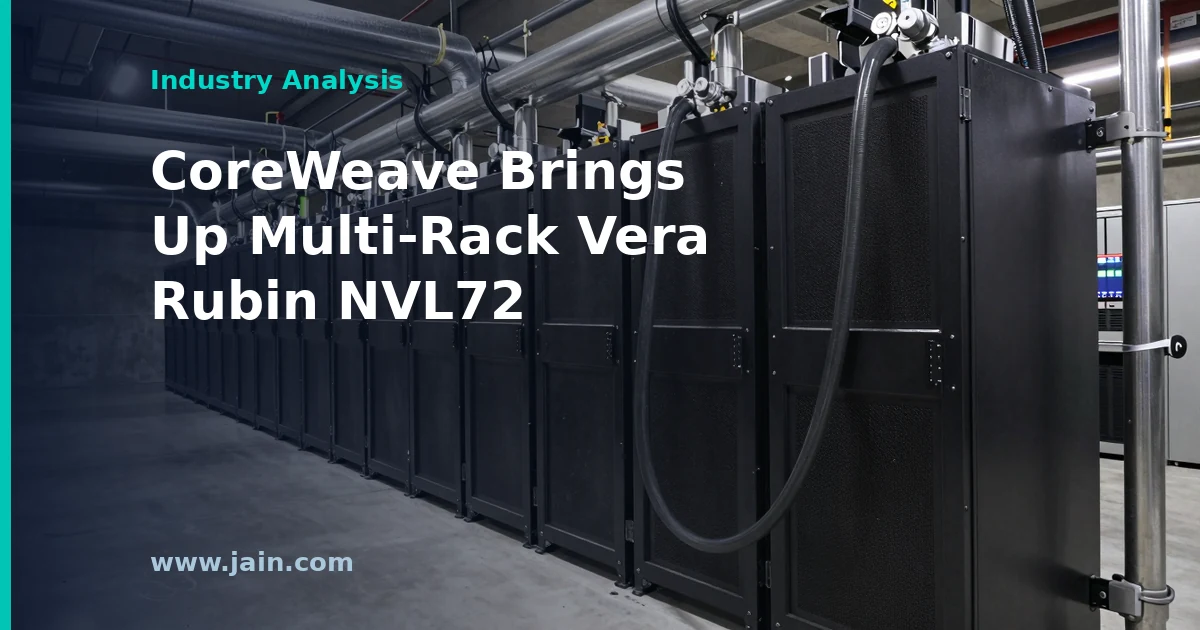
CoreWeave, a company that rents out computing power for artificial intelligence, says it has switched on several of Nvidia’s newest server cabinets and wired them together to work as one giant machine.
Each cabinet packs 72 of Nvidia’s top chips. Linking hundreds of those chips lets companies build and run bigger, more capable digital assistants.
Why it matters: machines this crowded need a lot of electricity and liquid cooling, so the buildings that house them have to change quickly. CoreWeave has not said who is using the system or when customers can rent it.
CoreWeave (Nasdaq: CRWV) has brought up a multi-rack NVIDIA Vera Rubin NVL72 cluster on CoreWeave Cloud, joining hundreds of NVIDIA Rubin GPUs into a single scale-out cluster aimed at agentic AI, Light Reading reported on September 16, 2026, publishing the company’s announcement. “Bring up” is the industry term for powering on, configuring and validating new hardware so it can run real workloads.
Alongside the compute news, CoreWeave introduced two additions to CoreWeave AI Object Storage: cross-region write acceleration, which lets a job write data locally while it is copied to another region in the background, and a new Archive tier for colder data.
Executive Summary
Each Vera Rubin NVL72 rack combines 72 Rubin GPUs, 36 Vera CPUs, NVIDIA’s NVLink 6 chip-to-chip interconnect, ConnectX-9 SuperNICs (high-speed network cards) and BlueField-4 DPUs (processors that offload networking and security tasks). CoreWeave says it has joined several of these racks over NVIDIA Spectrum-X Ethernet so they behave as one cluster for training, inference and reinforcement learning. The company attributes the result to automation in its Mission Control software, including a Rack LifeCycle Controller that handles hardware detection, firmware, validation, power and cooling.
The significance is less about any single rack than about what comes with it. Rack-scale systems shift the unit of deployment from the server to the entire cabinet, and that concentrates power, heat and networking demands in a way that tests data center design. CoreWeave is positioning itself as an early operator of NVIDIA’s next generation, and signaling that speed of bring-up is now a competitive metric in its own right.
The announcement is detailed on architecture but light on the facts that determine commercial impact: how many racks are running, where, for whom, and when customers can buy the capacity.
The Rack Is the New Computer
For most of cloud computing’s history, the basic building block was a server: a box with a few processors that could be installed, swapped and scaled one at a time. NVIDIA’s NVL72 designs change that. Inside one rack, 72 GPUs are tied together by NVLink so they can share work almost as if they were a single, very large chip. That is known as scale-up. Joining multiple racks over a network, as CoreWeave describes with Spectrum-X Ethernet, is scale-out.
The combination matters because the largest AI models and the most demanding inference jobs no longer fit comfortably inside one rack. CoreWeave frames the multi-rack cluster around agentic AI, meaning systems that chain many model calls and tool uses together to complete a task. Its argument is that delays compound across those steps, so tightly coupled compute and fast data access pay off. That reasoning is plausible, though the company did not publish benchmarks showing how much faster agentic workloads run on the new cluster.
The networking claims are ambitious. CoreWeave says each Rubin GPU gets two ConnectX-9 SuperNICs, providing 1.6 terabits per second of scale-out connectivity, and that the fabric supports roughly 128,000 GPUs per rail in a non-blocking design, meaning traffic should not queue for lack of capacity. That figure describes what the network architecture can accommodate, not what has been deployed; the cluster announced here is described as hundreds of GPUs.
Deployment Speed Becomes a Competitive Weapon
The most revealing part of the announcement is how much of it is about process rather than silicon. CoreWeave describes racks arriving as hardware that still has to be connected and validated, and says its Rack LifeCycle Controller automates that work, with software components it calls Racky handling rack control and Valvey executing cooling actions. Racks then go through NVIDIA field diagnostics plus full-rack workload testing, and only those that pass as a system move into production.
This matters economically. Every week a costly rack sits installed but unvalidated is capacity that earns nothing while its financing costs keep accruing. For GPU cloud providers competing for the same scarce next-generation hardware, the ability to turn delivered racks into billable capacity quickly can be as important as securing the allocation in the first place. Automating firmware updates, power sequencing and cooling control is how an operator compresses that interval.
The claim that “every GPU performs at its best” is marketing language and should be read as such. What the release does substantiate is a described validation workflow; it does not provide failure rates, burn-in durations or time-to-production figures that would let buyers compare CoreWeave’s process with competitors’.
What Next-Generation Racks Demand of Facilities
CoreWeave explicitly lists cooling and power among the layers that had to be engineered for the cluster to perform as one system, and it built a dedicated software component to execute cooling actions. That is a clear signal of where the operational burden now sits. Dense rack-scale AI systems of this class have relied on liquid cooling, piping coolant directly to the chips because air alone cannot remove heat fast enough.
For data center developers and colocation providers, the implication is that readiness for the rack era is not just about floor space. It requires facility cooling loops, electrical distribution designed for highly concentrated loads, and structural and networking plans that allow new racks to be added without rework. CoreWeave’s point that its modular network topology lets racks be added without redesigning the fabric at each expansion speaks to that last requirement.
Operators whose buildings were designed for traditional air-cooled servers face costly retrofits or the prospect of being passed over for this generation of hardware. Suppliers of liquid-cooling equipment, power distribution gear and high-capacity optical networking stand to benefit, while the release gives no per-rack power figures that would let facility planners size requirements precisely.
Storage Moves Closer to the Loop
The storage announcements address a less glamorous bottleneck: GPUs sitting idle while they wait for data. With cross-region write acceleration, CoreWeave says a job writes locally while replication to another region happens in the background, so intermediate results, retrieved context and outputs are not held up by long-distance transfers. The new Archive tier gives customers a place to keep colder data within the same storage service.
Background replication is a well-established technique, and its value depends on details the company has not provided, such as how far replicated copies can lag, how conflicts are handled and what happens if a region fails before replication completes. For buyers, the practical question is whether keeping training data, checkpoints and archives within one provider’s storage stack is worth the added dependence on that provider.
Background
CoreWeave is a Nasdaq-listed cloud provider (ticker CRWV) that specializes in renting GPU computing capacity for artificial intelligence workloads, marketing itself as “The Essential Cloud for AI.” Unlike general-purpose clouds, its business is built around large clusters of NVIDIA accelerators plus the networking, storage and orchestration software needed to run them for AI training and inference.
NVIDIA’s Vera Rubin platform is the successor to its Grace Blackwell generation, pairing Rubin GPUs with Vera CPUs. The NVL72 designation refers to rack-scale systems in which 72 GPUs are interconnected with NVLink, a design approach that has moved AI infrastructure from individual servers toward entire racks engineered as single units, with corresponding increases in the power, cooling and networking demands placed on data centers.