
TL;DR · 30-second read
The Short Version
- Applied Digital just finished switching on a huge computing building for artificial intelligence. Its electricity capacity is comparable to a small city’s demand.
- Its main customer, CoreWeave, rents out artificial intelligence computing power. CoreWeave is reported to have signed 15-year rental deals worth about $7 billion in total.
- Signing a deal is not the same as getting paid. Rent usually starts once the space is powered and ready, and this building now is.
- Investors remain cautious. The shares are down nearly a quarter in three months, and the company carries heavy debt.
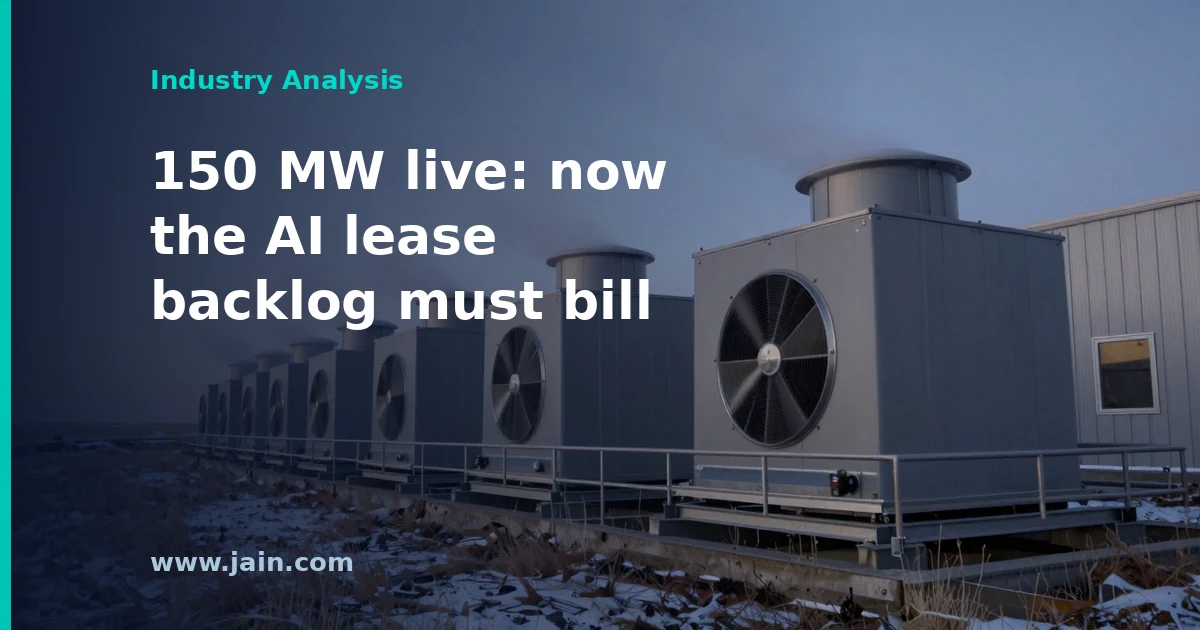
Applied Digital (Nasdaq: APLD) has switched on the second phase of Building 2 at Polaris Forge 1, its campus purpose-built for artificial intelligence and high-performance computing (HPC), Simply Wall St reported on October 2, 2026. The phase adds 75 megawatts (MW) of IT capacity. IT capacity is the power available to run servers and GPUs, as distinct from cooling and other building loads. The phase completes the facility’s 150 MW buildout.
The shares rose 5.05% on the day to US$25.38. They remain down 23.23% over three months, though the three-year total shareholder return is still roughly fourfold.
Executive Summary
The milestone itself is simple. A second 75 MW block is now live at Building 2, and the facility’s planned 150 MW is complete. Its significance lies in what it does to the company’s revenue story. Polaris Forge 1 is tied to long-term leases with CoreWeave, a cloud provider that rents out AI computing power. Those leases are described as 15-year agreements worth $7 billion in total contracted revenue. A contract of that kind is a promise to pay. Energized, delivered capacity is generally what turns the promise into rent that appears on an income statement.
That conversion is where the valuation debate now sits. On a price-to-sales basis, the stock trades at about 12.1 times revenue, against roughly 1.9 times for the broader US IT sector. Bullish valuation models put fair value well above the current price, but they depend on revenue that has not yet been reported. With the 150 MW buildout finished, the coming quarters should begin to show how much of the backlog is converting into revenue, and on what timetable.
The risks are the ones an energization milestone does not remove. The company depends on a small number of hyperscale tenants, meaning very large cloud and AI compute buyers, and it carries a sizeable debt load. If contracts slip or financing tightens, the upside case is exposed quickly.
Contracts Are Promises. Energized Megawatts Are Invoices.
In wholesale data center leasing, rent typically starts when a tenant’s capacity is delivered and accepted, not when the contract is signed. A signed lease establishes backlog, the revenue a company is entitled to over time. Building, powering and handing over the space is what starts the billing clock. Switching on the second 75 MW phase of Building 2 completes the 150 MW facility at Polaris Forge 1. The question for Applied Digital is no longer whether it can finish this building. It is how fast the capacity turns into recognized revenue.
The scale of that backlog gives the milestone its weight. The most-followed valuation narrative on Applied Digital describes the CoreWeave agreements as 15-year leases totalling $7 billion in contracted revenue. Spread evenly, that works out to roughly $467 million a year. That figure is simple arithmetic, not a disclosed payment schedule, and real lease revenue usually ramps as phases come online. It still shows the size of the revenue stream that delivered capacity is meant to unlock. Until the building is live, that stream exists only on paper.
Three groups are most directly affected. Shareholders are paying today for revenue that energization begins to release. Lenders’ repayment depends on that rent arriving on schedule. CoreWeave depends on Applied Digital to house the computing capacity it in turn rents to its own customers.
Why a 12.1x Sales Multiple Rides on Delivery
Simply Wall St’s own price-to-sales comparison puts the stock at about 12.1 times sales. That compares with roughly 1.9 times for the wider US IT group and a 5.5 times multiple the publication treats as a fair ratio. A high price-to-sales ratio means investors are paying for revenue they expect rather than revenue already booked. As the publication notes, a gap like this can close through stronger fundamentals, a lower share price, or both. Delivered megawatts are the most direct route to stronger fundamentals. Each phase that starts paying rent raises the sales line without the share price having to fall.
The bullish narrative assumes much more than one campus. Its US$68.35 fair value, about 63% above the US$25.38 close, rests on an 11.07% discount rate. It also assumes Applied Digital reaches roughly US$3.0 billion in revenue and US$295.0 million in earnings by around 2029, which still implies a forward price-to-earnings multiple near 104.7 times. Against that US$3.0 billion target, the CoreWeave leases at their simple annual average would cover only about a sixth. The remainder of the bull case therefore depends on capacity beyond this 150 MW facility, along with the financing and tenants needed to fill it.
A fair reading cuts both ways. Completing the facility is real execution, and it narrows the gap between contracted and earned revenue. It does not, by itself, validate a valuation built on several times more revenue than this campus is reported to be contracted for.
The Risks Energization Does Not Retire
Bringing capacity online moves risk without eliminating it. Construction and delivery risk on this building falls away. Counterparty risk, the chance a tenant pays late, renegotiates or fails to take full occupancy, becomes more prominent as revenue concentrates on the leases now running. The valuation commentary flags dependence on a few hyperscaler tenants as a central risk. With CoreWeave named as the anchor customer at Polaris Forge 1, much of the campus’s near-term revenue rests on one counterparty.
The balance sheet is the other pressure point. Data center campuses are capital-intensive, and the sizeable debt load cited in the valuation commentary must be serviced whether or not rent ramps on schedule. The recent three-month decline of 23.23%, after a roughly fourfold three-year return, suggests the market is giving more weight to these execution and funding questions than it did earlier in the cycle. A completed building is a necessary condition for the bull case, but not a sufficient one.
Background
Applied Digital designs, develops and operates digital infrastructure for high-performance computing and artificial intelligence customers in North America, and trades on the Nasdaq Global Select Market under the ticker APLD. Its fiscal year runs from June 1 to May 31, according to the definitive proxy statement it filed with the SEC on September 25, 2026.
The company has positioned Polaris Forge 1 as a purpose-built AI campus anchored by long-term leases with CoreWeave. CoreWeave is one of the specialist cloud providers, often grouped with hyperscalers, the largest buyers of data center capacity, that rent GPU computing to AI developers. Investors have rewarded that strategy with a roughly fourfold three-year shareholder return, though the shares have cooled sharply in recent months as attention has shifted to execution and funding. Source: Applied Digital (APLD) Completes Polaris Forge 1 Expansion, Is The Valuation Gap Too Wide? (Simply Wall St). Report on the second 75 MW phase of Building 2 completing Polaris Forge 1’s 150 MW buildout, with valuation commentary. Primary sources: Applied Digital, Form DEF 14A (definitive proxy statement), filed with the SEC on September 25, 2026.Sources