
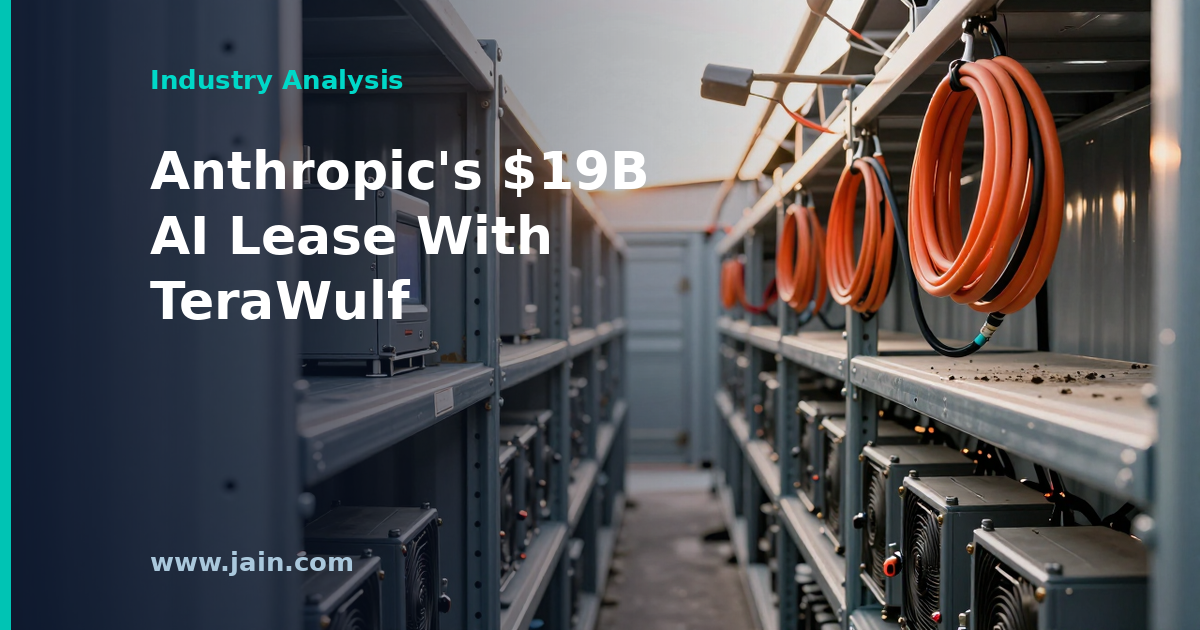
Anthropic, the AI lab behind the Claude model family, has signed a data center lease valued at roughly $19 billion with TeraWulf (Nasdaq: WULF), a bitcoin miner that has been repositioning itself as an AI infrastructure host. The agreement was reported by SiliconANGLE on July 5, 2026.
The transaction makes Anthropic a long-duration anchor tenant on TeraWulf’s power-rich footprint, and it ranks among the largest single AI hosting commitments disclosed to date.
Executive Summary
The headline number — about $19 billion — is what an AI lab would normally spend building its own campus, not renting one. By pushing that spend into a lease with a listed bitcoin miner, Anthropic is trading capex for speed: TeraWulf already controls interconnected sites and substation capacity, which is the scarce input in the current AI build-out.
For TeraWulf, the contract is a category change. A company whose revenue has been tied to bitcoin’s price now has a multi-year, investment-grade-style cash flow tied to a frontier AI customer. That is why WULF sits on many investor watchlists as a proxy for the miner-to-AI-landlord thesis.
The deal also sharpens a broader trend: hyperscalers and AI-native labs are no longer waiting on traditional colocation supply. They are contracting directly with whoever holds the two things that matter most right now — energized land and a grid connection.
Why an AI Lab Rents from a Bitcoin Miner
Bitcoin miners spent the last cycle acquiring the exact ingredients AI now needs: cheap power contracts, substation rights, and shells that can dissipate very high rack densities. Retooling those shells for GPUs is non-trivial — liquid cooling, tenant-grade redundancy, and network fiber all have to be added — but it is far faster than greenfield permitting. For Anthropic, leasing from TeraWulf compresses time-to-first-megawatt in a market where a new build can take three to five years.
The economics also matter. A lease shifts risk: Anthropic pays for capacity as it is delivered rather than tying up cash in construction, while TeraWulf finances the fit-out against a signed contract. That is the same playbook enterprise tenants use with traditional colocation providers; what is new is the scale and the counterparty.
What $19 Billion Actually Buys
The release frames the commitment as a lease value rather than an upfront payment, which typically means it spans many years of rent, power pass-through, and services. Without disclosed megawatts, PUE assumptions, or a term length, the figure is best read as a ceiling on Anthropic’s obligation and a floor on TeraWulf’s backlog — not a check written on day one.
Even so, a nine- or ten-figure annualized run-rate at a single landlord is unusual. It implies gigawatt-class ambitions over the life of the contract, which in turn implies transmission upgrades and generation additions that neither party controls alone.
Winners, Losers, and the Miner-to-AI Trade
The clearest winner is any miner sitting on energized capacity in a utility territory friendly to large loads. TeraWulf’s deal will be used as a comparable by peers negotiating their own AI conversions, and it validates the equity story that has driven the miner-to-AI rerating. The clearest pressure point is on traditional wholesale data center developers, who now face a well-funded competitor class that already owns the power.
For Anthropic, the strategic read is independence. Locking in dedicated capacity outside the big three clouds gives the company optionality on where its next generation of models trains and serves, and reduces the risk that compute becomes a chokepoint controlled by a strategic investor or competitor.
The Grid Question Behind the Deal
Every large AI lease today is really a bet on the interconnection queue. Utilities in the regions where miners cluster — parts of Appalachia, Texas, and the upper Midwest — are already signaling multi-year waits for new large-load connections. A lease of this scale will draw scrutiny from regulators, ratepayer advocates, and neighboring loads who compete for the same megawatts.
None of that is a criticism of either party; it is the operating reality of the market. But it means execution risk on a deal of this size sits less with the tenant or the landlord than with transmission planners and permitting timelines that neither company can accelerate on its own.
Background
Anthropic, founded in 2021, has grown into one of a small group of frontier AI labs whose compute needs now rival those of the largest cloud tenants. Like its peers, it has relied on hyperscaler partners for training capacity while seeking to diversify its infrastructure footprint.
TeraWulf emerged from the last bitcoin cycle with a portfolio of power-anchored sites in the eastern United States. As mining economics compressed and AI compute demand surged, the company — along with several listed peers — began marketing its energized capacity to high-performance computing and AI tenants, a pivot investors have tracked closely under the miner-to-AI-landlord thesis.
Source: Anthropic inks $19B AI data center lease with TeraWulf – SiliconANGLE — report on Anthropic’s multi-billion-dollar hosting agreement with the Nasdaq-listed bitcoin miner.