AI Hardware Roars Back: Is the Next Leg of the AI Rally Here?

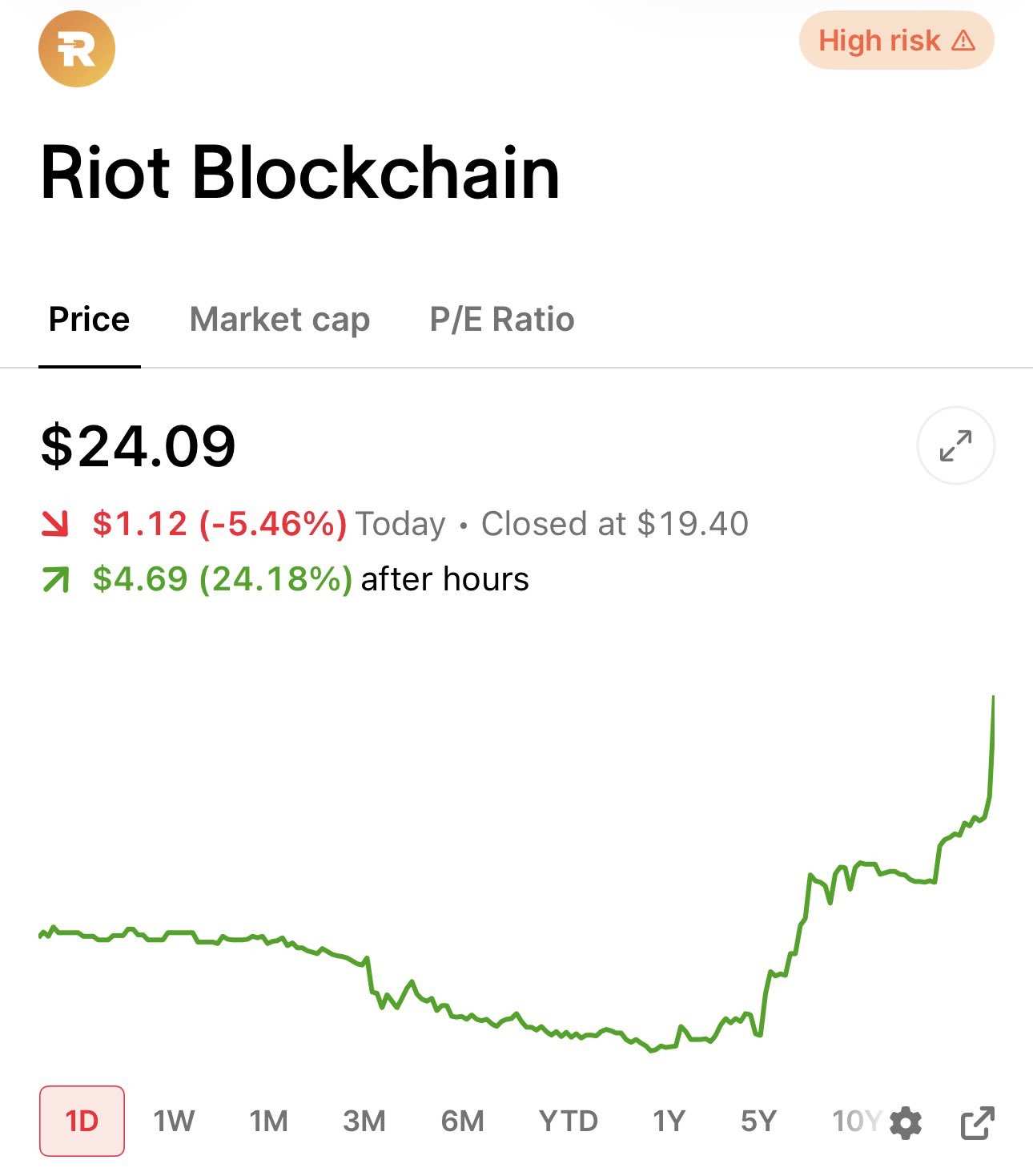
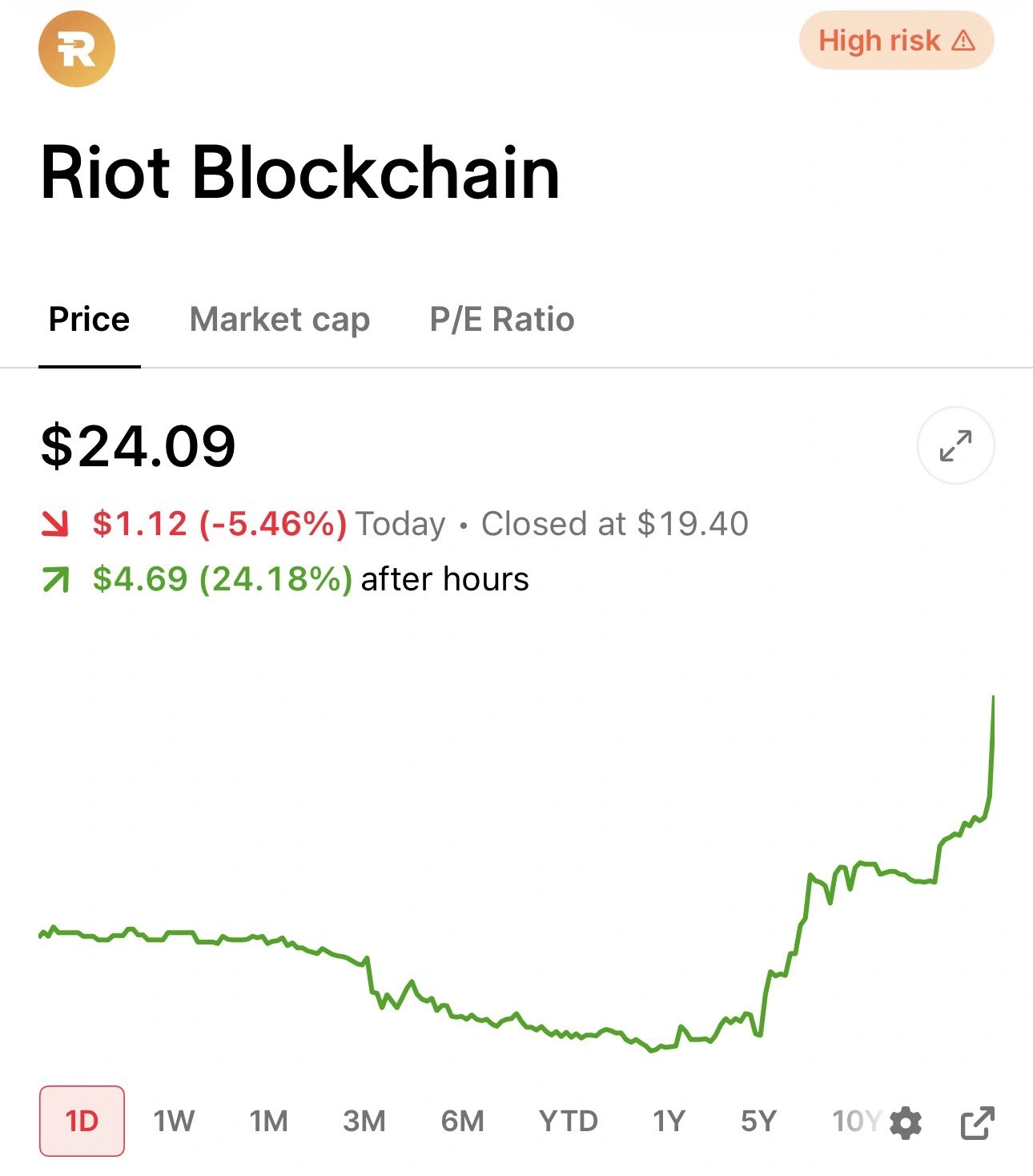
$RIOT +15%: Anthropic signs a $9.1 billion long-term compute power contract; Riot accelerates its pivot from Bitcoin mining to AI data centers.
$RIOT shares surged approximately 15%. The core catalyst behind this move was not the earnings report itself, but an AI infrastructure partnership that could fundamentally alter the company's long-term business model.
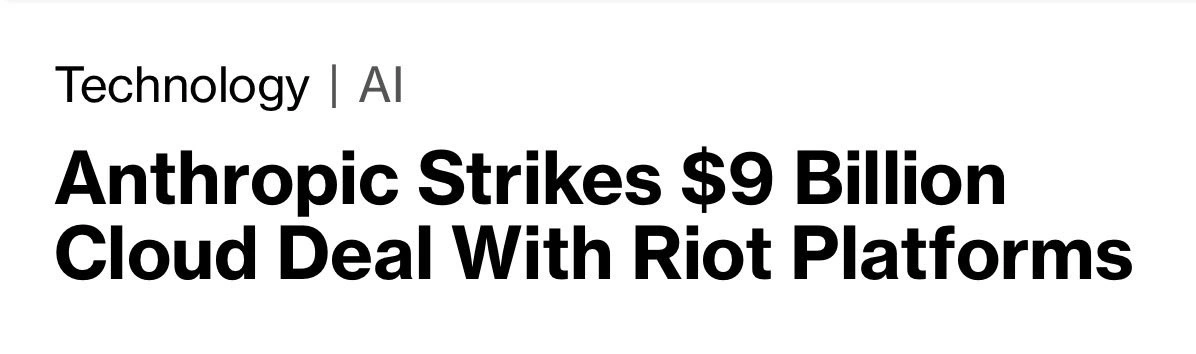
According to market sources, AI company Anthropic has signed a long-term compute power cooperation agreement with Riot Platforms valued at approximately $9.1 billion. For Riot, this signifies a gradual transition from traditional Bitcoin mining to AI data centers and high-performance computing infrastructure, leveraging its previously built large-scale power infrastructure and data center campuses.
This is precisely what has the market excited.
In the past, investor analysis of $RIOT primarily revolved around Bitcoin prices, mining difficulty, hashrate, and BTC production costs.
However, the AI era is offering these mining companies, which possess substantial power resources and data center land, an alternative growth path:
Shifting from "Bitcoin mining" to "leasing compute infrastructure."
This could lead to an entirely different business model.
$9.1 billion long-term contract shifts market expectations
Anthropic is currently one of the most important AI model companies globally, with its Claude series of models rapidly expanding into the enterprise and developer markets.
The larger the AI model, the more computing resources are required for training and inference.
This means that what Anthropic truly needs is not just GPUs, but:
Power + data centers + GPU servers + networking + cooling + long-term stable infrastructure.
Riot Platforms' greatest advantage lies precisely in the large-scale power infrastructure it has built around Bitcoin mining over the past few years.
For AI data centers, land itself is not scarce.
What’s truly scarce is:
What matters are data center campuses that are already connected to the grid, possess substantial power capacity, and can be quickly retrofitted into high-density computing facilities.
This is also why an increasing number of Bitcoin mining companies are beginning to pivot toward AI and high-performance computing (HPC).
If Riot Platforms can convert its large-scale power campuses into AI data centers, the company's valuation logic could gradually shift from that of a cyclical Bitcoin miner to an AI infrastructure operator.
This is also the core reason for the market's positive reaction.
The earnings report was far from perfect, with evident pressure points.
It is worth noting that Riot Platforms' latest earnings report was not entirely bullish.
While revenue largely met market expectations, the loss exceeded analysts' forecasts.
Based solely on the earnings figures, there may not have been sufficient justification for a sharp rally in the stock price.
However, capital markets often trade not on past performance, but on changes in future cash flows.
A substantial long-term AI computing power contract could theoretically significantly enhance the visibility of Riot Platforms' future revenue.
This differs fundamentally from its Bitcoin mining business.
Bitcoin mining revenue is highly dependent on BTC prices and network difficulty, resulting in significant volatility in future cash flows.
In contrast, long-term AI data center contracts may provide a more stable and predictable source of income.
If the contract can be implemented gradually as planned, Riot Platforms' business structure could undergo significant changes.
Bitcoin prices determine short-term elasticity, while AI computing power contracts dictate long-term valuation.
Why are Bitcoin mining companies emerging as new players in AI data centers?
Previously, the market struggled to understand why Bitcoin miners could benefit from AI infrastructure.
The answer is actually quite simple:
Electricity.
One of the biggest bottlenecks for AI data centers is no longer just GPUs, but power supply.
A large AI data center may require hundreds of megawatts or even greater power capacity.
Meanwhile, building new power infrastructure, substations, and transmission networks often takes years.
In contrast, some Bitcoin mining companies have already completed land acquisition, power access, and data center infrastructure construction ahead of schedule.
Therefore, for AI companies, partnering with these firms may prove more efficient than building new AI data centers from scratch.
This is also why companies like Riot Platforms, IREN, and Core Scientific have been increasingly drawing the attention of AI infrastructure investors in recent years.
Their true assets may no longer be Bitcoin mining rigs.
But rather:
Abundant low-cost electricity + land + grid access + data center infrastructure.
These resources are being repriced in the AI era.
$RIOT's core valuation logic may be shifting.
If Riot can continue to secure more long-term AI data center contracts in the future, investors may change how they value the company.
Past:
$RIOT ≈ Bitcoin price × Mining hashrate × Mining profit margin
In the future, this may gradually evolve into:
$RIOT ≈ Bitcoin business + AI data center revenue + Value of power assets + Data center expansion potential
This means the company has established a second growth curve.
More importantly, there is a certain degree of resource synergy between these two businesses.
Bitcoin mining can leverage low-cost electricity for high-density computing, while AI data centers can provide stable cash flows under longer-term contracts.
If the return on capital for the AI business is significantly higher than that of traditional Bitcoin mining, Riot Platforms may even gradually shift its capital expenditure from pure mining infrastructure to AI/HPC infrastructure in the future.
This would represent a very significant strategic pivot.
However, $9.1 billion cannot be directly equated to $9.1 billion in revenue.
Investors also need to remain rational.
The total value of long-term contracts does not mean the company immediately receives $9.1 billion in cash, nor does it imply that all revenue will be recognized in the short term.
What truly warrants attention are the contract terms, computing power scale, construction progress, capital investment, customer payment structures, and the go-live timing of the data centers.
The amount of capital Riot Platforms needs to invest to complete the AI data center retrofitting is equally important.
If the contract value is substantial but requires significant upfront capital expenditure for infrastructure development, the company's free cash flow may remain under pressure in the short term.
Therefore, what the market really needs to verify next is:
whether the $9.1 billion contract can be translated into actual data center capacity and stable cash flows.
If the answer is yes, then the significance of this contract far exceeds that of an ordinary business partnership.
It means Riot Platforms is acquiring a new identity within the AI supply chain:
from power asset holder to AI data center operator.
This is also why the market chose to buy heavily even though the latest earnings report showed losses exceeding expectations.
Because investors are no longer trading on Riot Platforms' past profits, but on the potential value of its future AI infrastructure.
For $RIOT, a true turning point may be unfolding:
In the past, it used electricity to mine Bitcoin; in the future, it may use electricity to power AI.
Against the backdrop of surging demand for AI computing power and electricity becoming an increasingly scarce resource, data center companies with large-scale power campuses are seizing the opportunity to redefine their valuations.
Disclaimer: Community is offered by Moomoo Technologies Inc. and is for educational purposes only.Read more

Comments
to post a comment
2