

Google just guaranteed $3.2 billion of lease payments for an AI data center it doesn't own, built by a company that used to mine bitcoin. That's not generosity. It's financial engineering, and it's how the entire AI buildout works.
The deal centers on TeraWulf, a Maryland-based bitcoin miner that has spent the past two years converting a retired coal plant site on Lake Mariner in western New York, outside Buffalo, into an AI data center campus. Google agreed to backstop $1.4 billion in new lease obligations on top of prior commitments, bringing its total support to $3.2 billion, according to CNBC and Carbon Credits. In exchange, Google's warrants now give it roughly 14% ownership of TeraWulf, up from 8% just months earlier.
Google isn't the tenant. Fluidstack is. The AI cloud provider signed two 10-year contracts with TeraWulf for more than 200 megawatts of critical IT load at Lake Mariner, later expanded with a 160-megawatt building called CB-5, pushing Fluidstack's total contracted capacity there to 360 megawatts. Data Center Dynamics puts the combined value of those leases at $3.7 billion over the initial term, rising to $8.7 billion if Fluidstack exercises its extension options.
So why does Google need to guarantee someone else's rent? Because TeraWulf can't borrow the billions it needs to build CB-5 and the buildings after it on its own credit. Lenders don't trust a former crypto miner's balance sheet. They do trust Google's. The backstop lets TeraWulf raise project-level debt against Fluidstack's lease payments, with Google's guarantee sitting behind it as insurance. Google gets warrants and a growing equity stake. TeraWulf gets a construction loan it couldn't get alone. Fluidstack gets a building. Nobody at Google has to put a data center on its own books.
Meta's version is even bigger
TeraWulf's structure is modest next to what Meta just did in Richland Parish, Louisiana. Meta's Hyperion campus, a 4-million-square-foot site expected to draw up to 5 gigawatts once finished in 2029, is being financed through a joint venture with funds managed by Blue Owl Capital. Blue Owl owns 80% of the venture. Meta owns 20%. Morgan Stanley arranged $27 billion in debt and $2.5 billion in equity through a special purpose vehicle, with Pimco anchoring the bond sale. The debt carries an A+ rating from S&P and doesn't mature until 2049.
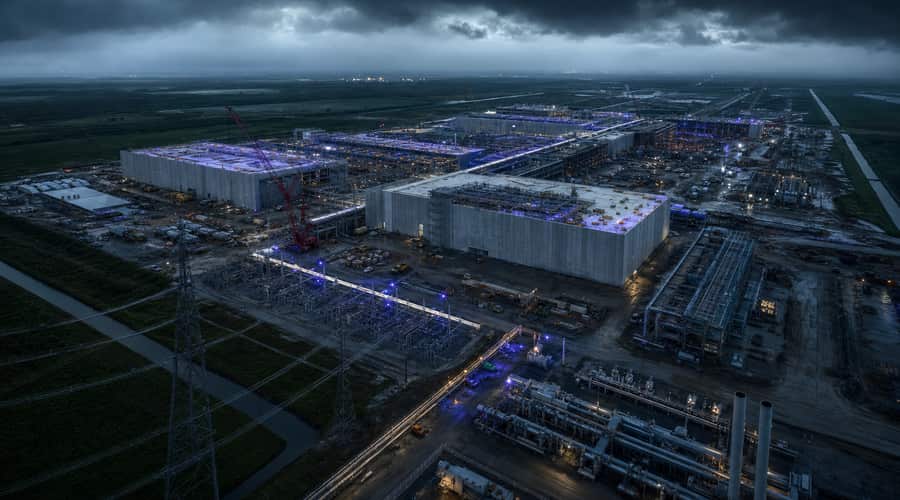
Meta restructured its $50 billion Richland Parish, Louisiana data center through a holding company registered in Delaware on the exact day state regulators approved the gas plants to power it. The arrangement, which left Meta with just 20% of the joint venture while Blue Owl Capital took 80%, was never disclosed to regulators. Now consumer... - Meta Louisiana data center financing deal - AI infrastructure power plant regulatory approval
Meta will occupy Hyperion and pay rent on it for decades. Because Meta doesn't control the entity that holds the debt, the debt never touches its balance sheet. That's the accounting mechanism underneath nearly every headline gigawatt-scale AI campus announced this year: a special purpose vehicle raises the debt, a private capital manager like Blue Owl holds the majority stake, and the hyperscaler signs a long lease that counts as an operating expense rather than a liability.
The scale of this off-balance-sheet shift is no longer a rounding error. A study cited by Forbes found the five largest US hyperscalers have moved more than $1.6 trillion in AI infrastructure debt into footnotes rather than balance sheets. Moody's separately estimates roughly $662 billion in hyperscaler lease commitments now sit outside reported debt entirely, and more than $120 billion of that shift happened in under two years.
Who actually eats the loss
Here's the thing investors actually need to understand: the SPV structure doesn't eliminate risk. It relocates it. If Fluidstack walked away from Lake Mariner tomorrow, TeraWulf would be left holding a half-built data center campus with debt sized to a tenant that no longer exists, and Google's backstop would be the only thing standing between that debt and default. In the Meta version, Blue Owl and Pimco's bondholders, not Meta shareholders, would eat the first losses if Meta ever walked from Hyperion. Meta's 20% equity stake means its downside is capped by design.
That asymmetry is the whole point of building it this way. The hyperscaler gets the compute, keeps its own balance sheet clean, and pushes the tail risk onto a private credit fund or a warrant-holding partner who was betting on AI demand holding up for a decade or more. If that demand shows up, everyone gets paid. If it doesn't, the first calls won't go to Sundar Pichai or Mark Zuckerberg. They'll go to whoever's name is on the special purpose vehicle nobody outside the deal has ever heard of.
Also read: Sam Altman and Dario Amodei Can't Agree on What AGI Even Means • Timothy Armoo Pours $6.7 Million of His Fanbytes Fortune Into AI Startups • NewLimit Says Its AI System Reversed Aging Signs in Human Liver Cells
Join the discussion
Open in the community →Almost there. Sign in and your reply posts straight away.


