
TL;DR · 30-second read
The Short Version
Amazon is building its own natural gas power plant in west Texas to run a giant artificial intelligence computer center on the same site.
Its permit allows up to 33 million tons a year of carbon dioxide, the main gas warming the planet. That is more than any other power plant in the country.
Plugging into the public grid mixes in wind, solar and nuclear power. A private gas plant does not, so every ton traces back to one project, while Amazon still promises to cancel out its carbon pollution by 2040.
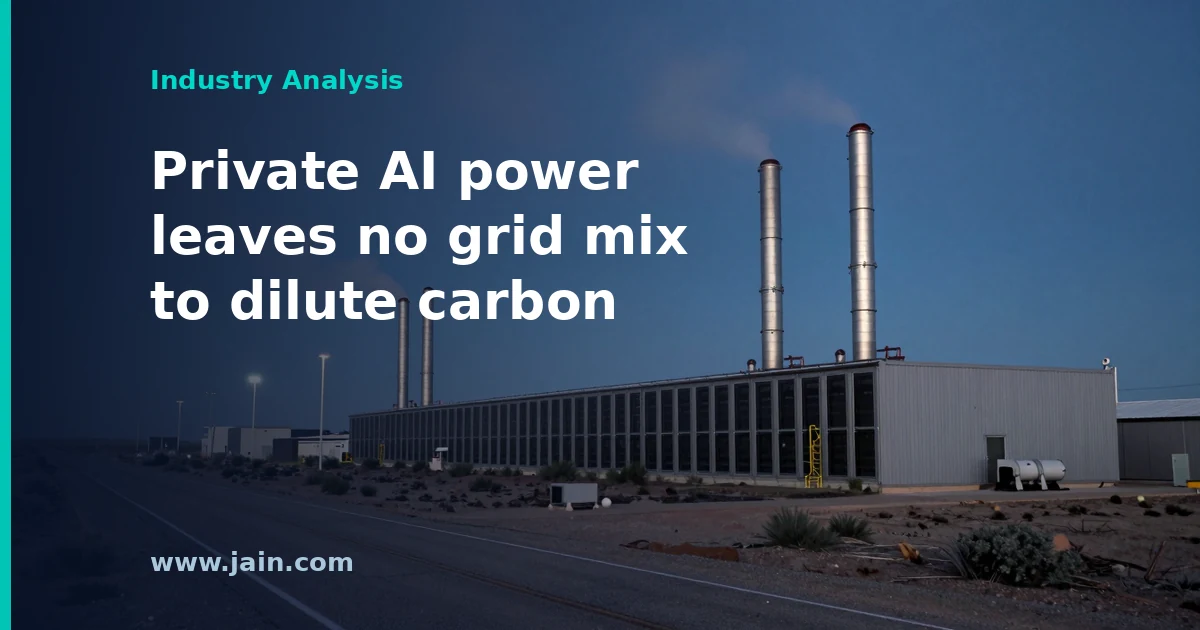
Amazon is building a natural gas power plant in Pecos County, Texas, to supply a new AI data center on the same site, according to a New York Times report on August 8 that Tom’s Hardware covered the following day. Project permits describe a plant of up to 7.65 gigawatts (GW) running 35 gas turbines, authorized to release up to 33 million tons of carbon dioxide a year. That is more than any other power plant in the United States.
Amazon co-founded The Climate Pledge in 2019 and committed to net-zero carbon emissions across its global operations by 2040. Amazon spokeswoman Margaret Callahan said “the world looks different now than when we co-founded the climate pledge,” but that “our commitment hasn’t changed.”
Executive Summary
The Pecos County project is a clear example of “behind-the-meter” generation at hyperscale. Behind-the-meter means power is produced on site for a single user instead of being drawn from the public grid. Hyperscalers are the handful of companies that run cloud platforms at global scale. At 7.65 GW, this is a utility-sized power station built to serve one data center campus.
The scale matters, and so does the structure. A grid-connected data center’s footprint is an allocated share of a regional mix that includes gas, wind, solar and nuclear, and the operator can lower its reported figure with clean-energy contracts. A dedicated gas plant has one fuel and one customer. Every ton it emits traces to the AI campus it serves, and at the permitted ceiling those tons would make it the country’s largest single point source of power-sector CO2.
For Amazon, the plant sits in direct tension with a public 2040 net-zero goal. The company says the goal is intact but has not described how the two will be reconciled. For the wider industry, the permit is a preview of the emissions ledger that comes with choosing speed-to-power over grid interconnection.
No Grid Mix, No Dilution: Why Bring-Your-Own Power Changes the Carbon Math
A data center plugged into the public grid consumes electrons from a shared pool. Its reported electricity emissions are calculated from that regional mix, and under common greenhouse-gas accounting practice a buyer can point to renewable-energy contracts to lower the figure it reports. Two things soften the number: the grid’s own blend of generation sources, and the contracts layered on top.
A dedicated gas plant removes both. The 35 turbines permitted in Pecos County burn a single fuel for a single customer, so the permitted 33 million tons a year maps directly onto one AI campus. There is no wind farm or nuclear unit in the blend to average it down. If Amazon owns or controls the plant, standard accounting treats those tons as the company’s direct emissions, which are the hardest category to offset with purchased certificates. Even under a third-party ownership model, the link between the smokestack and the server hall is unambiguous.
That is why the number stands out. The permit is a ceiling, and actual emissions will depend on how many turbines are built and how hard they run. At the permitted level, though, one company’s AI buildout would exceed every other power plant in the country. Everyone weighing on-site generation is affected: Amazon’s own 2040 accounting, the more than 700 members of The Climate Pledge that Amazon co-founded, and every other hyperscaler now pricing the trade-off between waiting for the grid and building its own power.
Speed to Power Is Choosing the Fuel
The shift to on-site generation is driven mainly by time. Connecting a large new load to the grid can take years of studies and upgrades, and communities have grown wary of data centers pushing up local electricity bills. Building power on site sidesteps both problems. Gas has become the leading choice because turbines scale quickly and fuel is available. Nuclear agreements such as Microsoft’s Three Mile Island deal and large renewable portfolios are also being pursued, but they generally take longer to deliver at gigawatt scale.
Policy points in the same direction. The Trump administration has backed gas-fired data center projects and promoted oil, natural gas and coal over renewables, which lowers the regulatory friction for fossil-fueled generation at data center sites. Pecos County sits in the Permian Basin region, and that proximity to gas production strengthens the logistics case.
The economics change too. By building a 7.65 GW plant, Amazon effectively becomes a major power producer, which means taking on turbine procurement, fuel supply, plant operations and fuel-price exposure that grid customers leave to utilities. Turbine manufacturers and gas suppliers gain a large anchor customer. The operator gains control over its timeline, and in exchange it owns the emissions outright.
Testing the Claim That the Commitment Hasn’t Changed
Amazon’s position is that its 2040 net-zero goal stands even as the landscape shifts. The claim deserves a fair test. The company’s emissions have risen each year for the past several years, a trend analysts attribute to data center construction for AI. Microsoft has made a similar case about its 2030 goal amid its own carbon-intensive expansion. Neither company has abandoned its target, and ambitious targets set in advance of a technology shift are not inherently disingenuous.
The tension is structural, though. Gas plants are typically built to operate for decades, which would carry a facility of this size well past 2040. For a net-zero commitment to hold, something has to bridge the gap. That could be carbon capture, a later fuel switch, running the turbines far below their permitted ceiling as grid or clean supply arrives, or large-scale offsets. None of these has been described for this site. Until one is, the commitment is a statement of intent that the Pecos County permit does not yet support.
Background
Amazon operates more data centers than any other company worldwide and is building several new AI-focused campuses around the world. In 2019 it co-founded The Climate Pledge, committing to net-zero carbon emissions across its operations by 2040. Its emissions have nonetheless risen each year for the past several years as data center construction accelerated.
Across the industry, hyperscalers and data center operators are increasingly building dedicated on-site power instead of waiting for grid connections, driven by long interconnection timelines and local concern over rising electricity bills. Some are pursuing nuclear and renewable deals, but natural gas has become the leading choice because it can be scaled and brought online quickly. Source: Amazon’s new 7.65GW Texas AI data center power plant could become the largest source of CO₂ pollution in the US (Tom’s Hardware, August 9, 2026): coverage of permits for Amazon’s 35-turbine gas plant powering an AI data center in Pecos County, Texas.Sources