
TL;DR · 30-second read
The Short Version
Amazon is building a huge complex of computer buildings, the kind that run online services and artificial intelligence, on an old steel mill site outside Philadelphia.
Pennsylvania plans to let Amazon add 280 natural gas engines that switch on if the power goes out. That is on top of 76 diesel engines already there.
The catch is that Amazon agreed to a strict yearly pollution limit, so those engines can only run so much. For buildings like these, keeping the lights on is now decided partly by pollution permits and packed town meetings, not just the power company.
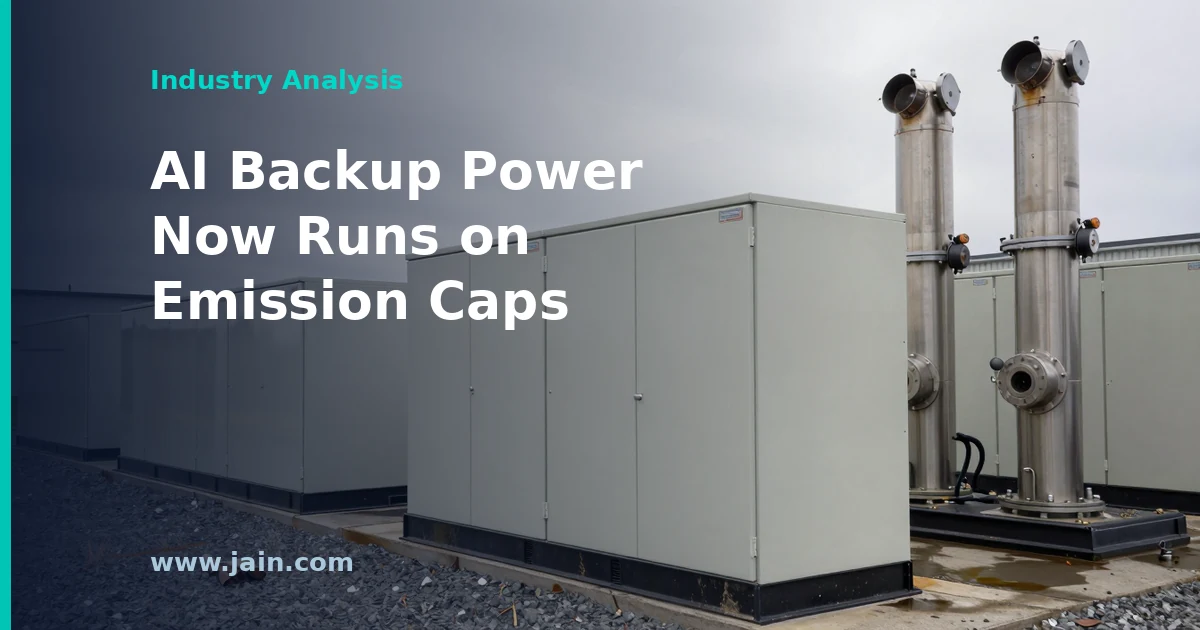
WHYY reported on July 15, 2026 that Pennsylvania’s Department of Environmental Protection (DEP) plans to approve 280 natural gas-fired generators and three diesel-fired generators to supply backup power at Amazon’s data center complex under construction in Falls Township, Bucks County. Amazon has already installed 76 diesel generators at the 250-acre site, the former U.S. Steel mill now called the Keystone Trade Center. The generators would run when the site’s electricity supply from the utility PECO is interrupted.
DEP officials presented the plan at a tense public meeting on July 14 at Pennsbury East High School. Under the pending application, Amazon agreed to keep annual emissions of nitrogen oxides and volatile organic compounds under 25 tons. The air quality plan approval opens for 30 days of public comment once it appears in the Pennsylvania Bulletin, which DEP expected on July 18.
Executive Summary
Amazon’s Falls Township campus, with up to 10 new buildings plus 1 million square feet of retrofitted warehouse space and more than half built, is set to carry 359 backup generators in total if DEP approves the new units. Amazon says the complex will host cloud computing infrastructure and “advance AI innovation.” It is part of a $20 billion investment Amazon has pledged in Pennsylvania.
The figure that matters most is the 25-ton emissions ceiling, not the generator count. By fitting emissions controls on its larger generators and limiting fuel use, Amazon qualifies the site as a “synthetic minor” source. That means it accepts enforceable limits to stay below the threshold for heavier regulatory treatment. In effect, the campus’s backup power becomes an annual emissions budget written into an air permit.
This moves the reliability question for large AI-oriented campuses out of the utility’s engineering studies and into state air permitting, public comment periods and community meetings. It also sits beside a separate, unresolved debate over who pays as data center demand grows on the regional grid.
A 25-Ton Cap Turns Backup Power Into a Budget
The headline number is 280 gas generators, but the number that governs how they can be used is 25. Under its pending application, Amazon agreed to keep combined annual emissions of nitrogen oxides and volatile organic compounds under 25 tons per year. Both pollutants can form ground-level ozone and worsen asthma. To stay under the limit, Amazon will install emissions control systems on its larger generators and limit fuel usage. Staying under 25 tons qualifies the campus as a “synthetic minor” source: a facility whose equipment could in principle emit more, but which accepts binding limits to remain below the level that triggers the more demanding permitting that applies to major sources.
A fuel-use limit works in practice as a limit on running time. Data center backup generators typically run for routine testing and maintenance, and for real outages. The permit turns that into a fixed annual allowance shared across the whole fleet. In a year with a reliable grid, most of the allowance goes to testing. A long outage or repeated grid emergencies would draw it down faster. Reliability planning for this campus therefore has a regulatory ceiling written into the air permit, alongside the electrical design.
That affects the people who plan, build and permit these sites. Developers sizing backup fleets for large campuses have to design against local emission thresholds as well as uptime targets. The approving authority for that design is a state air regulator operating in public: a packed auditorium meeting, a 30-day comment window, and a petition critics say has drawn more than 4,000 signatures. Pennsylvania’s Permit Fast Track Program sped up earlier permits for this project. The backup power decision still runs through public comment.
Hundreds of Engines Behind a Grid-Connected Campus
The campus is designed to run on grid power from PECO. The generators exist for the moments that supply fails. Even so, the fleet is large. Seventy-six diesel units are already installed, and 283 more are proposed, for 359 in total. That scale reflects what hyperscale operators expect from a site this size. A hyperscale campus is a very large, standardized facility built by a major cloud provider, and customers of cloud and AI services expect it to keep running through a utility outage.
The new units are mostly gas-fired rather than diesel. Amazon has not publicly explained the choice. In general, gas units draw fuel from a pipeline rather than on-site tanks and produce less soot than diesel. They still emit nitrogen oxides, which is why the emissions controls and the tonnage cap matter. Amazon has not disclosed the combined generating capacity of the fleet, so it is not possible to say how much of the campus load the generators could carry, or for how long.
The Grid Cost Question the Transmission Agreement Does Not Settle
PECO’s Glen Murphy said the utility found the project will not raise the distribution rates PECO customers pay. He said the project’s second phase will require infrastructure upgrades, but a “take-or-pay” transmission security agreement with Amazon protects residents from those costs. Under a take-or-pay arrangement, the customer commits to pay whether or not it uses the capacity. Murphy called the project a likely net benefit to customers that could “bring down rates a bit.”
Those agreements do not cover a different cost: the price of electricity supply itself, which rises with demand on the regional grid. PECO is part of PJM, the grid operator serving Pennsylvania, New Jersey and other states. New Jersey Assemblyman Balvir Singh argued that added demand will push up bidding and prices across that shared grid. The two claims are not contradictory. One concerns the wires that connect the campus; the other concerns the market for the power flowing over them. Neither side offered a figure for the supply-cost effect.
Weighing the Claims on Both Sides
Amazon’s Becky Ford said the company’s Pennsylvania data centers use water for cooling around 6% of the year on average, relying mostly on outside air. An engineer working for the Morrisville Municipal Authority said the project will draw Delaware River water rather than drinking water, in an amount requested to equal about 70 homes’ use. These are useful figures, but an annual average says little about hot-weather peaks, and a requested amount is not metered use. Ford also said the nearest homes are about 5,000 feet away and will hear no noise from the complex. That answers the residential question, not the one resident John Baldassano raised: whether generators running during an emergency would disrupt workers at industrial sites closer by.
DEP’s Jillian Gallagher said projected emissions are similar to those of hospitals, universities and snack food manufacturers in the state. Resident Seema Kazmi countered that the area is already pollution-stressed. A per-facility threshold does not by itself address cumulative burden, which is her concern. Her point about emissions from grid power supplying the site also falls outside the scope of this air permit. Better data is coming. The state budget signed July 12 requires large data centers to report their energy and water use annually to DEP. Proposals to tie tax incentives to new clean generation, and to pause data center development, did not pass.
Background
Amazon’s Falls Township campus sits on the Keystone Trade Center, a former U.S. Steel mill site along the Delaware River in Bucks County, north of Philadelphia. It is one of two Pennsylvania data center projects in Amazon’s pledged $20 billion state investment. The other is in Salem Township beside the Susquehanna nuclear plant. The local utility, PECO, operates within PJM, the regional grid and wholesale power market that spans Pennsylvania, New Jersey and neighboring states.
Large data centers keep fleets of on-site generators so servers stay running through grid outages. In Pennsylvania these generators require air quality approval from DEP. Pennsylvania has courted data center investment through fast-track permitting and tax abatements, while debate continues over grid costs, water use and local pollution. Source: Amazon to install hundreds of gas-fired generators at Bucks County data center site (WHYY), reporting on Pennsylvania DEP’s planned air permit approval and the July 14, 2026 public meeting in Falls Township.Sources