
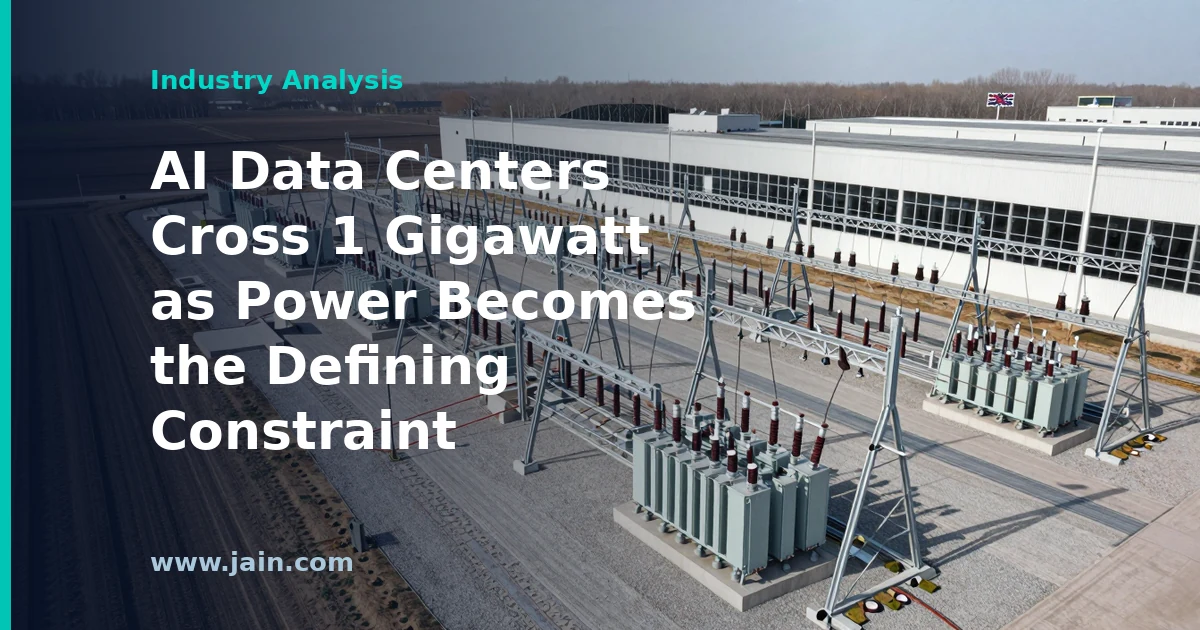
Individual AI data center campuses in the United States have crossed the 1-gigawatt power threshold, according to a May 15, 2026 report from Quartz — a scale at which a single computing facility draws as much electricity as roughly a large power plant produces. The report frames these sites as an emerging strain on the U.S. power grid.
The milestone matters less as a round number than as a signal: the binding constraint on AI infrastructure buildout has shifted from chips and capital to electricity itself.
Executive Summary
For most of the data center industry’s history, a large facility drew tens of megawatts, and a 100-megawatt campus was considered enormous. The reporting highlighted here marks a step change: single AI training and inference campuses now demanding 1 gigawatt or more — a thousand megawatts — concentrated at one grid interconnection point. That is a load comparable to a mid-sized city, arriving on the grid in a fraction of the time it takes to permit and build the generation and transmission to serve it.
Why it matters: electricity supply, not silicon supply, is now the gating factor for AI capacity growth in the United States. Utilities plan generation and transmission on decade-long horizons; hyperscale AI developers want power in two to four years. That mismatch shapes where data centers get built, how fast AI capacity can scale, who pays for grid upgrades, and which operators — those with secured power — hold the scarcest asset in the industry.
The source is a brief news report rather than a detailed study, so the specific sites, operators, and grid regions involved are not enumerated. But the direction of travel it describes is consistent with what grid operators and utilities have been signaling: unprecedented load-growth forecasts driven overwhelmingly by data centers.
From Megawatts to Gigawatts: A Different Kind of Customer
A gigawatt-scale data center is not a bigger version of a traditional one; it is a different category of grid customer. A gigawatt is roughly the output of a large nuclear reactor, and connecting that much load at a single substation requires high-voltage transmission capacity that most locations simply do not have spare. Traditional data centers could slot into existing industrial corridors. Gigawatt campuses force utilities to build new transmission lines, upgrade substations, and in some cases procure or build new generation — projects that routinely take five to ten years to permit and construct.
This inverts the historical relationship between data centers and utilities. Data centers used to be desirable, quiet, high-load-factor customers that utilities courted. Now the largest projects arrive as planning problems: loads so large that a utility must ask whether serving one customer degrades reliability or raises costs for everyone else. Several of the practical consequences — long interconnection queues, large-load tariffs, and demands for financial guarantees from developers — follow directly from that inversion.
Power as the Scarce Asset — and the New Competitive Moat
When electricity is the bottleneck, secured power becomes the most valuable asset in the AI infrastructure stack. A developer holding an executed interconnection agreement for hundreds of megawatts, or land adjacent to underused generation, holds something that cannot be quickly replicated at any price. That favors incumbent data center operators with existing utility relationships, energy companies entering the data center business, and sites near retired or underutilized industrial load where grid capacity already exists.
It also reshapes geography. Buildout gravitates toward regions with available generation, faster permitting, and willing utilities — which can pull AI infrastructure away from traditional hubs toward areas that historically saw little data center investment. For buyers of AI capacity, the practical implication is that delivery timelines increasingly depend on a provider’s power position, not its ability to procure GPUs — graphics processing units, the specialized chips that do the computational work of AI.
Who Bears the Cost of the Strain?
“Straining the grid” is ultimately a question about allocation: of capacity, of reliability risk, and of cost. If a utility builds transmission and generation to serve gigawatt loads and spreads the cost across its rate base, ordinary ratepayers can end up subsidizing AI infrastructure. If it charges data center developers the full incremental cost, projects become more expensive but the burden lands where the demand originates. Regulators across multiple states are actively working through exactly this question, and the outcome will materially affect both AI economics and household electricity bills.
There is also a reliability dimension. Grid operators plan around peak demand, and very large, fast-growing loads compress the margin between available supply and consumption. The fair reading is that gigawatt data centers do not create grid fragility by themselves — decades of underinvestment in transmission predate the AI boom — but they arrive fast enough to expose it. How operators respond, through on-site generation, flexible operation during grid stress, or long-term power purchase agreements that fund new supply, will determine whether AI load becomes a grid liability or a financing engine for new generation.
Background
Data centers are the physical home of the internet and, increasingly, of artificial intelligence: warehouse-scale buildings full of servers, networking, and cooling equipment. For decades they were a modest and predictable slice of U.S. electricity demand, and overall U.S. power consumption was roughly flat, allowing utilities to plan conservatively. The generative-AI boom that began in late 2022 broke that pattern: training and running large AI models requires vastly more computing — and therefore more electricity and cooling — than conventional workloads.
Since then, hyperscale operators and AI developers have announced successively larger campuses, with facility sizes climbing from tens of megawatts toward the gigawatt class this report describes. Grid operators and utilities across the country have responded with sharply raised load-growth forecasts, and questions of interconnection timelines, cost allocation, and reliability have moved from utility back offices to the center of both energy policy and AI strategy.
Source: AI data centers pass 1 gigawatt and strain the U.S. power grid — Quartz report, May 15, 2026, on single AI data center campuses crossing the 1-gigawatt power threshold and the resulting pressure on the U.S. electric grid.