
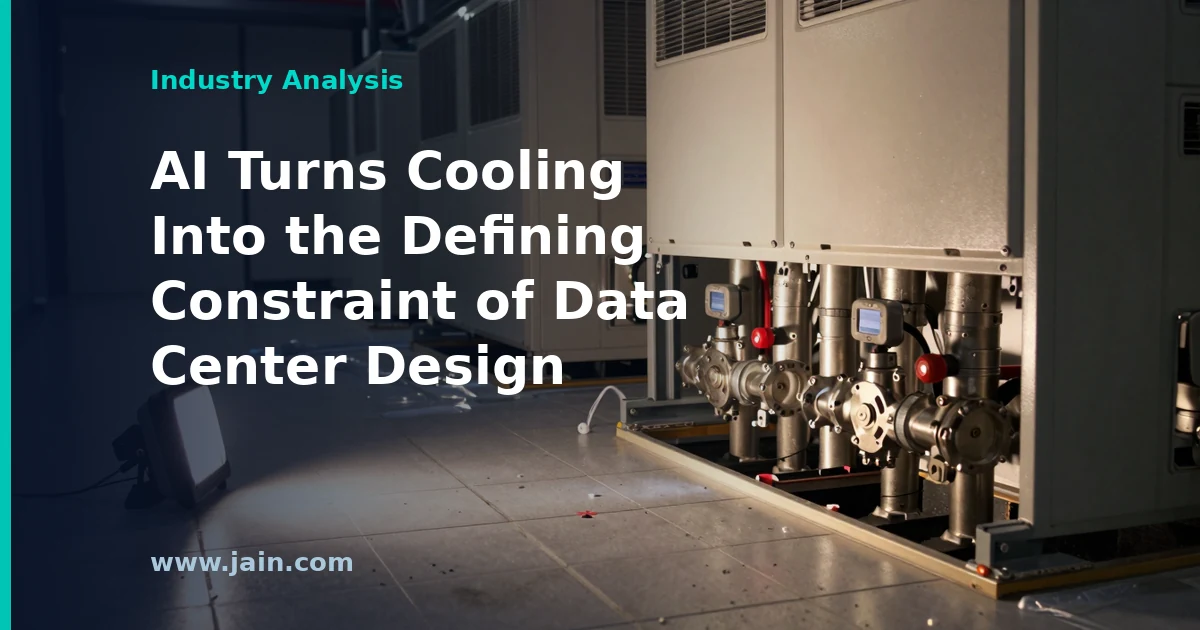
Data Center Knowledge reported on April 23, 2026 that cooling has moved to the forefront of data center design challenges, driven by the power density of AI computing. The trade publication’s framing captures a shift the industry has been living through: thermal management, once a back-of-house engineering detail, now shapes where facilities are built, how they are architected, and how quickly they can serve AI demand.
Executive Summary
The report’s core argument is structural rather than incremental: artificial intelligence has changed the physics of the data hall. Traditional enterprise servers could be cooled with chilled air pushed through raised floors and contained aisles. AI training and inference clusters concentrate far more electrical power — and therefore far more heat — into each rack than air can economically remove, forcing designers to treat heat rejection as a first-order constraint alongside power availability and land.
Why it matters: when cooling becomes the binding constraint, it stops being a line item and starts being a strategy. Choices between air, direct-to-chip liquid cooling (circulating coolant through cold plates mounted on processors), rear-door heat exchangers, and immersion systems now determine a facility’s compatibility with next-generation chips, its water and energy footprint, and its retrofit economics. Operators, colocation providers, and their customers are all repricing those decisions in real time.
When Air Runs Out of Headroom
Air cooling served the industry for decades because server heat loads were modest and evenly distributed. AI accelerators break that model: they pack extraordinary computation — and heat — into small silicon footprints, and operators deploy them in dense clusters to keep chip-to-chip communication fast. Past a certain density, moving enough air through a rack becomes physically impractical and economically punishing, because fan energy and airflow engineering costs rise steeply while cooling effectiveness plateaus.
Liquid is the natural successor because water and engineered coolants carry heat far more efficiently than air. But switching thermal mediums is not a component swap. It changes piping, floor loading, leak detection, maintenance procedures, and the skills a facilities team needs. That is why the trade press now describes cooling as a design challenge rather than an operations task: the decision has to be made before concrete is poured, and it constrains everything after.
The Retrofit Divide: Winners and Losers
The shift creates a two-tier market. New builds designed liquid-ready from day one can court the highest-value AI tenants. Older facilities — the majority of the world’s installed base — face a harder calculus: retrofitting liquid cooling into a live building is disruptive and expensive, but declining to retrofit risks ceding AI workloads entirely and competing for a shrinking pool of conventional enterprise demand.
The beneficiaries are visible across the supply chain: cooling equipment manufacturers, mechanical engineering firms, and colocation providers with modern, high-density-capable inventory. The squeezed parties are operators of legacy stock and, potentially, customers who signed long leases in facilities that cannot follow the density curve. For buyers of data center capacity, a facility’s thermal architecture is becoming as important a diligence question as its power contract.
Cooling as a Sustainability and Siting Question
Cooling choices also carry environmental and community consequences. Evaporative systems trade energy efficiency for water consumption — a sensitive issue in drought-prone regions where many data center clusters sit. Closed-loop liquid systems can reduce water draw and, in some designs, make waste heat recoverable for district heating or industrial reuse. As municipalities scrutinize data center growth, thermal design is increasingly part of the permitting and public-acceptance conversation, not just the engineering one.
That elevates cooling from a cost center to a siting variable. A design that minimizes water use or enables heat reuse can be the difference between a fast permit and a contested one — a dynamic worth watching as AI capacity expansion collides with local resource politics.
Background
For most of the industry’s history, data center design was governed by power and space, with cooling treated as a solved problem: chilled air, raised floors, and hot-aisle containment handled the modest, evenly distributed heat of enterprise servers. The AI buildout that accelerated after 2022 broke that assumption. Training and serving large models requires dense clusters of power-hungry accelerator chips, and each hardware generation has pushed per-rack heat loads further beyond what air-based systems were designed to handle.
The result has been a rapid industry pivot toward liquid-based thermal architectures — direct-to-chip cold plates, rear-door heat exchangers, and immersion systems — and a re-sorting of the market between facilities that can host high-density AI workloads and those that cannot. Trade coverage like this Data Center Knowledge report reflects a consensus that has hardened across operators, chipmakers, and engineers: cooling is no longer downstream of design; it is design.
Source: AI Pushes Cooling to the Forefront of Data Center Design Challenges — Data Center Knowledge’s April 23, 2026 report on how AI rack densities are making thermal management a primary data center design constraint.